
By OMAR ARRIAGA, JRN 101 STUDENT
There’s a difference between noise and accountability. Right now, American media is getting dangerously good at the first and worse at the second.
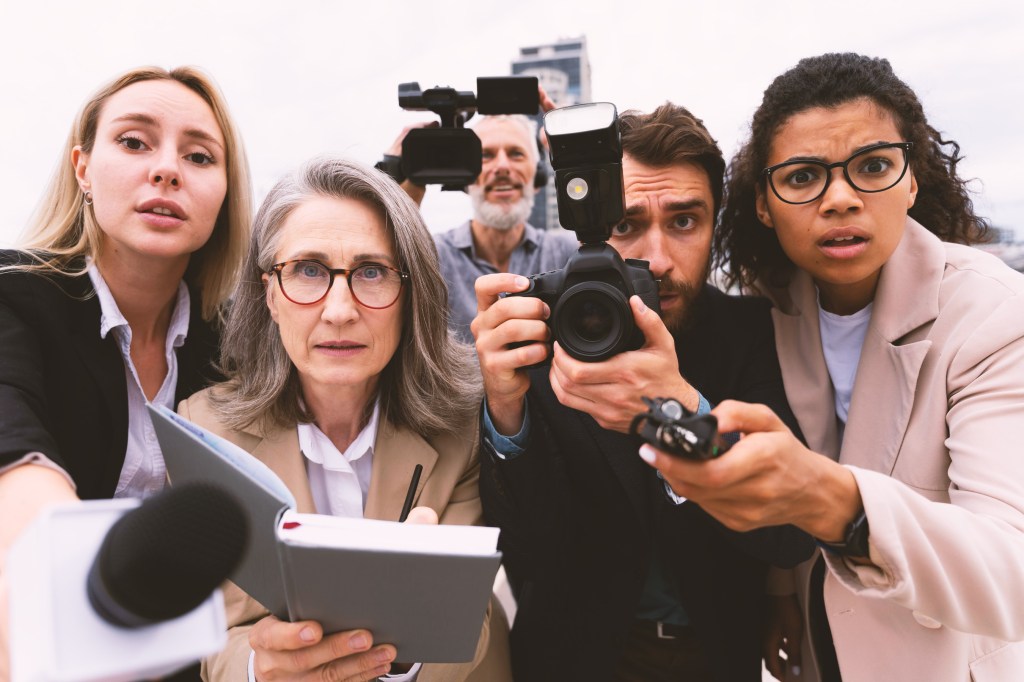
We’re told the press is the “watchdog” of democracy. It’s a powerful image: journalists standing guard, holding power to account, asking the uncomfortable questions others won’t. But what happens when that watchdog hesitates? What happens when it decides staying quiet is safer than doing its job?
It’s not just a media problem, but a democracy problem.
The role of the watchdog has never been optional in American society, but it definitely is foundational. Without it, corruption grows quietly, misinformation spreads unchecked and the public is left to make decisions in the dark. A functioning democracy depends on informed citizens, and informed citizens depend on journalism that is willing to push, challenge and, when necessary, fight.
But today, that fight feels weaker.
Part of that shift comes from the collapse of traditional journalism structures. Local newspapers are disappearing. Newsrooms are shrinking. Reporters are expected to produce more content, faster, often with fewer resources and fewer facts. The result? Less time for deep investigation and more pressure to chase clicks. It’s not that journalists don’t care, but more that the system they’re working in makes real watchdog work harder to sustain.
And yet then there’s something more uncomfortable: fear.
“A lot of the media are afraid to put up a fight,” former Chicago Sun-Times and Fox Sports journalist Greg Couch said during a class interview recently in JRN 101. He wasn’t talking about physical confrontation but something arguably more important: courage.
Too many journalists today are walking a tightrope between access and accountability. Ask the wrong question, push too hard, challenge the wrong figure, and you risk losing interviews, sources, or insider information. In a competitive media environment, that access can feel like everything.
But it shouldn’t be. When access becomes more important than truth, journalism stops being journalism.
Journalism, at its core, is built on seeking truth, minimizing harm, acting independently and being accountable. It’s the foundation of credibility. When those principles are compromised, even slightly, the entire structure starts to crack.
“You have to know when you’re getting a journalist and when you’re not,” Couch said.
In today’s media landscape, it’s not always obvious. The rise of social media has blurred the line between reporting and reacting. Anyone with a platform can share information, offer opinions or claim to expose the truth. But that doesn’t make them watchdogs.
Real watchdog journalism requires discipline. Verification. Context. And most importantly, independence.
In an era dominated by quick takes and viral posts, depth is often sacrificed for speed. Stories break in seconds, but understanding them takes time, and time is something modern media doesn’t always prioritize.
The consequence is a flood of information without enough explanation. We see headlines, clips and hot takes, but not always the deeper reporting that tells us why something matters or who should be held accountable. Without that depth, the watchdog role becomes shallow and more of this bark than a bite.
And people notice.
Trust in the media has been declining for years. Many Americans feel that news organizations are biased, incomplete, or more focused on engagement than accuracy. Whether that perception is entirely fair or not, it has real consequences. When people stop trusting the press, they stop listening to it. And when that happens, the watchdog loses not only its audience but its power.
The watchdog role isn’t just failing because of external pressure. It’s also being weakened from within.
Choosing not to ask a tough question to maintain a relationship?
That’s a crack.
Rushing a story without full verification to beat the competition?
Another crack.
Leaning into sensationalism because it grabs attention?
You get the point.
Individually, they might seem small. Collectively, they erode the very role journalism is supposed to play in a democracy.
Still, this isn’t a lost cause, but it’s a turning point.
Because the need for a strong watchdog has never been greater. We’re living in a time of political polarization, rapid information spread and growing skepticism toward institutions. That’s exactly when journalism should be at its strongest; not pulling back, but pushing forward.
That doesn’t mean becoming aggressive for the sake of it. It means being intentional. Asking the follow-up question. Sitting with a story long enough to truly understand it. Being willing to risk access in order to protect integrity.
It also means redefining what success looks like in journalism. Not just clicks or shares, but impact. Did the story reveal something important? Did it hold someone accountable? Did it give the public information they genuinely need? Did it leave its audience with one provocative thought?
That’s the kind of work that rebuilds trust. That’s the kind of work that makes the watchdog matter again.
Because at the end of the day, a watchdog that’s afraid to bite isn’t protecting anyone.
And a democracy without a watchdog isn’t really a democracy at all.
 Velocity
Leave a comment