
As a queer person who’s struggled with mental health, for me, religion has only recently begun to be as healing as it has been harmful.
My relationship with the notion of faith has changed drastically throughout my life. Even before experiencing homophobia from churches and being told to pray my depression away, I spent a lot of time believing it simply wasn’t meant for someone like me.
Having been raised Christian, my alienation from my original beliefs started with Biblical literalism. When I was taught stories about God, questions were discouraged, and space wasn’t allowed for alternative interpretations. Doubts and questions were seen as personal failings, and my curiosity was shrugged off with annoyance.
The science I learned in school seemed to contradict Biblical teachings, and as I became more aware of the evil in the world, I found myself unable to believe in any of it. I grew jealous of people that had what I saw as blind faith.
Still, I thought of religion as a nice and comforting idea. I just couldn’t reconcile it with my cynicism.
I’d already felt that way for a long time before I began questioning my sexuality. Before then, I’d been too young to comprehend the gravity of the concept of hell.
When I was a child, it was normalized by my parents and family friends to claim that anyone who made the wrong decisions in life or thought differently from us would burn forever. At the time, my innocence hadn’t led me to ask myself why I was expected to love my neighbor, yet a supposedly loving God could condemn billions to eternal punishments for mistakes made in temporary lives.
So when I first encountered the loud, hateful parts of Christianity, I had no reason to feel anything but disgust with the religion as a whole.
I didn’t want anything to do with a belief system that, in my view, espoused the condemnation of people like me as abominations for loving who they love. And divine justification of American warmongering and existence of morality solely through fear of God turned me away from resonation. I’d found no truth or real comfort in it before then, so I came to see it as nothing more than a waste of time at best and a monolithic source of oppression, brainwashing and bigotry at worst.
Even now, I know there are many Christians who would label me an abomination or a heretic. However, they have no ownership over my understanding of and connection with God.
Being young and having no one to go to for guidance on questions about life, death and the universe led me to do my own research on religions other than the flavor of Christianity that had been pushed on me.
Plenty of other ideas resonated with me much more than the Bible’s teachings did, but I ended up at the same conclusion every time: I can find some truth in the ideas, but not enough to call myself a follower.
Religion had been presented to me as the infallible, concrete answer to every question. Before I had the brainpower to doubt it, it had wrapped up in a neat little bow all my issues: where we come from, what to do with our lives and what would happen after our deaths. I had it in my mind that I was meant to be entirely confident of the answers to each of these questions—that I should be able to rattle them off and ace some sort of cosmic quiz.
It made me uncomfortable to not have the answers in any situation at all, let alone to what I saw as life’s most pressing questions. Suddenly having to grapple with all of it at once was the catalyst for a long and deep existential crisis.
Eventually, I tried the option of simply allowing spirituality as a whole to be a completely personal journey without labels, expectations or institutional involvement. As viable as that is for many people, it didn’t work for me at all. Having no community—only myself to answer to—was lonely and unengaging, even without mental health crises skewing me toward the conclusion that I was irredeemable in some way.
Still, unlearning the mistrust I’d come to harbor took work, and not just on my part. Since I’d never be open to the kind of hateful, nationalistic Christian extremism that has become so prevalent, I needed to see that a more “love thy neighbor” kind of view still existed in a meaningful capacity. As silly as it sounds, at first, it was seeing things like the film Wake Up Dead Man that opened my mind to the possibility that it does exist and that it’s worth engaging with.
Even then, however, it took suffering significant pain and guilt for me to begin to consider turning back to Christianity. I researched to find a denomination that would do the bare minimum of accepting someone like me at all.
I concluded that the United Church of Christ would be the most accepting, so I attended services at what was at the time Salem UCC in Oak Lawn. Despite being welcomed warmly, for a while, I simply went through the motions. It was nice to meet new people, get out of the house and have something to do with my Sunday mornings, but I still wasn’t sold.
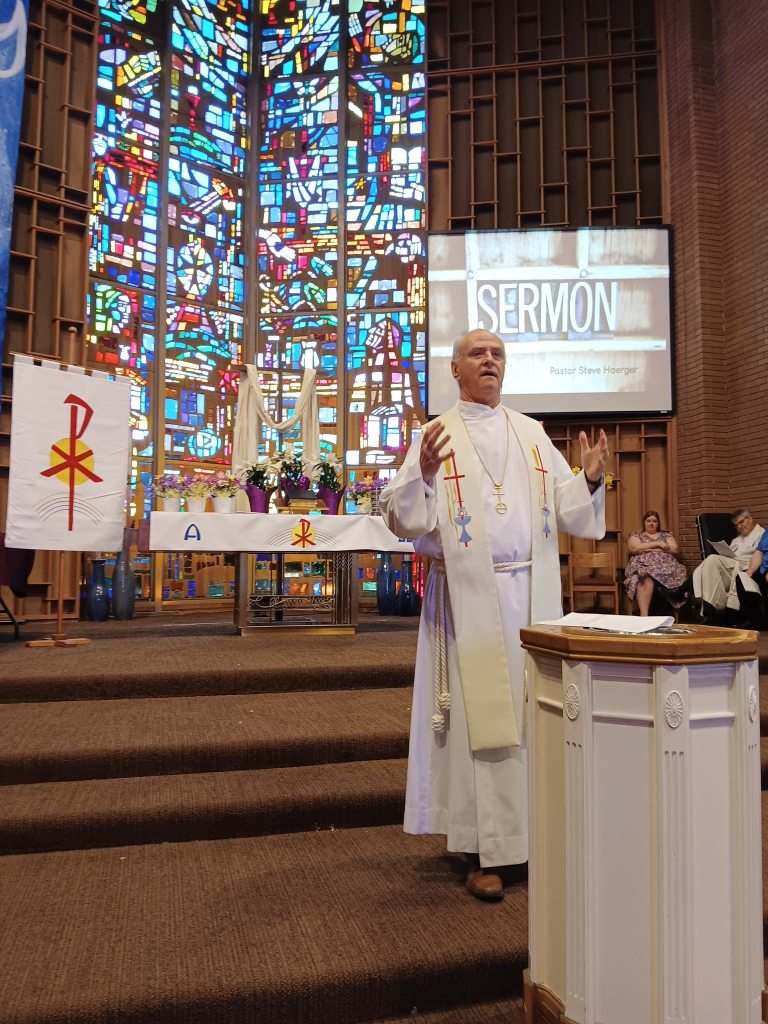
It wasn’t until I talked more to the pastor, the Reverend Steve Hoerger, that I truly began to see that there was much more to Christianity than what I’d been raised with. He recommended books with progressive and rational theological perspectives I hadn’t seen before.
In the time since I first came to Salem UCC, it has merged with Pilgrim Faith UCC to become New Hope UCC. Having this community has brought me some peace on its own, but having an avenue to explore my beliefs that finally felt right has been more therapeutic than I could have imagined.
I will always understand that Christianity has a lot of baggage, and I will never stop empathizing with the apprehension that many young queer people feel toward it. Even now, I know there are many Christians who would label me an abomination or a heretic.
However, they have no ownership over my understanding of and connection with God. They have no say in the fact that there are churches that truly welcome all and serve their communities indiscriminately.
Spirituality is a personal thing: It is what we make it, it cannot be taken away, and everyone has their own journey with it.
But I’ve come to realize that doesn’t mean anyone should be made to feel they don’t belong–no matter where they are on that journey or how often they’ve felt shunned by people who declare their hatred as holiness.




 Velocity
Leave a comment