
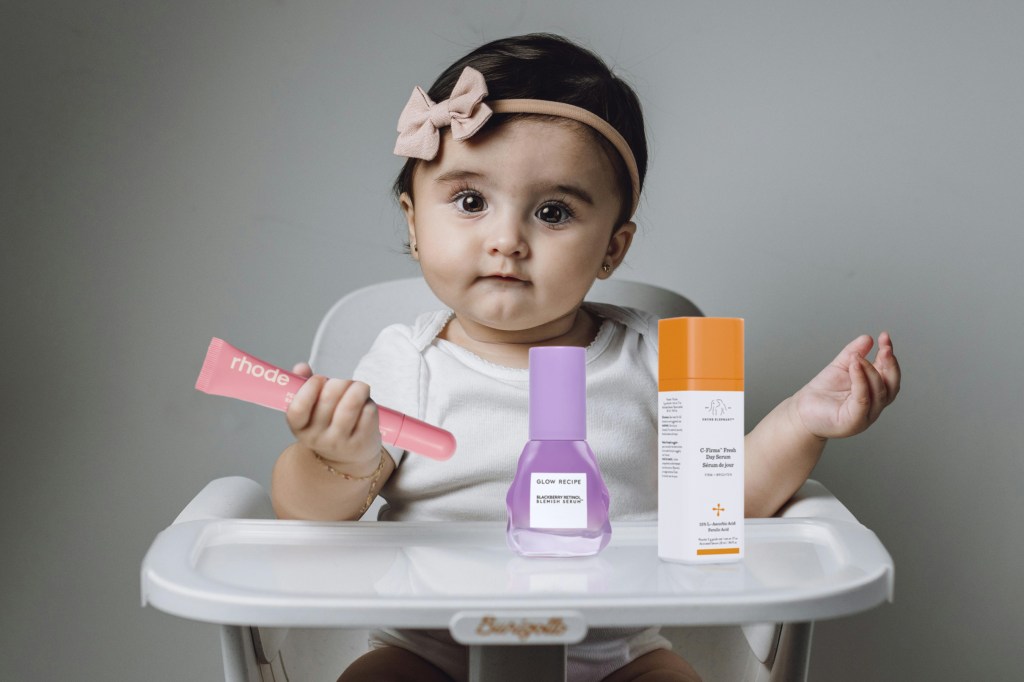
Walk into any Sephora these days and you’ll find girls barely in middle school filling their basket with name-brand serums, toners and retinol products that were once marketed to women twice their age.
Birthday parties once held at Chuck E. Cheese are now celebrated at Ulta. Those of us in Gen Z once tucked tubes of Lip Smackers into our backpacks; now we see little girls with Rhode lip treatment tucked inside designer bags.
Across social media, influencers are promoting elaborate skincare routines–skin flooding, slugging, double cleansing, retinol layering–to an audience that keeps getting younger each year. But estheticians say the trend is backfiring. Over-exfoliation, compromised skin barriers and product overload are showing up on clients at alarming rates, and the younger audiences are most affected.
Christina Chojnacki has watched this shift in real time. A licensed esthetician and manager at Blue Mercury, a high end beauty retailer in the Chicago suburbs, she has spent years behind the counter watching those partaking in the beauty industry getting younger and younger.
“Play makeup, what used to be play makeup, is now real makeup,” Chojnacki said.
She describes seeing grade-school girls coming in and loading their baskets with Drunk Elephant, NARS, and Charlotte Tilbury brands known for their price points and formulations designed for women in their 30s, 40s and older. She has seen mothers purchase $78 lip gloss for 4-year-olds. She has watched girls in junior high ask to be color matched for $125 concealers.
And she has seen the consequences up close.
“These products that kids are putting on their face are really for anti-aging,” she said. “They’re for older women. And what’s happening is this beautiful young face is breaking out.”
“It girls” have always set beauty standards and trends. But in 2026, the standard comes with a filled shopping cart. Hailey Bieber didn’t just popularize her “glazed donut” aesthetic; she built a brand around it. Her company Rhode turned the dewy, glass-skin look into a trend, and millions of younger women and girls are following. When a celebrity sells the ideal and the product at the same time, the line between aspiration and advertising disappears entirely.
One trend, skin flooding, is exactly what it sounds like: layering product after product on the skin, from toners to essences to serums to moisturizers, in pursuit of the glass skin look dominating social media feeds. Dermatologists and estheticians say the practice has consequences.
When a reaction occurs, nobody knows which product caused it. Skin barriers become compromised, breakouts worsen, and the solution the internet offers is always more product.
“If they’re getting samples and putting products after product after product and they have a reaction, we don’t know what product gave them that reaction,” Chojnacki said.
Science is catching up to what estheticians have been observing. A 2025 Northwestern University found that girls ages 7 to 18 using an average routine costs $168 a month, with some exceeding $500. The top-viewed TikTok skincare videos contained an average of 11 potentially irritating ingredients, which if used put young users at risk of developing lifelong skin allergies, the kind that can limit soaps, shampoos, and cosmetics that a person can ever use again.
“It’s problematic to show girls devoting this much time and attention to their skin,” said Dr. Molly Hales, a Northwestern dermatologist and lead researcher on the study. “The pursuit of health has become a kind of virtue in our society, but the ideal of ‘health’ is also very wrapped up in ideals of beauty.”
The influence does not stop at skincare. Chojnacki says concealer has become the single biggest trend she sees among young girls coming into Blue Mercury–heavy, full-coverage formulas designed to mask deep circles and wrinkles on faces that don’t show them.
Lip plumping glosses, setting spray loaded with silicone, and high-end fragrances are flying off the shelves in the hands of consumers who aren’t even teenagers.
None of it, she says, is necessary.
“When kids come in and they want a foundation, I tell them, ‘You don’t need that,’” Chojnacki said. “Why don’t we try a CC cream? A tinted moisturizer?” She paused. “But these kids want the full matte face.”
The question of what young skin actually needs has a simple answer, according to Chojnacki. A gentle cleanser. A basic moisturizer. That is it. The rest–the retinols, the vitamin C serums, and the anti-aging creams–are not only unnecessary for young skin, they can cause lasting damage.
“I would say starting retinol too early is the one thing I wish people would stop doing immediately,” she said. “It’s a preventative. It’s anti-aging. But it’s not necessary when you already have smooth skin.”
For young women already deep in the scrolls, however, the logic of the algorithm is hard to argue with. Yaretzi Gutierrez, a sophomore at Moraine Valley who considers herself a well-researched and selective buyer, admits the pull is real even for someone paying attention.
“They have the best skin and we’re like, well if your skin looks like that using these products, I think mine is going to look like that too,” Gutierrez said. “You sold me.”
But Gutierrez says what is actually being sold is rarely the full picture. Behind the glowy skin and reviews, she says, is a marketing machine built on carefully constructed illusions.
“They promote people who had severe acne, but they’re over here promoting products like it did miracles when really they went on Accutane,” she said. “The product could be so trash, but if they do the marketing right, it will sell.”
She is not alone in recognizing the pattern, but awareness does not always equal immunity.
“I’d say I’m a target audience, but I like to do my research,” Gutierrez said.”I don’t think all trends suit everyone. I know slugging doesn’t suit everyone.”
Her sister Emily Gutierrez sees the same forces at work but feels their weight differently. For Emily, social media influencers run deeper than the products they recommend; they shape how young women feel about their own lives.
“The internet has influenced me to be a better version of myself, but it also has created a negative mindset about where I should be in life,” she said. “Social media only shows the good side of people’s lives so it creates a negative mindset for people who have regular lifestyles.”
The comparison trap, she says, is almost impossible to escape, especially when the people setting the standard seem to have it all.
“Sometimes I feel like all these young people are getting everything they want and having all these experiences, but it’s also because they might have it easier in life,” she said.
Still, she stops short of calling social media purely destructive: “It also makes me want to push myself to be able to live that kind of life. You just have to make sure you understand how social media works.”
The blurring of the line between what is real and what is marketing is something Sharnel Lojan sees playing out far earlier than most people realize. A childcare worker with three years of experience working with toddlers and young children, Lojan says the boundaries between childhood, adolescence and adulthood have never been less defined.
“A lot of spaces are kind of blurred,” Lojan said. “What’s for kids and what’s for teens and what’s for young adults because they’re all on the same internet space.”
Lojan points to the COVID era as a turning point. When socialization moved online during the pandemic, children lost something that is proving difficult to recover: the ability to simply be kids, disconnected and imaginative.
“Holding on to being a child as long as you can is becoming harder,” she said. “You want to keep up with what’s going on, and I think sometimes it’s a wish to be older than what you are.”


She also pushes back on the idea that it is a purely social media problem. Parents, she argues, are part of the equation, and so is the retail landscape that has left tweens with nowhere age-appropriate to land.
“They don’t really have a lot of teen or preteen inspirations,” Lojan said. “You either have little kid stuff, or you make that jump to crop tops and distressed everything. They don’t have an in-between, so they don’t know what their style is supposed to be.”
And when children don’t have space designed for them, the beauty industry is ready to fill the void. “If you market to the kids, you get the adult money,” Lojan said. “That’s just what it is.”
Chojnacki agrees. Back at Blue Mercury, she reflects on what she sees: parents dropping hundreds of dollars on products for children who do not need them, kids who look older than their age, and beauty standards that keep lowering the floor.
“There’s a lot more bullying going on than ever before,” she said. “Girls are getting depressed if they’re not looking as pretty as their classmates. Or let’s be real, who can even afford this stuff?”
Smooth skin is not what young girls see when they look in the mirror or at their phones. Chojnacki believes social media has changed how young women and girls perceive themselves, and not for the better.
“There are apps now to make your skin look better, to make you look thinner,” she said. “These kids are saying, ‘Oh my god, I look so ugly.’ And then you go on FaceApp and it disappears.”
When a $125 concealer becomes a sixth-grade status symbol, or a $78 lip gloss becomes a birthday gift for a 4-year-old, the pressure does not stay inside the store. It follows kids to school, on their phones, and into the mirror.
Chojnacki is quick to point out that social media is not entirely the villain. A well-made tutorial can teach a teenager how to apply some eyeshadow without overdoing it. A skincare video can steer someone toward a gentler routine. The information, she says, is not always the problem.
“It’s not just the kids’ influence,” She said. “It’s the parents too. If the mom is always getting treatments lasers, microneedling, dermaplanning the kids are watching this.”
The beauty industry did not stumble into classrooms and birthday parties by accident. It followed the algorithm, the influencer, celebrity, and the parent straight to the youngest and most impressionable consumers it could find.
“These kids are growing up way too quick,” Choknacki said quietly. “And they look older too.”
And somewhere in Sephora, a girl who should be picking out birthday decorations is picking out a $60 serum because the internet told her she needed it, and nobody told her she didn’t.




 Velocity
Leave a comment