
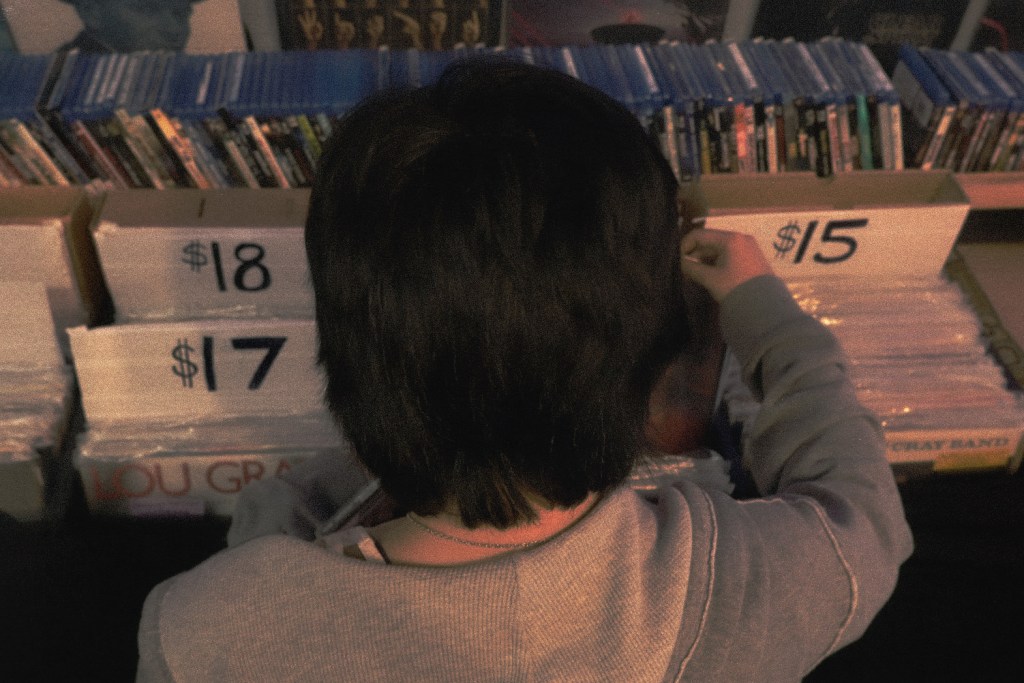
On a Saturday morning in Evergreen Park, a teenager flips through a bin of $7 albums at The Record Shop on 95th. She’s not scrolling. She’s not streaming. She picks up an album, reads the back, puts it down, picks up another. There’s no algorithm guiding her–just her curiosity–and a store full of things she can actually hold.
Vinyl sales exceeded $1 billion in revenue last year–a record high for the past 40 years, according to The Hollywood Reporter. As streaming prices climb and AI floods the internet, a growing number of people are reaching for something physical.
Today, there’s a growing sense that nothing is real anymore. The world as we know it has turned into an algorithmic labyrinth where everything is catered to us. Don’t know what to listen to? Your phone will tell you. Don’t know what to watch? Your TV will tell you. What was once tangible is now just data and coding traveling through the ether. Newspapers and magazines have turned into online publications. The books we used to read can be read to us through apps. The movies and shows we watch are accessible through streaming services that raise their prices year after year.
Now that the entire world fits into a pocket, we find ourselves wanting more. More innovation. Something different. And in a digital world, what’s “different” seems to be what’s tangible.
When it comes to music, we have become used to having songs stored in our phones, readily accessible. But several factors are bringing people back to non-digital music: rising subscription costs, removal of music catalogs from streaming services, infiltration of AI content, and lower audio quality.
“I don’t use streaming at all,” said Michael Couch, 27, a Boston-based musician. “Spotify compresses the files so the audio quality goes down quite a bit. People go, ‘Oh you won’t really notice,’ and then I tried it and I was like yeah, no, this sounds terrible. It’s like listening to LimeWire-downloaded MP3s from 2005.”
Couch’s distaste for music streaming services isn’t the norm yet. Most Gen Z music fans are balancing vinyl or CD spinning with music streaming. But as other digital audio options become available and prices continue to rise, more people may ditch streaming altogether.
“I only recently started collecting more CDs, like during COVID,” said Klaudia Walkosz, the library aide in Moraine Valley’s student maker studio. Like many other members of Gen Z, she has parents who collected CDs in the late ’90s and early 2000s.
First-year biology student Ethan Rigor also “inherited” much of his music: “I didn’t start [my collection] myself, I kind of stole it from my dad,” he said. “He started me off with his CDs.”
What’s special about CDs and other forms of physical media is that they stand up against time. Rigor and Walkosz can both hold something that someone held 20 years before them. That connection to the past is a feeling you can’t get when you share a link to a song with your friends.
While they both still use Spotify, they have their own quarrels with the streaming service, mainly regarding the price.
“I think having a massive library available at your fingertips is a massive plus,” Walkosz said. “But the massive con to me is just the price. Spotify Premium is $25 a month now if you have the family plan.”
Rigor said he uses Spotify to find new artists or to preview an album before he makes the decision to buy it. But he’s becoming fed up with rising prices of streaming services.
“I’m kind of getting there with Spotify. They just raised their prices again,” he said. “I have Hulu, Netflix and Prime. I would probably just cut down to Netflix because it’s getting expensive.”
Paying for a Spotify or Apple Music subscription on top of Netflix, Hulu, an Amazon Prime account and a gym membership is a challenge facing most Americans–on top of rent, utility bills, gas and groceries. Many find it doesn’t make sense to continue throwing money at streaming services that leave them with nothing tangible.
“Right now what we’re seeing is that people are getting tired of paying for air,” said Jessika Law, one of the owners of The Record Shop on 95th. “They actually want the physical product. The physical albums, CDs, movies—whatever it is that’s physical, that’s what you guys are wanting.”
As streaming became the norm, a handful of services monopolized the industry. For years, vinyl pressing plants halted operations since the cost-to-profit ratio became too unsustainable.
“When vinyl started going by the wayside, a lot of bands stopped pressing vinyl on records,” said Mike Keysboe, owner of Long Live Records in Palos Park. “Artists only released on CDs or on streaming, and all the pressing plants started closing.”
Now that vinyl is coming back, consumers are finding they have options–and a voice. Over the past five years we’ve witnessed numerous boycotts. Spotify recently came under fire for raising its prices yet again. Today, the company is worth more than $109 billion, but if you’re a student struggling to balance tuition, food, gas, and day-to-day expenses, you now have to budget an extra dollar a month to stream music.
Meanwhile, every stream only pays your favorite artists $0.003. It’s a win for Spotify, but a lose for students and a lose for artists.
“If you listen to less than 50 percent of a song, then Spotify doesn’t count it as a stream,” Couch said. “If you make a five-minute song, then someone has to listen to at least two and a half minutes of it for it to count as a stream.”
“If you listen to less than 50 percent of a song, then Spotify doesn’t count it as a stream. If you make a five-minute song, then someone has to listen to at least two and a half minutes of it for it to count as a stream.”Michael Couch, Boston-based musician
Record stores like Long Live Vinyl Records are taking part in the fight against big corporations. Located in a shopping plaza at 12916 LaGrange Road, the store is easy to miss unless you’re looking for it.
Keysboe opened the business last year as a part-time store, with operating hours starting after 4 p.m. on the weekdays and noon on the weekends. Keysboe teaches fourth grade during the day, but before he was in education, he worked in sales.
Go on a work trip, make sales, negotiate with clients, meet your deadline, get your check, come home to your wife. Boss calls. Go on another work trip, make more sales, negotiate with more clients. That was Keysboe’s life for years, and it looped on and on and on.
But Keysboe was good at what he did. He made millions of dollars for his employers–that is, until his daughter was born 17 years ago and the company made the decision to push him out. Why? Because Keysboe asked if he could be closer to home with his new family.
Keysboe knows that the story of profits over people isn’t unique to him, but opening a small local store with no ties to a larger corporation is his personal get-back. Just one employee setting his own rules at his own pace and creating a space for people like him to come together.
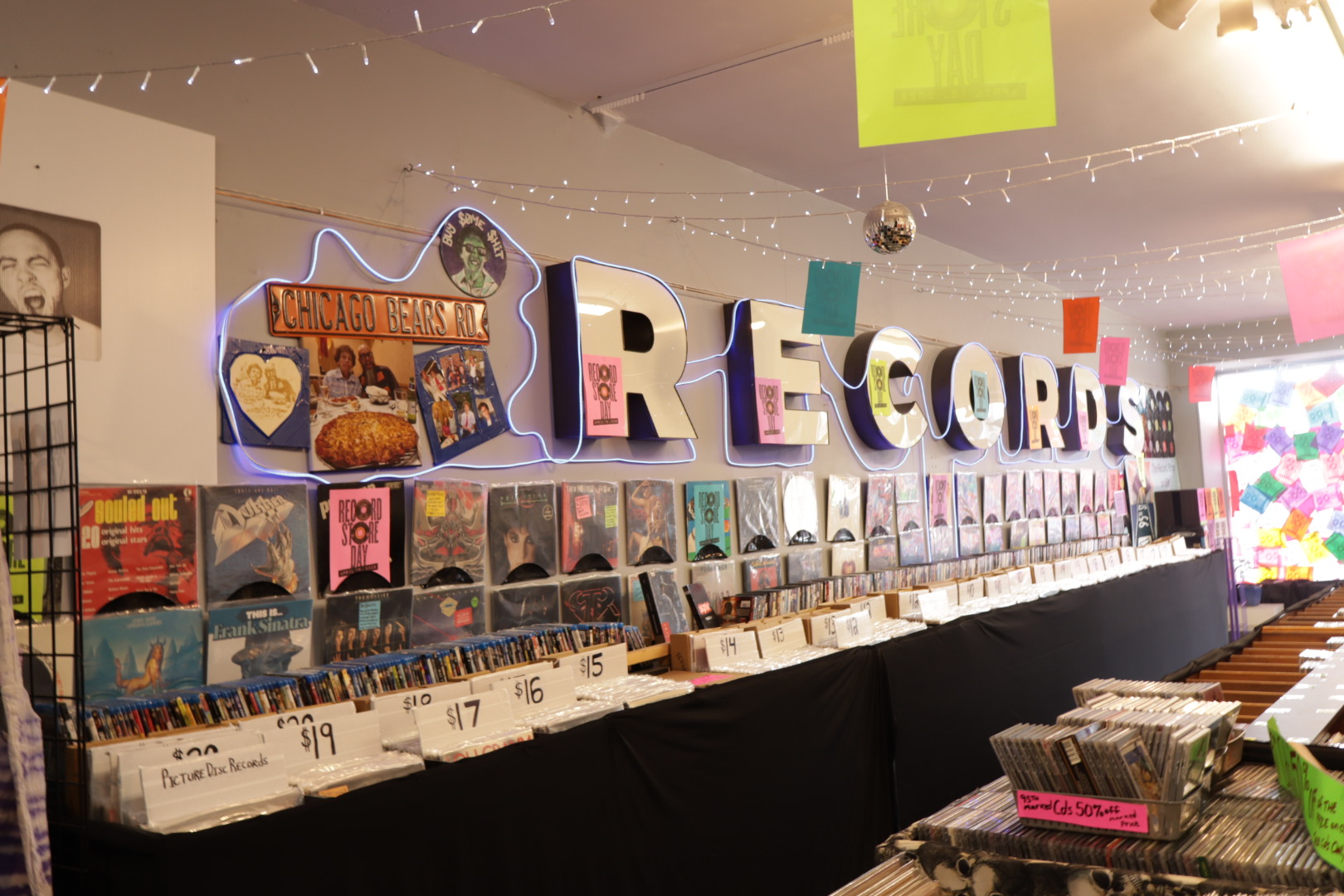
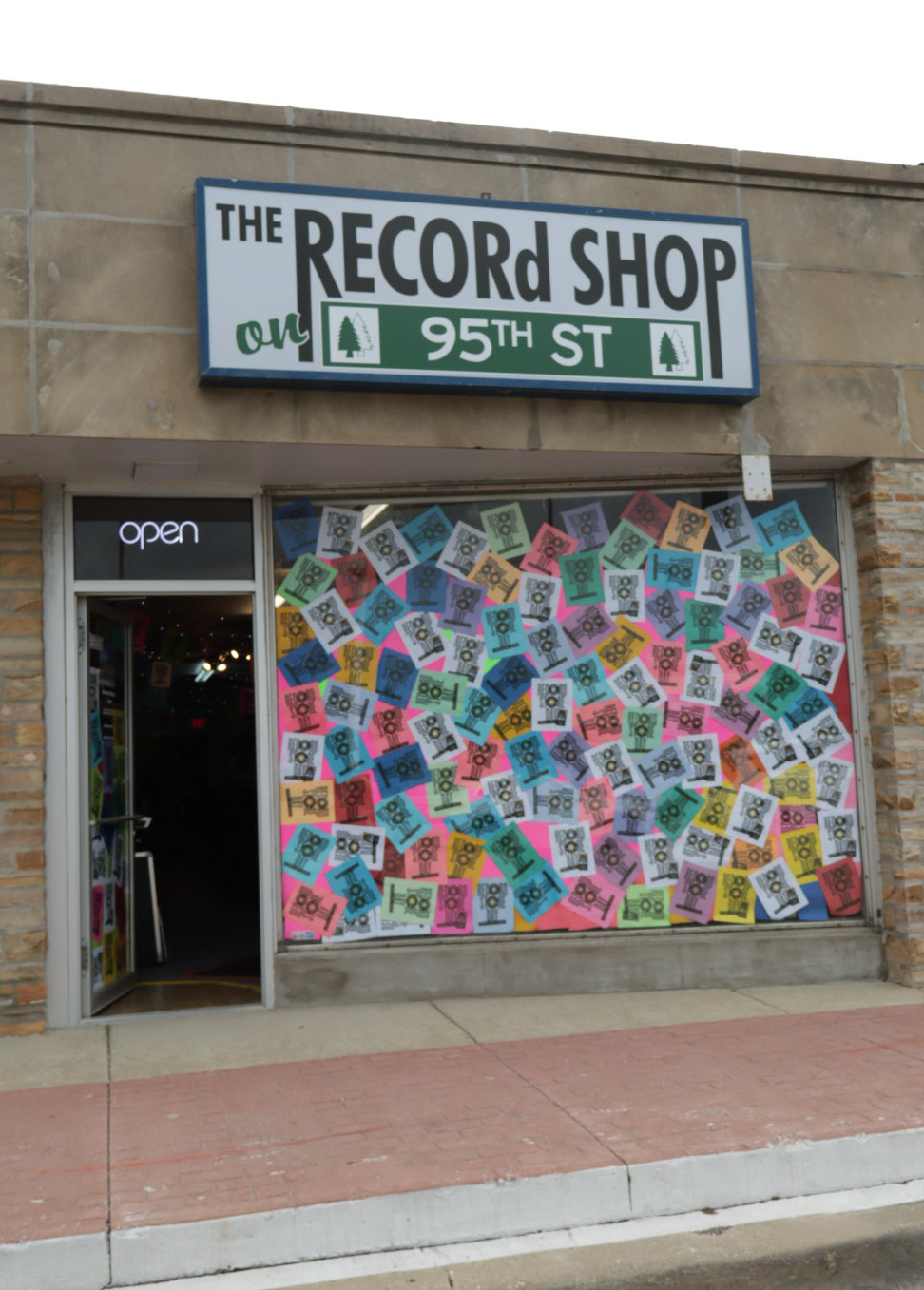
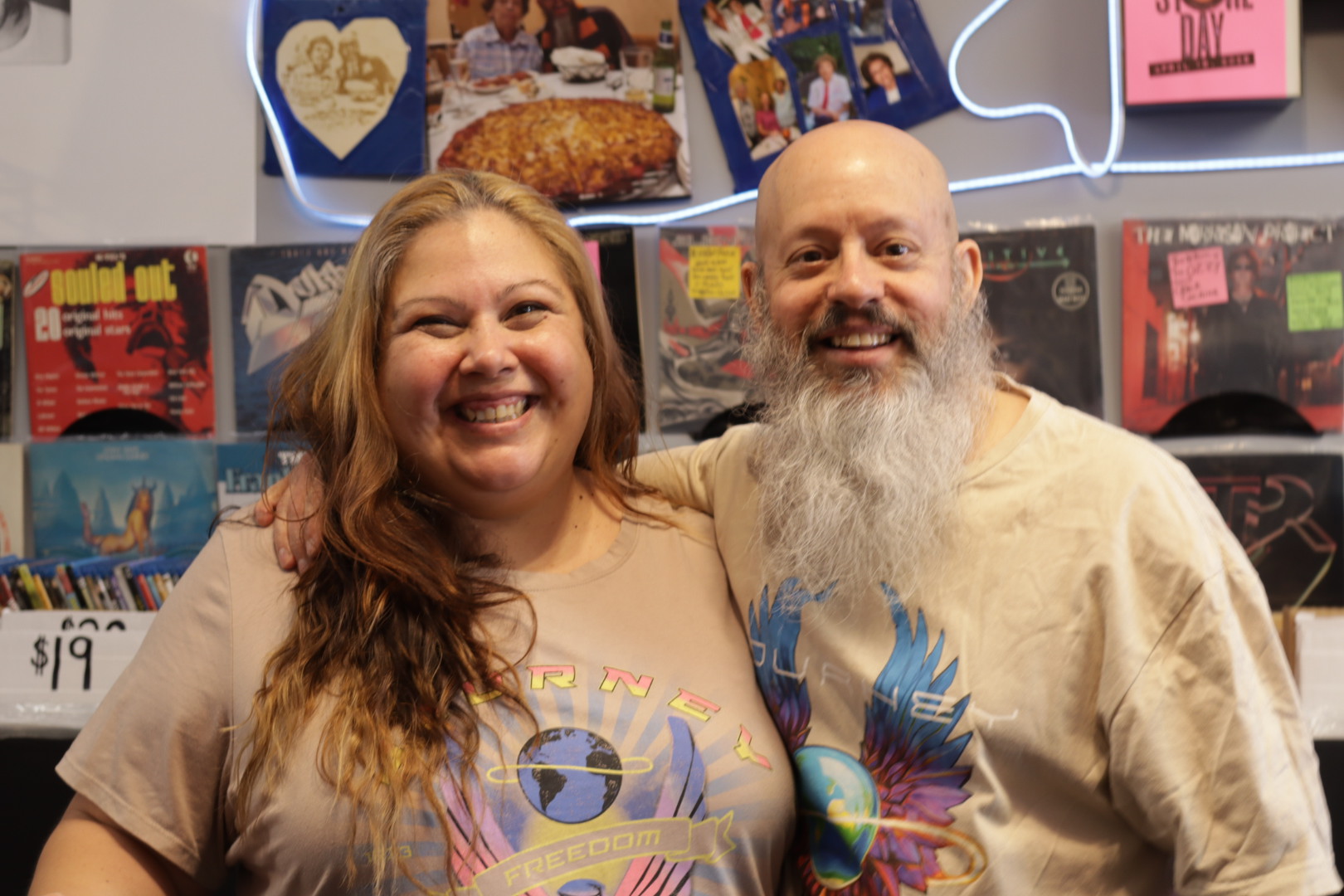
At The Record Shop on 95th, located at 3576 W 95th St. in Evergreen Park, owners Jessika and Jeff Law put an emphasis on keeping their business budget friendly and creating an atmosphere that’s different from any other store in the Chicagoland area.
Their vinyl bins are set up by price point, ranging from $7 to over $50, keeping stock accessible to people, especially younger crowds, who don’t have hundreds of dollars to spend on records every week. You can walk in with a $10 bill and leave with something new to add to your collection.
The shop never has more than one copy of an album on the floor at a time, which forces shoppers to take a pause, stay mentally engaged and keep an open mind about what they want to listen to. They carry everything from oldies to Billboard top 40 hits. New and used vinyl, LPs, EPs, 45s, DVDs, CDs and cassette tapes.
While the location in Evergreen Park has only been open for the past two years, the Laws have been in the record store business for the past decade. Initially, they opened up in Arizona with the goal to create a third space for their son to hang out in. Each growing up as only children, the Laws spent most of their youth hanging out in libraries, shops and record stores, and they wanted their son to have the same thing.
The store became that third space for other kids in the community. They kept prices low and hosted listening events to bring communities of fans together.
“Sometimes we get to listen to an album before it even comes out digitally,” Jessika Law explained. “It’s really cool because it’s a group of people getting together and listening to their favorite artist or band and getting to share stories with each other.”
The Laws ended up back in the Chicagoland area to assist Jeff’s mother as she reached the end of her life. After her passing, the new store in Evergreen Park became an outlet for Jeff; it was a way to stay occupied and process his feelings in his own time.
“It was my way of grieving,” Jeff Law said.
Although the presence of loss hung heavy around the Laws, their commitment to remaining a focal point for the music community of Evergreen Park remained. Last month, the store received a proclamation from the Evergreen Park Board of Trustees in recognition of the town’s first celebration of Record Store Day.
Vinyl “is not a trend,” Jeff Law says. “It is not going away any longer. It is staying here.”
Many record shops are creating small pockets of community within communities—an escape from a world that’s become so fast paced that we’re often left without time to think or process.
Spending an hour flipping through CDs or vinyls instead of scrolling for an hour on our phones can keep us tethered to reality.
If you’re interested in taking things a step further by burning a mixtape to a CD instead of building a playlist on your phone, Moraine Valley has resources to help you get started. Walkosz encourages students to express their creativity using the library’s makers lab: “There are some CDs that you can customize the top of. My idea is that students could use the Cricut to make special designs on their [mixes].”
At a time when people are craving real connection and time well-spent, a visit to a record store can feel like entering a safe haven. And while companies are making money from selling air, owning something tangible can in itself feel like a form of rebellion.

 Velocity
Leave a comment