
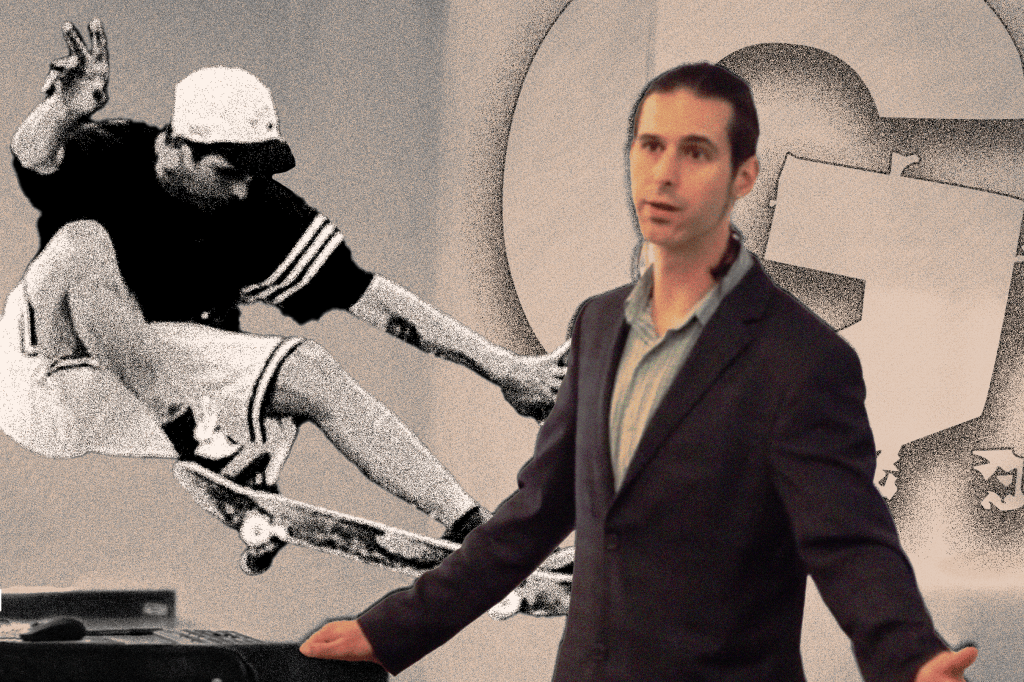
In 2000, while many young adults were finding their footing in the world, Panshula Ganeshan spent three months at a monastery in Hawaii, learning to live according to Hindu traditions. The experience would become a defining part of his life, long before he found his place teaching composition at Moraine Valley Community College.
Now a professor and writing tutor at Moraine Valley, Ganeshan draws on a life shaped by personal exploration, Eastern philosophy and a passion for the written and performing arts. His experiences, from studying monastic life to discovering his potential as a writing instructor, have helped shape his approach to teaching. He strives to make writing accessible and create an environment in which students feel supported.
Growing up in Homewood, Ganeshan attended Homewood-Flossmoor High School. “I dropped out. I wanted to be a skater…skateboard professional,” Ganeshan said.
His path eventually led him to Hawaii, where he spent three months at a monastery. At the time, he was exploring meditation and Eastern philosophy while working through a difficult period in his life.
“I was on the repair,” he said.
Drawn to Eastern philosophy, Ganeshan became interested in the teachings and lifestyle of the monastery. His time there involved practical work, including gardening and cleaning.
“They were training me how to live a Hindu lifestyle,” he said.
Ganeshan, who was raised Catholic, said his spiritual exploration grew partly out of questions about life and death that he felt his upbringing had not answered.
“I was raised in that system, but as soon as I started to question what happens after death, those answers didn’t come to me through Catholicism,” he said.
His experience at the monastery became an important part of his life and outlook.
“I learned how to live a contemplative, spiritual, and values-based lifestyle,” he said.
“I learned how to live a contemplative, spiritual, and values-based lifestyle.”
Panshula Ganeshan
He has returned to the monastery several times since his initial stay, including making trips with his wife.
During his stay, Ganeshan developed a deep appreciation for the monastery’s teachings and the man who guided him. The guru gave him the name Panshula Ganeshan, a name he continues to use today.
“I really like what he represented in life,” Ganeshan said. “He was a real master of self…tremendous aura…really inspired the best.”
Ganeshan described his guru as someone who embodied peace, love, wisdom and presence. One of the most lasting impressions came from the way his guru approached the end of his life. Faced with terminal cancer, his guru chose a self-willed, medically supervised fast.
His guru’s example continues to influence Ganeshan’s everyday outlook. He said one of the teachings involved learning to recognize oneself as the observer “and how we, as awareness, are not the things we are aware of, such as the body, mind, and emotions.”
Although he explored different interests throughout his life, writing eventually became a defining part of his professional journey.
A realization hit him as a Moraine Valley student: “I had a vision when I was a student sitting in composition class: I could do what the teacher was doing. It was an inner voice telling me I could do this.”
The instructor, an adjunct professor whose name Ganeshan no longer remembers, introduced him to the idea that writing was a skill that could be developed over a lifetime.
“I saw it as a craft I could get better and better at,” he said.
Another of his instructors at Moraine Valley, Sandra Beauchamp, later encouraged Ganeshan to become a writing tutor. The opportunity brought him to the college’s writing center, where his interest in writing and teaching developed into a profession.
Ganeshan’s educational journey was unconventional. After dropping out of high school at 17, he did not begin college until he was 24. He later earned his bachelor’s degree from Governors State University and his master’s degree from Illinois State University.
Now, his commitment to learning continues. Ganeshan is pursuing additional education through a certificate program at Indiana University.
Outside the classroom, he has continued cultivating his poetry and the performing arts. He has produced songs and written poems, although he does not consider poetry a reliable source of income.
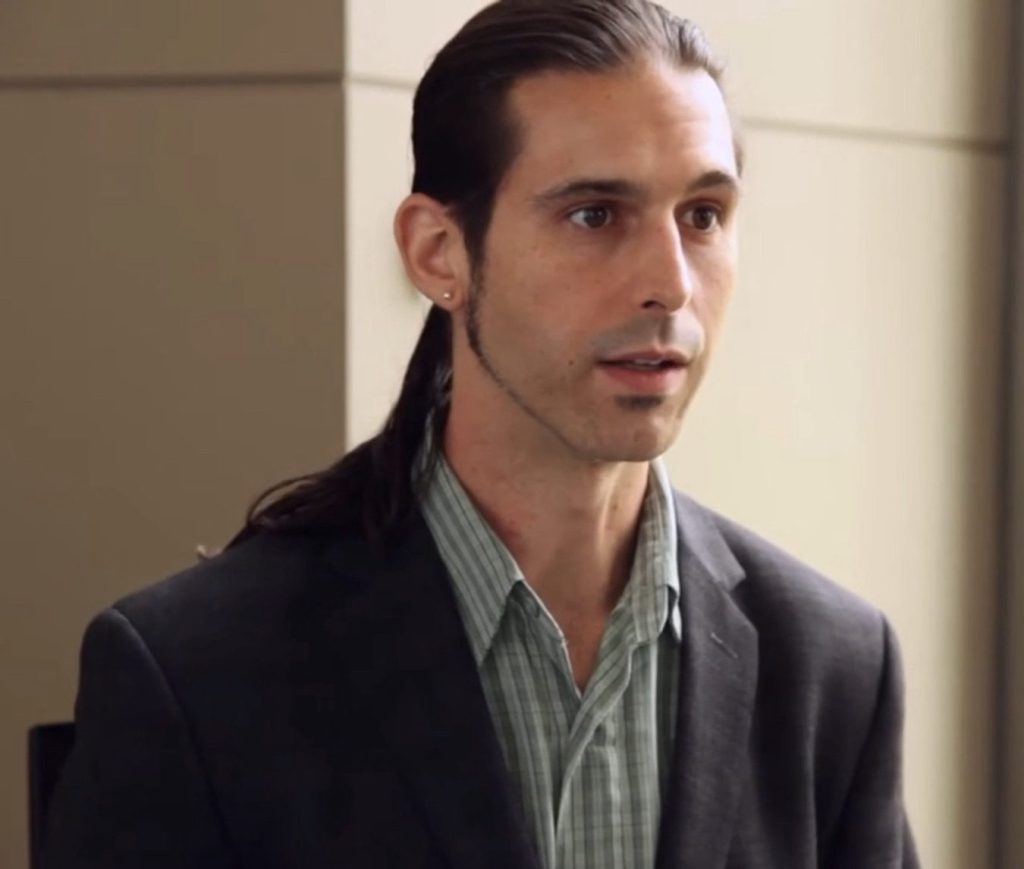
“I am not a prolific poet. I have like 20 poems that I am proud of, that feel complete, that are dope to me,” he said. “It’s never been an avenue to earn money, but doing it has been one of the most fulfilling things I have done with my life.”
For Ganeshan, writing is both a creative outlet and a craft that requires patience. He recognizes the process can be challenging, explaining that “you can be humbled with the writing task.”
Today, he brings that perspective to his work at Moraine Valley. His approach emphasizes making writing understandable, keeping students engaged and creating an inclusive environment.
“I’ve always tried to keep it entertaining and fun,” he said.
He aims to make assignments accessible and to ensure students feel seen and supported as they work through the challenges of writing.
Alexandria Senodenos, 20, a communication sciences and disorders major and former student of Ganeshan’s, described him as “fun, authentic and charismatic.”
Senodenos recalled a moment when Ganeshan walked into class and played one of his own rap songs as an example of how he brought his personality into the classroom.
“He was very much himself,” Senodenos said. “All the time, he was completely a hundred percent himself, and he wanted everyone to be themselves.”
That authenticity, she said, was accompanied by a willingness to adapt to students’ needs and encourage them to ask questions. She described him as a professor who genuinely enjoys teaching and wants to help his students succeed.
“He was very much himself. All the time, he was completely a hundred percent himself, and he wanted everyone to be themselves.”
Alexandria Senodenos, former student of Ganeshan
Her twin sister, Amalia Senodenos, 20, a community health major and also a former student of Ganeshan, similarly described his teaching style as unique and accepting.
“He was unique and very accepting of whatever work we put out and always tried to make us better,” Amalia said.
In Ganeshan’s classroom, a lesson could include Kendrick Lamar’s “Squabble Up” or even an opportunity to earn extra credit by performing a cartwheel. For Amalia, those unexpected moments made his teaching style stand out.
His flexibility also made a difference in how she approached assignments. She said he encouraged freewriting and allowed students to explore subjects that interested them, giving them room to express their personalities through their work.
She also appreciated that he was understanding and accommodating: “If we didn’t finish something right away, it wasn’t the end of the world.”
One lesson she carried beyond his class was the belief that students could pursue anything they set their minds to.
As artificial intelligence changes the way people write and learn, Ganeshan acknowledges that the future of the profession remains uncertain.
“Everyone at least has it in the back of their minds our profession is under threat because of AI,” Ganeshan said. “Personally, I am not super concerned. I think we’re going to be just fine, and we have survived the most destructive part of the storm which is that first onslaught of just everyone’s head is spinning.”
For Ganeshan, teaching is more than just helping his students improve their writing, it’s about guiding them on their path towards finding their place in the world and finding what they want from it. It’s about teaching his students to think critically and creatively so they can adapt to an ever-changing world, even when it seems challenging.
Ganeshan’s goal is to encourage students to explore their interests, remain curious and discover what they are capable of doing.
His advice: “Keep an open mind and try different things to learn what you like.”





Leave a Reply