
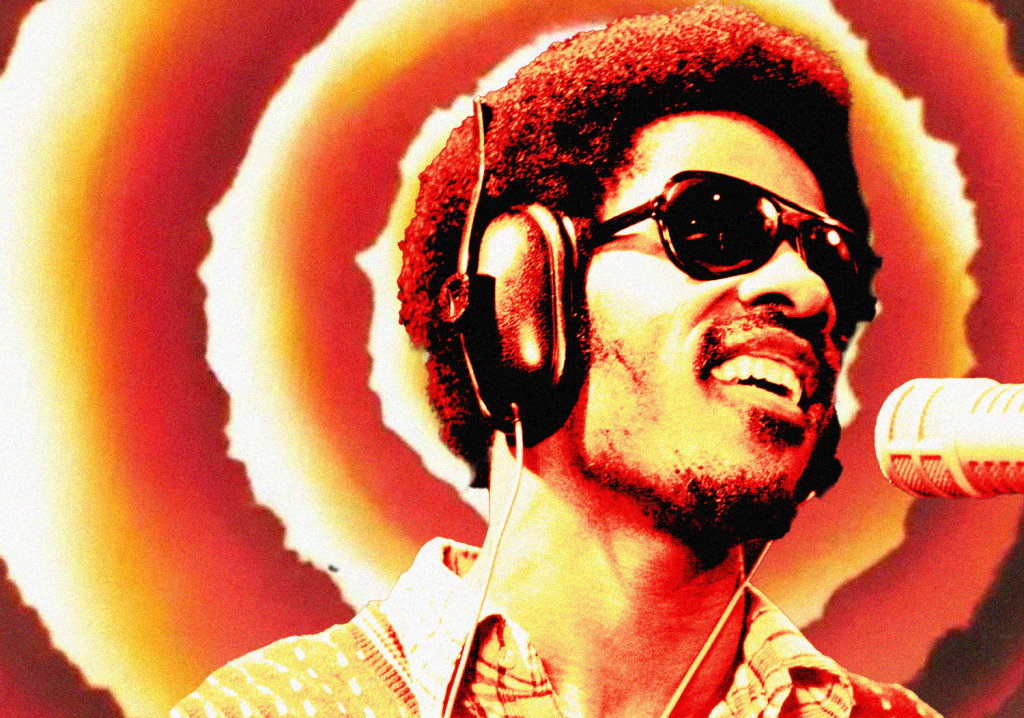
On Sept. 28, Stevie Wonder announced an EP containing four outtakes from the sessions of his seminal 1976 album Songs in the Key of Life to celebrate the album’s fiftieth anniversary. An arena tour was also announced, with dates in Europe and the United States, including Chicago’s United Center on Nov. 21.
It sold out within minutes.
Wonder’s popularity and influence among both casual music listeners and die-hard aficionados is immeasurable. He has had numerous top-ten hit singles, including a few that reached number one, and three consecutive album releases that won the Grammy Award for Album of the Year. But it wasn’t always like this.
Born six weeks premature, Wonder was blind from retinopathy, but he has always had a song in his heart. He was gifted with a voice that could light up a room, and he had a knack for instrumentation. At a young age, Wonder learned to play the harmonica, drums and piano. At 11, after signing with Tamla Records, a subsidiary of Motown, he became—for a lack of a better term—a member of an assembly line.
The artists at Motown Records were producing hit after hit during their peak, but around the late 1960s, many of them wanted to write and produce their own music. Wonder was one of them.
The first spark of what he wanted to accomplish started with his 1971 album Where I’m Coming From. It was the first time Wonder tried to make an artistic statement under the control of Motown, but unfortunately, it was somewhat lackluster and was released around the same time as Marvin Gaye’s magnum opus, What’s Going On.
Two major shakeups happened around that time:
First, Wonder signed a new contract with Motown after letting his previous contract expire when he turned 21. The new contract gave him complete artistic control, a 14 percent stake in royalties, compared to the 2-5 percent that artists typically received at the time, and his own publishing company. The deal was a major first for Motown.
And second, Wonder heard the album Zero Time by Tonto’s Expanding Head Band, an album performed entirely by two men: Robert Margouleff and Malcolm Cecil. The panoramic monster of a synthesizer known as T.O.N.T.O. (The Original New Timbral Orchestra) was created by combining other synthesizers of the time, such as the Moog, the Oberheim SEM, and the ARP 2600. Wonder got in contact with the two, and they showed him how to operate the beast. It sparked a collaboration that would continue through most of his classic period.
This classic period, which started with Music of My Mind and ended with Songs in the Key of Life, is commonly regarded as a high point not just in his discography but in the music of the 1970s as a whole. These albums were popular among Black and white audiences when they came out, and they continue to strike a chord with people with music that was both timely and timeless.
Wonder mixed genres not like a child playing with toys but like a mad scientist playing God. He weaved elements of jazz, pop and rock into the traditional funk, soul, and R&B sound, arguably ushering in a new wave of experimentation among Black artists.
He weaved classical-sounding orchestrations on tracks like “Village Ghetto Land” and “Pastime Paradise”; jazz fusion on “Contusion”; ballad-focused work on “Evil” and “They Won’t Go When I Go”; gospel on “You Are the Sunshine of My Life”; pure funk on “Superstition”; and even spoken-word and musique concrète elements on “Living for the City.” The list could go on.
“And a lot of people obviously tie my work into the concept of ‘skits’ but this was the first time I heard a skit on a record within the actual song,” Prince Paul recalled, in reference to “Living for the City” from Wonder’s Innervisions. “The words on ‘Living for the City,’ about a guy being in the big city, all the shit he sees, cops chasing after him and all that stuff—all that could be seen in your head. So that just means this was produced and done very well.”
Wonder’s newfound creative prowess led him to become a proper one-man band, as opposed to using the Funk Brothers, Motown’s in-house group of session musicians. Wonder still used session musicians, but they were very much in tune with what he wanted. In addition to the previously mentioned harmonica, piano, drums, and T.O.N.T.O. synthesizer, he also played organ, bongos, Fender Rhodes electric piano, synth bass, congas, and, most famously, the Hohner Clavinet, an instrument he’s been continually associated with since the single “Shoo-Be-Doo-Be-Doo-Da-Day” in 1968.
Not only were Wonder’s performances top-notch in both groove and melody, his production was top-notch too. You can feel where the instruments are in your speakers, and you can feel how loud they are when they need to be. The feeling that courses through your body during the various horn and clavinet breakdowns on some of his biggest hits is nothing short of groove flowing through your nerves. You just have to let yourself dance.
His lyrics are dense yet human. There’s a soul behind them that wraps around you like a heated blanket as he opens his soul and lets out all the love, heartbreak, and social movements he’s witnessed, in addition to the sweet harmonica solos.
Songs like “He’s Misstra Know-It-All” and “You Haven’t Done Nothin’” mention the disillusionment behind the business practices of then-President Richard Nixon. “Village Ghetto Land” and “Living for the City” convey Wonder’s feelings towards racism and inner-city poverty. “Pastime Paradise” relates to how we distract ourselves with temporary niceties. “Ngiculela – Es Una Historia – I Am Singing” and “Bird of Beauty” even weave in other languages that best show the international inclusivity Wonder wanted to accomplish, with lyrics in Zulu, Spanish and Portuguese.
Some of his best songs, however, are the ones that are more personal. “I Wish” is a song in which Wonder reflects on his childhood. Three days after the release of Innervisions, Wonder was involved in a serious car accident; “They Won’t Go When I Go” explores themes of death and spiritual peace. And “Isn’t She Lovely” talks about Wonder’s joy at the birth of his first daughter, Aisha Morris.
Despite this era burning fast and bright, Wonder continued to experiment and bring in new styles on newer albums. For his soundtrack to the film The Secret Life of Plants in 1979, Wonder used an early digital sampling synthesizer called the Computer Music Melodian, which can be heard on most tracks throughout the album. In addition, the album was the second in history to be recorded digitally, following Ry Cooder’s Bop Till You Drop by three months.
Wonder’s didn’t write music to be simply enjoyed by listeners; he wrote music that incited real change. Between 1968 and 1983, a campaign arose to establish a federal holiday celebrating the life and birthday of legendary civil rights leader Martin Luther King Jr.
Stevie Wonder was the man who brought national attention to that campaign with the song “Happy Birthday,” the closing track on his 1980 album Hotter than July. He even hosted a conference that gathered a petition with six million signatures in support of the campaign. It would eventually be signed into law as a federal holiday on Nov. 2, 1983, and first observed on the third Monday of every January starting on Jan. 20, 1986.
The artistry and craft of Stevie Wonder still manages to touch the hearts of people everywhere. His music teaches us to think about injustices, to love with all of our hearts, and to dance until our feet are sore. And even then, the groove won’t ever stop; it refuses to, much like love.




Leave a Reply