
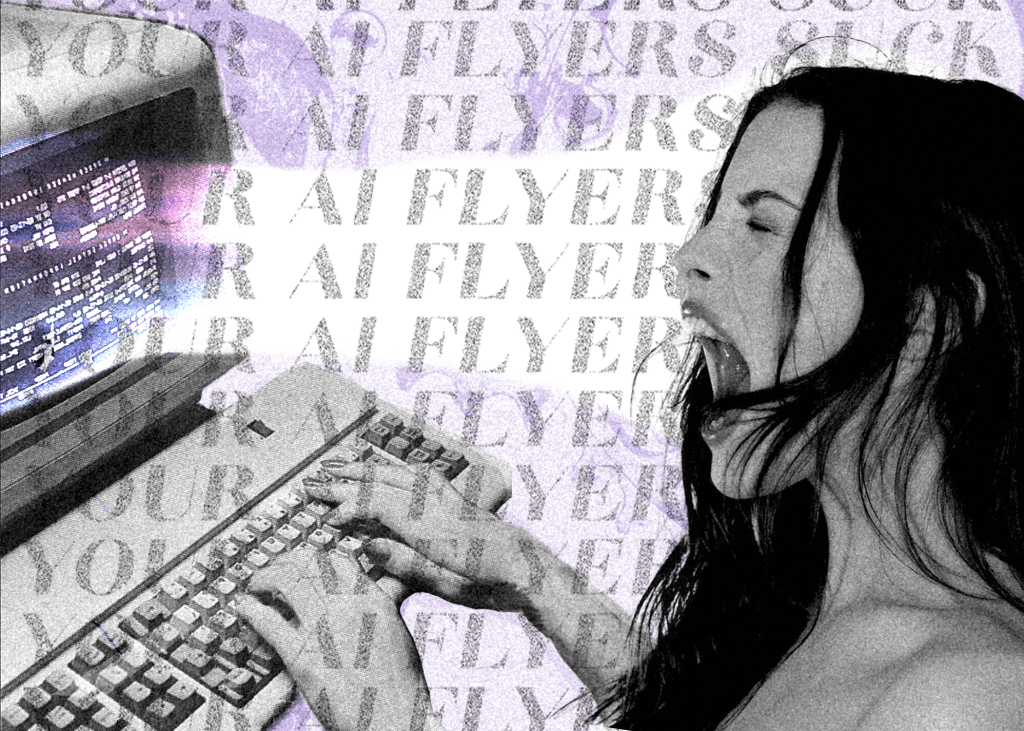
Scrolling through social media, you might come across a new style of advertisements.
With big uppercase lettering for every sentence, over-embellished illustrations and no room for empty space, this over-the-top type of posters has become synonymous with AI.
The public’s new infatuation for AI-made posters isn’t easy to ignore when it’s in every single advertisement, from restaurant menus, to school events to product launches. The increased use of AI symbolizes society’s new reliance on convenience rather than creativity.
One AI poster seems harmless. But it’s actually a warning sign: together, these posters threaten our creative spaces while also damaging our environment.
According to a 2026 Bentley University-Gallup survey, around 79 percent of Americans have seen advertisements resembling AI in the past 30 days.
The convenience and inexpensive access of generative AI are contributing to its increased use in graphic design. Simply typing a prompt into an AI image generator such as ChatGPT or Nano Banana can produce an “original image.”
But that label is misleading.
AI crawlers search for any type of imagery or text to help train AI models. That content is combined to create a new image. However, it’s not new, it’s another artist’s hard work.
Graphics need to be able to convey specific emotions or ideas. However, AI’s idea for visuals can come across as uncanny or too heavily enhanced.
“It’s an algorithm based on [non consensual] scraped data, and because of that, it’s going to essentially go with the most popular denominator, as opposed to something that was actually made by you,” said Priscilla Candelas, a Moraine Valley student with background in CGI.
Proponents of AI say that the technology could become so advanced that it would take over physical labor, giving us time to immerse ourselves in our creativity. Today, AI is pushing humans out of that creative space, but it could never top what humans can create.
AI’s ability to train itself to create images doesn’t necessarily mean that it has the ability to create good content. Its unflattering style has been given the name AI slop, which reflects the chaotic structure of AI-produced content.
For example, to be effective marketing, posters must be able to emphasize certain information. However, AI can’t differentiate and establish a hierarchy of information. Instead, headers and insignificant details are treated with the same font and size. Each segment demands the same level of attention, leaving onlookers confused.
Additionally, graphics need to be able to convey specific emotions or ideas. However, AI’s idea for visuals can come across as uncanny or too heavily enhanced. An AI flyer for a restaurant menu can exaggerate every detail of the food, such as a burger’s bun being covered in sesame seeds or weirdly textured cheese oozing in perfect symmetry. The final product leaves the burger looking unrealistic and unappetizing.
Despite its attempt to spark interest from consumers, AI’s lack of conscious design drives away any potential new impressions. That’s because nobody is standing in front of a bulletin board just to inspect strange images and read illegible text.
Hence, human-made posters surpass AI posters, as the latter lacks direction to engage views, says Vivian Sobie, a graphic designer at Opinize Design.
“It doesn’t know what your intent is,” said Sobie. “You’re just typing in something and it just throws everything together and makes you a flyer, essentially.”
When people see AI posters, there is a sense of distrust due to its errors.
AI misses the fundamentals of graphic design and has undoubtedly created a new appreciation for even the most basic, human-made designs.
“I think if there’s any benefit to what’s going on, it’s that it’s making people realize that there’s more to graphic design than just putting text and images together,” Candelas.
Some people still argue that AI is an easy way to funnel their own creativity, but there’s no argument when it comes to the environmental problems AI creates.
Information transmitted by AI chatbots and image generators is stored in data centers around the country. These data centers can be massive, roughly 10,000 square feet of physical space. And operating them takes a toll on the surrounding environment.
Data centers require a lot of water and energy to run continuously through the year, with no break. As the equipment inside data centers can heat up and damage itself, many facilities turn to water-based cooling.
The more AI is used, the more water it will require to cool off. A 2026 report by the United Nations University found that AI’s water footprint is approximately two tablespoons of water. That may not seem like much, but with the almost 2.5 billion prompts a day, those number add up quickly.
Despite concerns, the consequences of AI aren’t fully realized by the people using it. For most, these AI posters are a one-time prompt to plaster over social media and hallways.
“As far as in my industry, flyer designs or poster designs for mid to low tier bars and restaurants have completely dried up,” said Sobie. “They no longer are coming and getting any kind of work done due to the convenience [of AI].”
Money also plays a huge part in the increased AI usage. For some graphic designers, the cost of designing a poster ranges from $25 to $100, depending on the effort and time needed.
“It’s an algorithm based on [non consensual] scraped data, […] as opposed to something that was actually made by you.”
Priscilla Candelas, Moraine Valley student.
“AI is faster and cheaper,” said Sobie. “It can produce 20 variations before a designer has even finished their concept. For businesses that simply just need something that looks good, the economics are obvious for that reason.”
However, any money saved by using AI is lost by the lack of consumer interest. When people see AI posters, there is a sense of distrust due to its errors. For this reason, Moraine students such as Lizzy Serna ask for stores and other organizations to lean towards human creativity.
“People would trust them more and rely on the information,” said Serna. “If they were to present [AI posters], people wouldn’t know anything about it.”
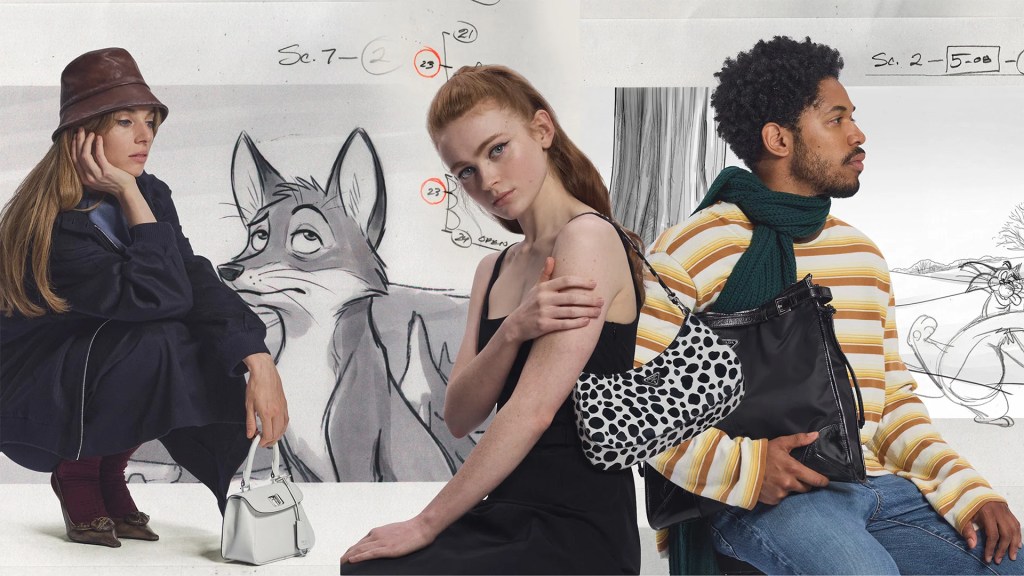
After this surge of AI takeover, there seems to be a new appreciation for human creativity in the art field. Most recently, the fashion house Prada released an animation ad for its upcoming holiday campaign, with former Disney animator John Pomeroy and other animators creating hand-drawn characters and illustrations.
The online reaction to promoting original artistry rather than using AI was positive.
It’s clear that people still yearn for something authentic. Although AI posters will continue to decorate hallways or bulletin boards, there is hope that more people will push themselves away from AI.
Candeles says that the public’s quick reaction against AI serves as a reminder that art is everlasting.
“I think that makes me even more hopeful, and I know that at the end of the day, animators will always exist, and so will artists,” Candeles said. “Art is as much a part of human nature as eating and drinking.”



Leave a Reply