
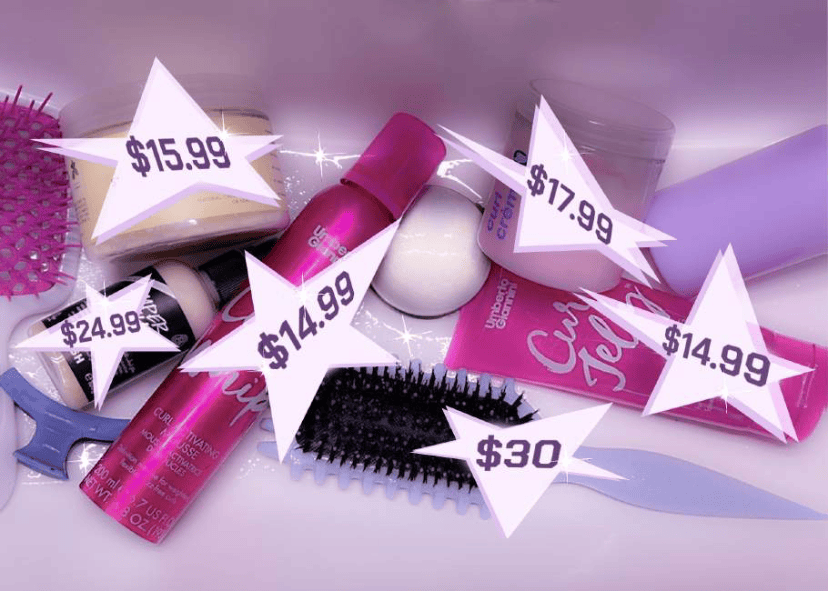
You wake up and your hair is dry. So you rush to CVS, racing to make there and back before you have to leave for class, for some Doux curl corps defining cream. $14.49. Without tax.
Cool, cool, cool. No problem. Except, the cream wasn’t for the dryness. That’s for the definition step. You completely forgot to go to Ulta. Great. You want to buy something a little cheaper because you want to be more financially responsible, only to see one the most recommended products on TikTok is OLAPLEX No. 7 for $32. “With tax?” HA! No, tax not included.
For curly haired individuals, it is so much more difficult to find hair products than it should be. Honestly, people are tired. Tired of products working and then suddenly not, of having to waste money on products that aren’t even beneficial, of the constant battle when it comes to hair care brands.
Here’s what consumers and professionals that work with textured hair daily want to see done differently in the industry and why they feel at a standstill with their options.
If the person who is making these products for curly hair doesn’t have curly hair, then how can they help you?
Moraine Valley students Heidi Sossah and Bana Barham aren’t too pleased with the current landscape of products for curly hair.
“You have to decipher a bit. I bought the Amika brand shampoo and conditioner, and my hair has never felt so healthy!” Barham exclaimed. But then she trailed off. “Together, the two products were $60, though…”
Amika is a brand sold in Sephora and online that was founded in 2007 by a group of industry outsiders. The brand was sold to Bansk Group for majority stakes in 2022.
Sossah said she often finds herself wasting money on products that don’t end up working, which forces her to worry about an extra step.
“I probably spend hundreds of dollars and I buy in batches too,” she said. “I’ll try something, and when it doesn’t work, I have to buy another. But now I am just stuck with the one I won’t use again.”
One of the products Sossah used to purchase was the brand Mielle, founded in 2014. It was previously labeled as a Black-owned business, but many consumers were unaware that P&G bought the company in January 2023. The move stirred trouble in the curly hair community, and the brand was hit with a primary class action lawsuit on Nov. 21, 2024.
The case of Gomes v. Mielle Organics, LLC et al. alleged the company’s products caused hair loss as well as scalp irritation. This was not the first instance where the brand had been called out for its damaging products.
Topclassactions.com lists other cases involving the company:
- May 24, 2024: California filed a 60-day notice of intent to sue due to violations of Proposition 65. Claims were made that the company’s strengthening shampoo contained diethanolamine (DEA), a known carcinogen that was not listed in ingredients list.
- December 12, 2024: Three separate claims were consolidated into a single multi-plaintiff class action lawsuit.
- February 21, 2025: Sharon Allen v. Mielle Organics LLC alleges the company falsely claims products are “natural” and “made in the USA” despite allegedly using synthetic products.
“You have to decipher a bit. I bought the Amika brand shampoo and conditioner, and my hair has never felt so healthy! Together the two products were $60, though.”
Bana Barham, student at Moraine Valley
As of 2026, the brand is considered Black-led rather than Black-owned, which leads consumers to wonder, if the people making these products for curly hair don’t have curly hair, then how can they help you? Furthermore, does the selling of companies have something to do with a rapid decline in product quality?
Home-based braider Carlisa McIntosh specializes in working with curly, textured hair and shared helpful tips on how to combat these issues.
“I believe that when companies sell to larger companies who don’t know too much about the product they’re selling or are just trying to go the cheaper and easier route about things, it does downgrade the quality of the product,” she said.
McIntosh honed in on the important steps when it comes to curly hair.
“I like to focus on products that offer deep moisturization, so I wash with The Doux Ladies First Honey Shampoo and follow up with Camille Rose Moroccan Pear Conditioner. I then add the Camille Rose Honey Hydrant Leave-in-Conditioner on damp hair.
“Always work on damp/wet hair, finishing with mousses and foams from both brands–that way, you have a smooth finish and no clumping of products–ending off with castor oil or a light hair oil, depending on curl pattern and density, to seal in that moisture all day.”
Lauren Cannon, an Ulta employee and Moraine Valley student, has curly hair herself and empathizes with customers when they shop.
“I always compare and contrast the products I already use and what I use them for, so consumers can know they’re not alone with having a lot of buildup, detangling, or frizz in their curls,” she said.
Cannon pointed out that it can be hard when popular products you see your favorite creators use don’t work for you, but there is usually a reason why.
“I typically look at the ingredients first before anything,” she said. “If there’s something I don’t understand, I Google it. Majority of the time people are picking what they see an Instagram model use, not knowing what’s inside the product or the texture of that person’s hair. We have to personalize our shopping.”
Cannon recommends the brands TGIN, Donna’s Recipe, and Camille Rose for products that have nourishing ingredients.
How to shop smart for curly hair products
The following products can be found in at Walgreens, Walmart, beauty supply stores and online. These products are produced by companies owned by people with curly hair, for curly hair, with the intention of increasing the normality of having a space where those with waves, curls, and textures feel taken care of.
- Camille Rose Hydrate Collection: Ranges from $8.49 to $16.99
- Doux Honey-Infused collection: Ranges from $10.99 to $16.99
- Amika curly hair line: Ranges from $28 to $44
- Donna’s Recipe: Ranges from $9.99 to $25


Leave a Reply