
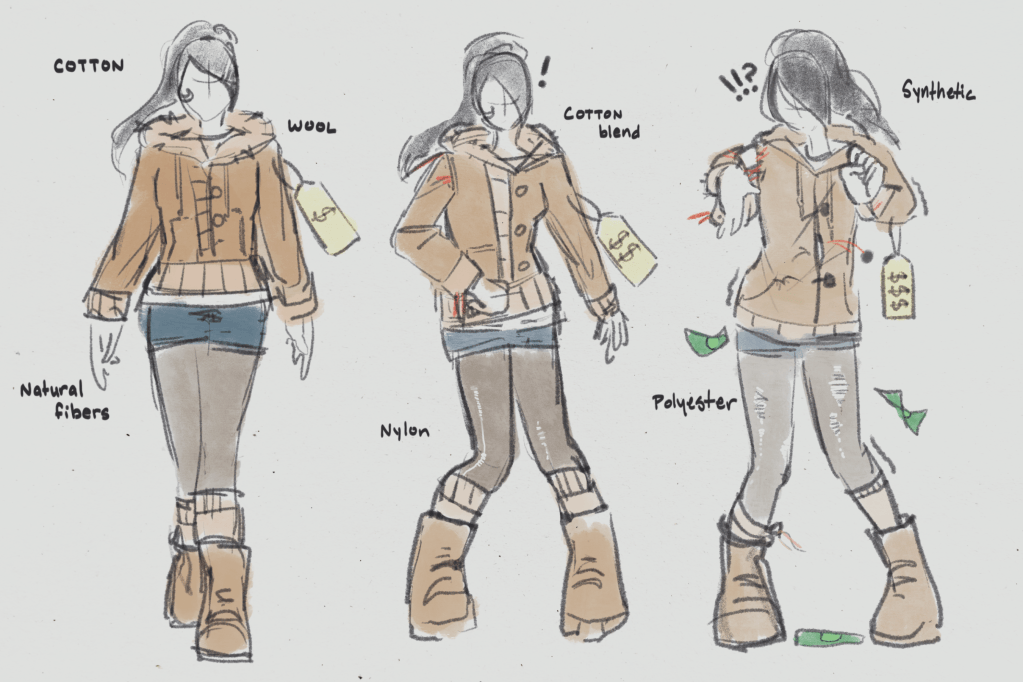
You walk into a clothing store looking for a new fall jacket and find one you like. Then you look at the price tag: $50. A bit more than you want to spend, but OK, you think, forking over your hard-earned money.
Then you start looking closer. The thread is fraying. The fabric is thin. Now, you’re out 50 bucks and still cold.
With prices going up and quality going down, shopping for clothes these days feels like a choice between dressing how you want or keeping your money in your pocket. One cause for this dilemma: Many companies are passing along increased costs due to new tariffs–taxes on imported goods.
Tariff policies have changed more than 50 times since April 2, 2025, according to the Tax Foundation. According to The Budget Lab at Yale University, estimated household costs due to tariffs total about $1,100 annually under current law.
Clothing and footwear are among the products that have been most affected by tariffs, leading consumers to change their shopping habits.
“People still want the feeling of ‘new,’ but they’re shopping like detectives: reading fabric labels, reverse-image searching silhouettes, and discovering that the ‘it’ bag looks suspiciously like the ‘it’ bag from five years ago with a slightly different clasp,” says fashion writer Randall Radic. “In a world where the original is overpriced, and the replica is one click away, ‘brand equity’ becomes a meaningless cliché.”
“It’s a struggle. I pay some of my bills too, and I have to save and manage my money a lot stricter because I do like makeup, clothes and other self-care or essentials.”
Natalia Gonzalez, 18
Just a few years ago, if you didn’t want to splurge, you could find cheaper alternatives. Now, fast fashion is often at the same price as items from the mainstream companies, and at the same or worse quality than before.
Brands are using materials such as polyester, nylon, and acrylic, sometimes even going for a blend instead of cotton and wool to cut costs, since these fabrics are lower priced—but the materials used don’t align with the higher prices consumers have to pay.
Natalia Gonzalez, 18, and Taylor Whittaker, 20, who work at Victoria’s Secret in Orland Square mall, expressed frustration with the state of the fashion industry.
“I noticed some change in a few companies a few years ago,” said Whittaker. “Honestly [at Victoria’s Secret] it depends on what you’re getting. I notice that it depends on your washer and dryer. I used to buy a lot of lace stuff and nothing happened, and I got new [washer] and things do rip.
The corner-cutting in the fashion industry has affected not only Whittaker’s aesthetic, but also her comfort and health: “I have sensitive skin; cotton doesn’t make me itch, and some fiber mixes work for me too, but it’s rare.”
She tries to help customers manage their budget in the face of increasing prices. “I even tell customers sometimes to just wait for certain items to go on clearance and make sure they have an account so they aren’t missing out on deals,” she said. “I’ve thought to myself at the register ‘Are you really going to pay $60 for some leggings?’ But I often use my discount for things I really want to buy.”
The difficulties that Gonzalez faces at the rack reflect those of many other students: juggling school, working multiple jobs and trying to stay fashionable on top of it all.
“It’s a struggle. I pay some of my bills too, and I have to save and manage my money a lot stricter because I do like makeup, clothes and other self-care or essentials,” she said. “There are items I want again or in a different color but now the prices are so much higher recently.
“Quality has gone down, with my items starting to thin, shrink or rip with every wash.”
Another consumer at the mall had concerns with recent product changes. Joríe Daway, 20, makes clothing herself and explains the obstacles of competing with popular brands.
“I feel like people buy fast fashion rather than buy it from clothes makers like me with better quality out of convenience because it is overnight shipping for certain things,” she said. “In return though, they are paying $60-plus on poor quality for one item at times.
“Often, I just alter the clothes that I already have.”
These three women are just a few voices of the population who have to figure out savvy ways to dress how they want while also having to choose between things, or come up with solutions that they didn’t need to a few years ago.
How to shop smart in light of tariffs
While consumers will continue to shop their favorite brands, they might as well get a bang for their buck, wherever they shop. Here are some tips to maximize your fashion budget:
- Always have an app or an account for the places you shop to build up points to use on later purchases, or just to catch any deals you can.
- Manage your money through different savings accounts so you can build up some money that is just for your gifts to yourself.
- Shop for your natural fiber basics with Saint George, Oak and Fort, Mou Ref, Mate the label, and KOTN.
- Pricier items may pay for themselves with increased durability and can remain fashionable much longer than their mainstream counterparts.






Leave a comment