
Warning: This story contains reporting on sexual assault and rape. If you or someone you know has experienced sexual violence, call the National Sexual Assault Hotline at 800-656-HOPE, or see the resources listed below.
“She uses clearly manipulative language further proving she is doing this out of spite and guilt,” a commenter named Enrico Pallazzo posted on TikTok.
“She remembers things too well for someone that supposedly was crossed with alcohol and ketomine. If you’ve ever personally done keto you’d know her remembering anything isn’t realistic,” Prgatory commented on TikTok.
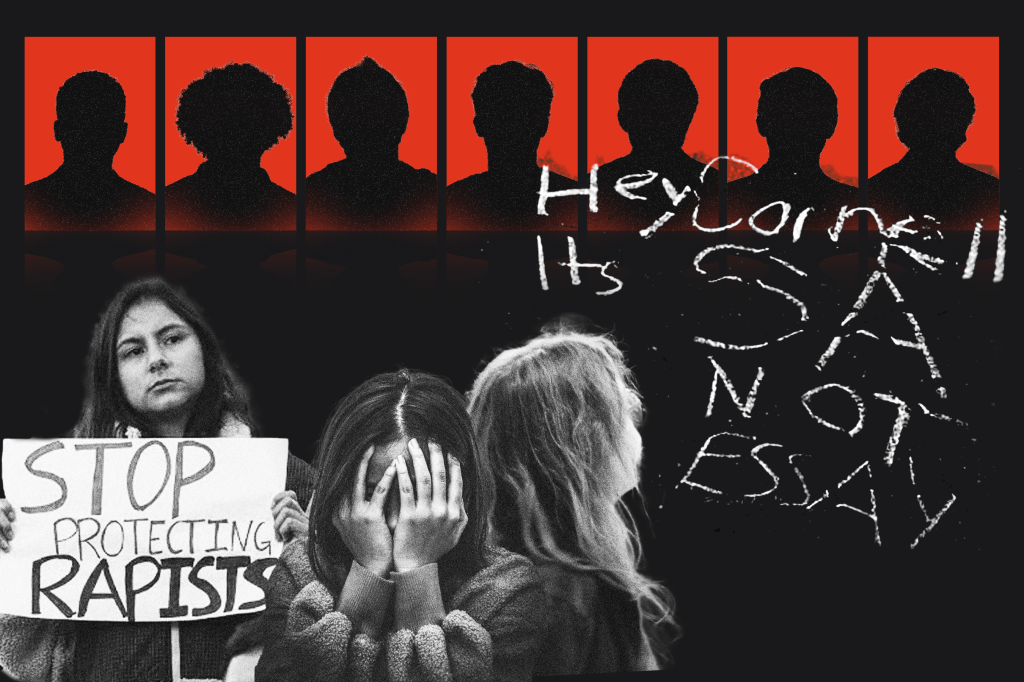
It was inevitable: As soon as prosecutors reopened the case of Jane Doe, who said she was gang-raped at a fraternity house at Cornell University, people on social media began choosing sides about whether to believe her or not.
The discrediting of women’s reports of their experiences with sexual assault is nothing new. But how does it affect women’s own ability to trust their perception of what happened? Do they actually end up discrediting themselves? How does the assumption that society will not believe them–will shun them and undermine them–make them view their own assault?
Often, women early on may try to ignore what happened to them, even feeling negatively about themselves rather than their perpetrator.
“I think the trauma makes it very difficult to come to terms with what happened sometimes, and then self-doubt can creep in,” said Michelle Skelton, who teaches Intro to Domestic Violence at Moraine Valley. “‘Did this really happen?’ ‘Am I remembering it correctly?’”
If a woman has not experienced sexual assault herself, it’s likely she knows someone who has.
“College-age people face a high risk of rape,” reports the anti-sexual violence organization Rainn, which operates the National Sexual Assault Hotline. According to Rainn, law enforcement agencies documented one reported rape every 20 days for victims aged 17-24, with 1 in 8 students experiencing sexual violence during their college years.
Law enforcement agencies documented one reported rape every 20 days for victims aged 17-24, with 1 in 8 students experiencing sexual violence during their college years.
Over the past two weeks, two more alleged sexual assaults have been in the news involving fraternities near the campus of the University of Chicago.
Moraine Valley students Mallory Mittelmeier, Hanin Raslan and Alexandra Zepeda each have people close to them who have experienced sexual assault, with one experiencing it herself.
“I’ve had people tell me things about it,” said Mittelmeier, 20, a radiology science major. “I’m sure there’s people that just don’t want to talk about it because it’s just, like, embarrassing to them maybe.”
“A couple…a few…” said Raslan, 19, who is studying to become a dental hygienist. “I was told nobody knows other than me.”
“I also had this experience with this one guy and he would try to make me do something I didn’t want to do,” Zepeda, 19, said. “So I, what I did is, I pushed myself away from him. It made me feel…different towards men. I was a little bit scared of them.”
Movements like #MeToo and most recently #IamJaneDoe work to bring all women into the cause. But despite the bonding, many survivors start out by denying what happened to them. Women are quick to support other women but often shy away from their own experiences, downplaying their seriousness and discrediting themselves before someone else can do so.
“After homicide,” said Patrick Treacy, Police Chief at Moraine Valley, “maybe this is the most serious crime there is.”
A lot of harm comes with rape or assault, during and after the experience. The victim has power taken away and is left vulnerable, and then is left to rebuild body and mind while often enduring people’s disbelief–even when the facts support the survivor’s account.
“Depending on the studies, anywhere from 92 percent to 97 percent of the cases are factually, like, this person was truly a victim,” Treacy said. “So there’s only 3 to 8 percent of false reports in sexual assaults–which is either equal to or maybe even less than other crimes that are falsely reported.”
People who look to discredit a survivor often bring up that she might have been drinking, might have been on drugs, might have behaved a certain way or dressed a certain way.
“The system isn’t really designed to welcome somebody who’s saying ‘this is what happened,’” said Moraine Valley counselor Sharon Brennan. “We do a lot of other things like questioning their motives and ‘why did you do that?’ And none of it should matter, because nobody has the right to my body or to harm me or to touch me or anything without my permission.”
“The trauma makes it very difficult to come to terms with what happened sometimes, and then self-doubt can creep in.”
Michelle Skelton, MV criminal justice professor
Shame, embarrassment, fear all work in tandem to hold survivors back from coming to terms with what they have experienced. Accurately remembering what happened is hard enough without the trauma and regardless of whether the survivor was drinking or doing drugs. If the details are not completely straight in survivors’ minds, fear of being disbelieved can make them hesitate to report or even process their trauma at all.
Since September, details about Jane Doe and the Cornell 7 case have spread all over social media. The woman referred to as Jane Doe was allegedly gang-raped by seven members of the university’s Chi Phi fraternity for seven hours straight. The case has rallied survivors and supporters, but it also started an ongoing race between protecting her identity vs. uncovering it. Online abuse and harassment has led Jane Doe to fear for her life.
“Jane Doe, we don’t know who she is, but already her credibility has been very strongly attacked online, threats if she’s exposed,” said Skelton. “So I think in some aspects, the fear of those repercussions would absolutely create an environment of ‘I don’t want to welcome that degree of disruption in my life.’”
Seeing how Jane Doe is being treated and the threats she’s facing could trigger even more shame, embarrassment and blame for future survivors.
Ranslan describes how survivors must feel: “Afraid, but afraid is a small word due to what happened to them. Afraid of the reaction..afraid of being exposed. You know, like everyone’s trying to expose who Jane is.”
Along with fear, Brennan said a lack of education about sexual assault often holds people back from reporting. Many people on both sides of the equation can misidentify consent. Often, a woman will not recognize that she was assaulted, or what happened may become entangled with her feelings for the person and not wanting to ruin his life.
“It’s not easy for people to come forward,” Brennan said. “They question if they said ‘I wanted to do this.’”
But even if you gave consent at the beginning, that doesn’t mean you’re consenting to everything after that, she said. For example, Jane Doe allegedly initially consented to involvement in a threesome, but that does not mean she consented to what happened in the seven hours that followed.
“That’s important, it being mutual, it being enthusiastic,” Brennan said. “They were clearly violating and raping her. She was not lucid, right? And they were lying to her about what was going on. There was an audience. That is not okay.”
You can take consent away, at any moment, Brennan points out. Change your mind. Back out. This is all valid. Consent is required on both sides. Both individuals need to understand what they are doing in a clear state of mind and be excited to be with the other person.
From the time they were young, most women were warned to protect themselves. Don’t walk with headphones on. Watch your drink. Pay attention to the warning signs. Don’t end up as the person whose story could be discredited.
And sometimes, the assumption that society won’t believe them can make them disbelieve themselves.
“People who are reporting sexual assault are not lying more frequently than anyone else about a crime,” Brennan says. “But we tend to believe the person who says that they were robbed at gunpoint, right? We believe the person whose car gets vandalized. We believe the person who gets jumped on the street.
“But why don’t we believe the person who says they were assaulted?”
Where to turn for help
If you or someone you know is a victim of sexual assault, there are resources to help process the trauma and begin healing.
Moraine Valley Community College offers free counseling for students by appointment or walk in. You can schedule an appointment by calling (708) 974-5722, or visit Room S202 in the S Building Mondays and Tuesdays from 8:30 a.m. to 6 p.m., or Wednesdays and Thursdays from 8:30 a.m. to 5 p.m.
RAINN, the National Sexual Assault hotline, is available 24/7:
- Call 800-656-HOPE (4673)
- Text the word “HOPE” to 64673
- Visit RAINN at rainn.org/hotline to connect with an adviser
Resilience, a Chicago-based rape crisis center, has its own free hotline, alongside a headquarters on Michigan Ave.:
- Call (888) 293-2080
- 444 N Michigan Ave Ste 970, Chicago, IL 60611
If you choose to visit a hospital following an assault, ask for a SANE nurse (Sexual Assault Nurse Examiner). These nurses have specialized forensic training to provide trauma-informed care and collect medical evidence for survivors of sexual assault, domestic violence or abuse.




Leave a Reply