
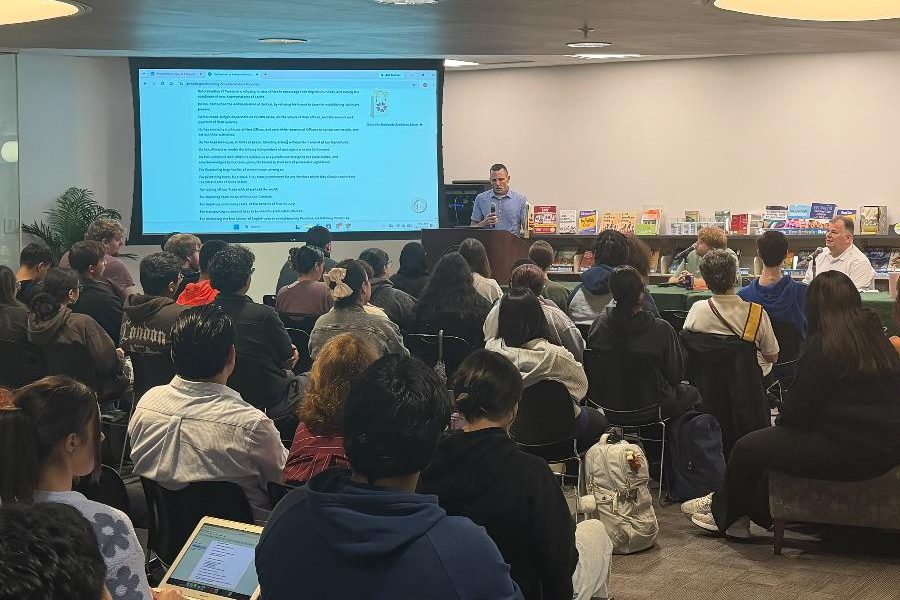
How is American democracy holding up, 250 years after its creation? Are mechanisms such as checks and balances put in place by the framers still working, or are current political pressures causing the system to crumble?
These were some of the questions explored in a recent event in the library organized by the Democracy Commitment program at Moraine Valley. As part of a series on the 250th anniversary of the Declaration of Independence, the event brought together history and political science professors to compare the values from 1776 to see if they are being upheld today.
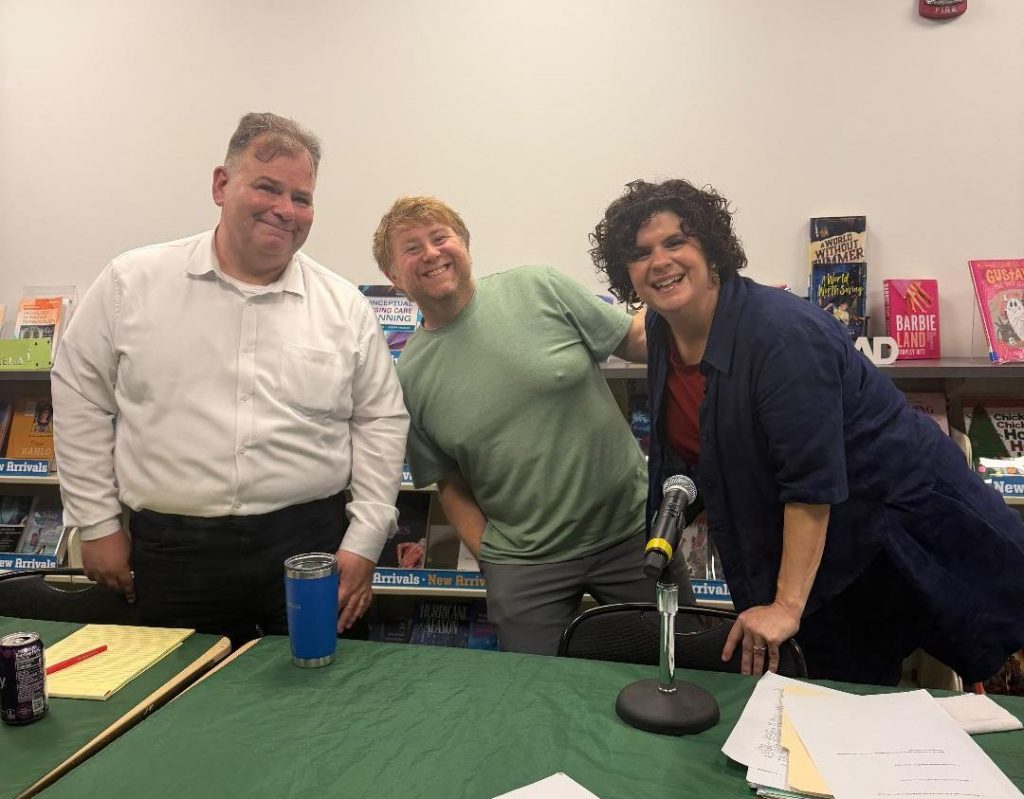
The event, titled “ A Republic, If We Can Keep It: The Declaration at 250 and the State of American Democracy,” was organized by the Democracy Commitment and the Moraine Valley Library. History and political science professors Josh Fulton, Jim McIntyre, and Merri Fefles-Dunkle unpacked the rich history of the country and offered insights about the Declaration of Independence’s context.
Projected on a screen was the text of the Declaration, which includes a list of grievances against King George III and his abuses of power, or, as Fefles-Dunkle put it, “all the reasons why the king sucks, like one after another.”
“A lot of these things do resonate today,” Fefles-Dunkle said.
For instance, she called attention to the wording stating that the king had “erected a multitude of New Offices, and sent hither swarms of Officers to harrass our people, and eat out their substance.”
She asked the audience whether they connected that grievance to anything happening today. Someone responded with “ICE agents.”
Another audience member stood up to add, “They’re arresting, like, innocent families..and not giving them a background check” or due process. McIntyre pointed out that the framers were “worried about those sorts of things.”
Library department chair Troy Swanson, one of the organizers of the event, raised concerns about things happening today, 250 years after the Declaration was written. “We have a president who’s calling into question whether or not votes should count or not. We have constitutional challenges around the Supreme Court, making rulings and a lot of polarization.”
The panel acknowledged that the current administration is not the only one that may have compromised the principles outlined in the Declaration, however, and Feffles-Dunkle invited audience members to express dissenting views.
As the event progressed, students confessed feelings of hopelessness and uncertainty about how to fix the American political system, which they see as broken. But a theme of hope emerged among the panelists and the audience.
“The minute we all lose hope is the second [Donald Trump] wins,” said Tuana Ozbir, a 19-year-old English major.
The panelists talked about many issues scaling years of American politics: World Wars, the Civil War, the Revolutionary War, and the modern-day political system. They pointed out that all throughout American history, people have fought for what they believed was right, even challenging their own government to do so.
Ozbir was firm in her belief that hope overrides any corruption, and panelists agreed that with the new generation of voters, there is new hope of the actions to come.
“I will always, of course, have hope in the activism and efforts of young people, of the new things, and art, and voices that emerge every single day,” Fulton said. That, he said, “is a cause for hope.”
“I will always, of course, have hope in the activism and efforts of young people, of the new things, and art, and voices that emerge every single day.”
Josh Fulton, history professor
Attendance at the event indicated strong interest in whether America is living up to the values upon which it was founded. An average library has three rows of chairs, but for this event, two extra rows had to be added. Other seating areas in the library were also full, and those attending included students, faculty and community members age 18 to 75.
The idea of hope is what inspired this event to compare modern issues to problems during the American Revolution. The founders were fed up with what the government had been doing without their approval, so they did something about it.
Some in attendance said we should be inspired by the founders to seek knowledge and then defend and stand firm in our beliefs.
“What you need to do is become educated on the issues that are important to you,” said Victoria L. Certinich, a 73-year-old member of the League of Women Voters. “Look into that one thing, find the truth, and find the candidates, or the referendums that you support, or are against, and vote accordingly.”
Fefles-Dunkle encouraged people not to give up on American values.
“I know it’s so easy to feel demoralized and to feel like you can’t affect these things,” she said. “You can…but part of it involves becoming engaged.”




Leave a comment