
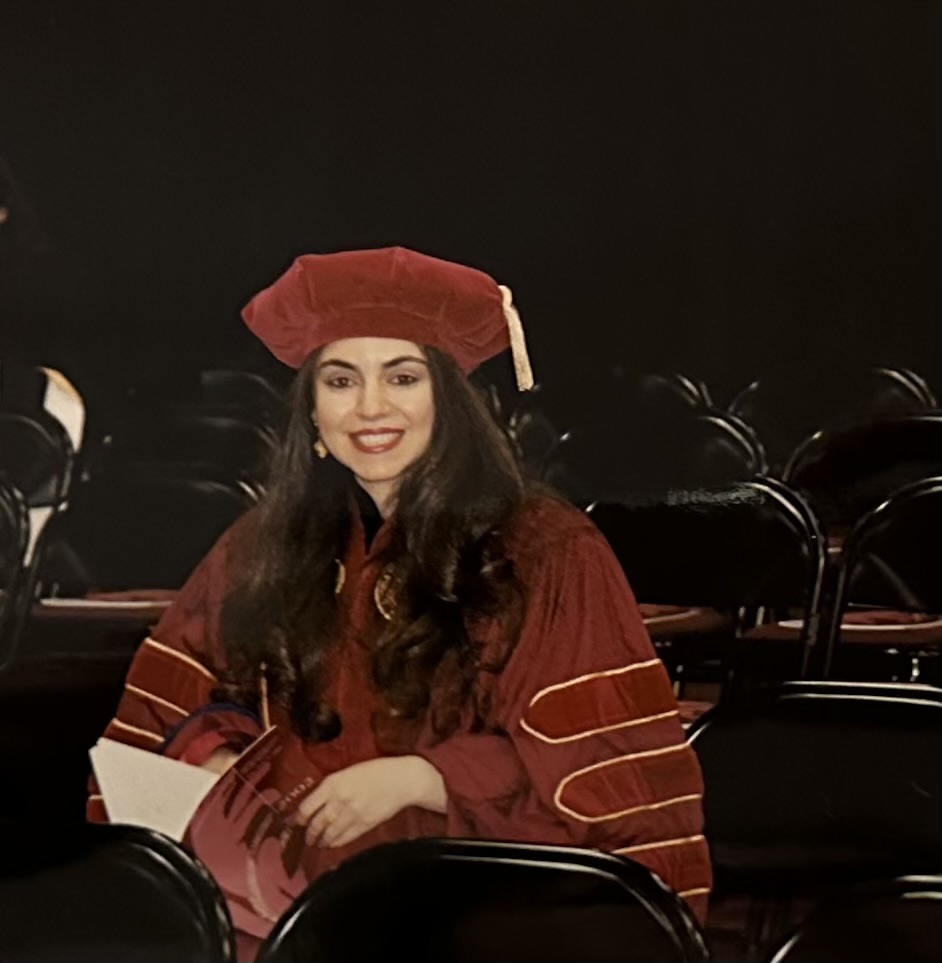
Just from meeting Amani Wazwaz once, you can tell that she’s a very sincere person. Her warmth and kindness radiate from the moment you walk into her classroom, which is why she is well-liked by both her students and colleagues.
“I think in her teaching, and in her personality, she genuinely just wants to see people succeed, just to better themselves,” said Amalia Thompson, 18. “She wants people to succeed in anything that they’re doing. And her kindness is also undeniable. Even if you don’t know her, and you just met her, you can already tell how genuine of a person she is, too. She’s just unapologetically herself in everything she does.”
Wazwaz, who has taught communications and literature at Moraine Valley since 2005, inspires those feelings in many of her students.
“Her personality is very warm, and also very, very encouraging,” said Lilliana Haritos, 63. “She definitely pushes you to be better than what you were originally, before coming into her class.”
Wazwaz’s personality was shaped by her childhood and by the different cultures she experienced throughout her life. She was born in Jerusalem and came to the U.S. at age three but went to Palestine and spent her years from first to seventh grade there, along with her high school years, and two years after that.
In high school, Wazwaz developed her love of literature. Her interest in literature was also shaped by her experiences in both Palestinian and American culture throughout her life. Being both an avid reader and a multicultural person has made Wazwaz empathetic.
“I loved the honesty I saw in literature,” she said. “Writers were discussing the complexity and the conflict that humans struggle with, and I felt that there was a sincerity that I loved about having this art form deal with the struggles of human nature.”
Despite not having lived in Palestine for many years, Wazwaz still cares deeply about the place and its people. She has described her life there as “heaven.”
“Jerusalem is my family home on the fourth floor of a house made of stone from the 1940s or even earlier,” she said. “This home is forever blessed with the scent of my mom’s exquisitely cooked meals, lovingly made and bursting with flavors.”
One of Wazwaz’s favorite parts of her childhood was spending time with her family in Jerusalem.
“I loved having my grandparents around me,” she said. “I loved walking to their homes. I loved feeling welcome by my aunts, uncles and cousins.”
There weren’t any phones in Palestine when Wazwaz grew up there, allowing everyone to be more natural with each other. This is one of the many things she appreciates about the city of her childhood. So it’s no surprise that Wazwaz often wears a shirt with an image of Jerusalem at its center.
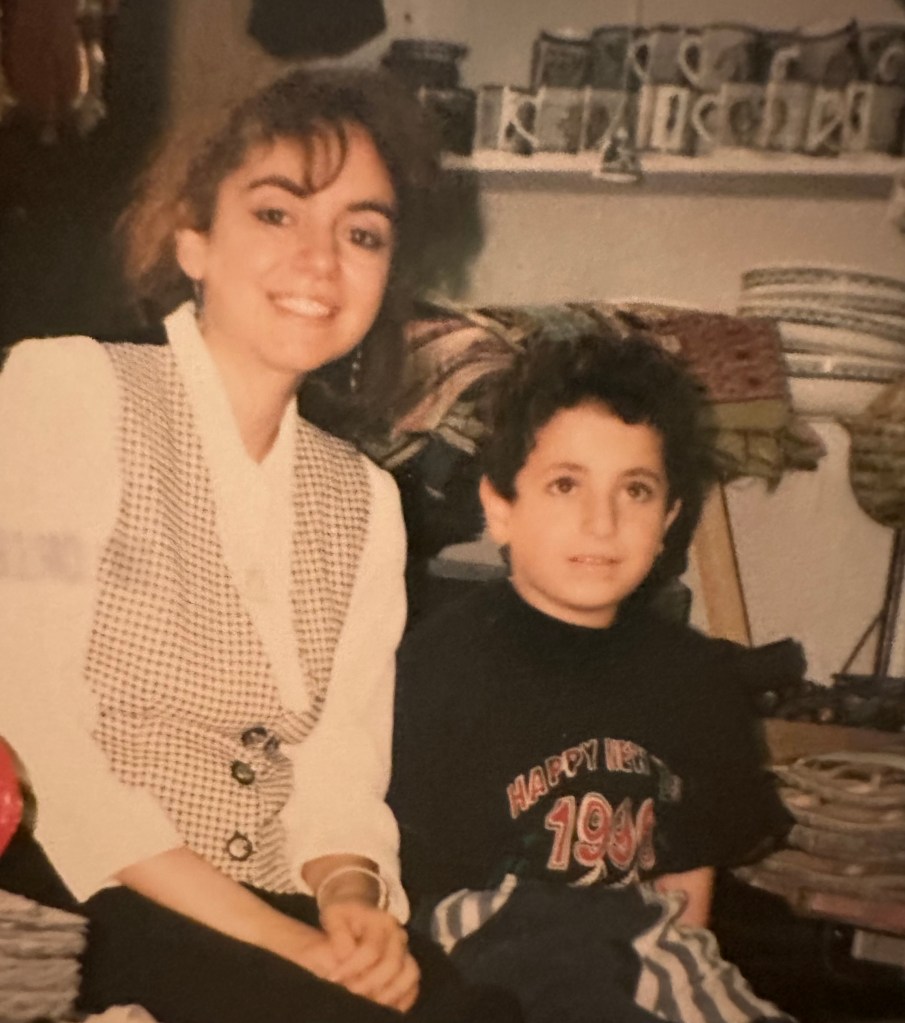
“I like to think that I carry Jerusalem, Palestine with me wherever I go, but the truth is Jerusalem is always carrying me. Jerusalem is the little child selling gum on the bus as he cries, ‘Miska! Miska!’ while hoping someone will buy his precious goods. On one particular day, no one did. The silence of his disappointment and sorrow has continued to hurt to this day.”
Whenever Wazwaz remembers something upsetting from Palestine, she feels the other person’s sorrow, and hopes that things turned out better for them after that.
“Jerusalem is the man I saw going home carrying two plastic bags of milk,” she said. “Sadly, he did not see the steel poles lying on the street and fell. The milk flooded the street. I knew he was poor, and my heart broke. My mind has replayed that scene over and over for many years.”
Wazwaz still feels connected to her home city, despite the years and miles separating her from Jerusalem. She can still remember the stories her neighbors and family would tell each other about their days.
“At night, after the last call to prayer for the day, the night sky welcomes the company of the many many stars; they are the other neighbors who have stopped by to visit and adorn the sky with their brilliance,” she said.
The sight of the star-adorned night sky still remains with Wazwaz, alongside the boy selling gum and the man with the milk.
“Hope was certainly all around in the sounds of Jerusalem,” she continued. More specifically, she brought up the call to prayer which sounds in Muslim communities and homes five times every day, and how that always reassured her of God’s presence and greatness.
The secret to Wazwaz’s success is being respectful and encouraging towards her students. She wants them to do their best in her classes, and to develop a deep appreciation of literature like herself. For those who don’t seem too interested, she hopes that they can read a book, because, she says, “They are bound to see themselves in the book.”
“She genuinely just wants to see people succeed, just to better themselves. She wants people to succeed in anything that they’re doing. And her kindness is also undeniable.”
Amalia Thompson, Moraine Student
Haritos has credited Wazwaz’s methods, and love of literature, with rekindling her own love of reading.
“Before taking her classes, I wasn’t an avid reader,” she said. “ With being in her classes, you learn to read a book in several sections, dissect the section, understand it, and then go on to the next section, dissect that section, connect it to the previous section.”
This method enabled Haritos to finish several books, both for class and personal enjoyment. But Haritos isn’t just a fluke amongst Wazwaz’s students. Thompson is also now putting more effort into her education after taking some of Wazwaz’s classes.
“The impact she had just on my education in general, as soon as I started COM-101, it was undeniable that I got to be more interested in doing what she was doing,” Thompson said. “And I got more interested in the concept of writing, which I never thought I was good at, but she encouraged me.”
Many students attribute their successes to Wazwaz’s teaching methods. She incorporates not just the text itself, but also the history of the era it was written, and what the author was trying to say with it. Haritos appreciates this thorough approach to teaching, and has experienced deep reflections in Wazwaz’s classes.
“We’re always doing some type of reflection,” Haritos said. “So that allows us to take whatever we have looked at, whatever we have read, whatever we have talked about, and reflect on it in our own voices. And really, there’s no wrong answer in our personal reflection.”
Thompson agrees with this assessment of Wazwaz as a professor.
“The difference between her and every other English teacher I’ve had is, she takes the teaching aspect and formulates it so it matches you and your writing style,” Thompson said. “She just wants to mimic her teaching skills to others.”
In other words, she’s a chameleon teacher, passing her own writing style on to her students, while allowing them to maintain their unique voices.
Wazwaz also credits her students with having an impact on her: “I am blessed that there have been so many kind and giving people in my life. Among these incredible people are my students. Their kindness, readiness to listen and respond respectfully create such a welcoming space of learning in the classroom.”
“I am blessed that there have been so many kind and giving people in my life. Among these incredible people are my students. Their kindness, readiness to listen and respond respectfully create such a welcoming space of learning in the classroom.”
Amani Wazwaz, Moraine Valley Professor of Communications and Literature
Since she began working at Moraine Valley, Wazwaz has eagerly helped both her students and the college grow. In 2018, she started the Moraine Reads series as part of her COM-108 class.
Since then, the feature has spread to other communications and literature classes. Awareness has spread to the point that there are now over a hundred videos in the program playlist.
Joe Mullarkey, Moraine’s Collection Management Librarian, has uploaded 14 videos himself, and praises Wazwaz as “very good, very dedicated and very respectful.” Mullarkey has known her since he started at Moraine Valley in 2006.
“A big accomplishment she did a few years ago was the Mosaics program on Islamic Golden Age scholars,” Mullarkey said. “That took a good amount of work outside of her classroom teaching.”
Alongside these achievements, Wazwaz has also hosted Black History Month events for Moraine Valley. She does have some experience in this field, given she teaches African-American Literature.
As a member of Palestine’s diaspora, Wazwaz sees similarities between African American history and the Palestinian people’s current-day struggles.
“It is also important to acknowledge that different African Americans have struggled for justice and equality in their own ways,” Wazwaz said. “They have also created a rich body of incredible visual arts, music, and literature. There are different times in history when African American artists have created these different majestic art forms as spaces to assert their identities and celebrate their successes and existence.”
Wazwaz’s passion as a teacher makes for such an engaging classroom that you can’t leave it without being affected in some way. This helps her make a positive impact not only on her students’ relationship with literature, but also their impression of Moraine Valley as a college.
“If I’m going to another four-year school, I would hope she was there, but she’s not gonna be there!” Thompson said. “I would go to Moraine again just to take her another time!”
Wazwaz’s impact also extends to her students’ personal lives, as Thompson has become more outspoken, driven to learn and a better critical thinker. Of course, every teacher brings part of themselves to their classes, and Wazwaz is no different.
Students go to Wazwaz’s office after class not only for help with their assignments, but also just to spend time with her. And she’s always satisfying in both areas. Haritos recently met with Wazwaz about one of her essays, and the professor helped pick out some areas Haritos needed to improve on, and ways to do so like putting more of her voice into them.
To Wazwaz, writing is an art that requires patience, a willingness to let go of old drafts and the passion for starting new ones.
“It is wonderful when they realize how much writing is an art,” Wazwaz said. “To cultivate one’s art, one needs patience. It also requires a readiness to let go of earlier drafts, ideas that have not been cooked well, and poetic images that need sharper coloring. If I can cultivate that readiness to let go and start again, then I have helped them well.”
All of these efforts have paid off for Wazwaz, with her students giving her rave reviews as amazing or a unique professor. The most repeated sentence in them is “Probably the best at Moraine.”
This is Amani Wazwaz–a professor who gives love, encouragement and support to everyone she meets, especially her students.
Her love even extends to the legacy she wants to leave to them: “I would love to continue to give back to my students, I would love to empower them and
encourage them to feel they can give back so much to the world.
“Just to make them feel like they belong–comfortable, happy, laughing–this is what I like. I love it. That’s what life is about: learning, studying, being with people.”
PHOTOS COURTESY OF AMANI WAZWAZ






Leave a comment