
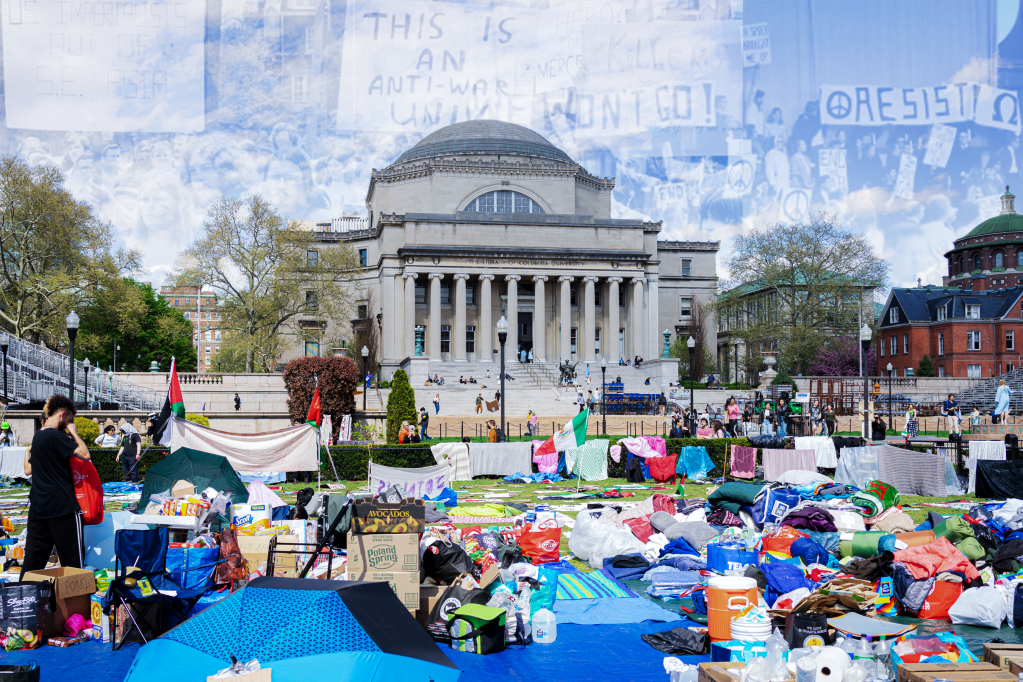
“We felt that it couldn’t be business as usual.”
In April 1968, in the midst of the Vietnam War, that was the mentality Eleanor Stein shared with fellow students at Columbia University. One that rose during encampment protests against the university’s “indefensible participation and complicity” in the war through its financial involvement in weapons research.
Stein, now a law professor at the State University of New York, recalled in a recent interview with NPR the strong feelings of personal responsibility she and her peers felt: “Whatever the risks, whatever the outcomes, we [felt we] should demand the university take action.”
Students were unable to stand by as they saw their country, their university, their tuition money–they themselves–contribute to oppression and mass suffering.
In spring of 2024, our generation of student activists see parallels, and are acting accordingly.

Over the past few weeks, Columbia University students have set up encampments to protest Israel’s ethnic cleansing campaign in Gaza and demand the university divest from corporations with financial ties to Israel, sparking protests across the country and the world.
In established institutions–from California to Texas, Washington to Indiana, from Arizona to New York–students are occupying courtyards and creating encampments. Harvard students are demonstrating along with Ivy league peers at Princeton and UPenn. Students in Ireland, Australia and France are calling for action. Locally, Northwestern, DePaul and the University of Chicago are joining the divestment movement.
Divestment calls have two intentions: putting economic pressure on Israel to reduce military resources used in Gaza’s ethnic cleansing, and distancing students and universities from Israel and corporations that benefit it.
Student protesters have faced strong disciplinary action from university administrations including arrests, evictions from dorms, organizational shut downs and violent police crackdowns.
None of this has stopped their movement and its message. Nor will it stop us from supporting them.
Here at Velocity, we see this publication as a student-led platform to report truth, express views in civil dialogue and hold power accountable. That’s why we support non-violent student protests calling for universities to divest from corporations tied with the Israeli apartheid state.
Student calls to divest, student calls for ceasefire–and students’ rights to speak them–should not be smeared by crackdowns, deplatforming of students or mischaracterization of their message as antisemitism.
Unfortunately, in recent days, we have seen acts of student violence and hate speech among demonstrators. We condemn these, especially those that are antisemitic. However, these acts do not paint the whole picture.
We condemn demonization of the nonviolent student protests as a whole from government bodies, media reports, and especially from university administrations.
This cannot be business as usual.
University administrations are abusing their power. At Columbia, more than 50 students have been suspended and evicted from dorms. Northwestern’s administration suddenly changed its code of conduct, banning tents and temporary structures. Nonviolent student demonstrators have been met with rubber bullets at the University of Texas at Austin and University of California Los Angeles. at UCLA and at the University of Southern Florida, students were tear-gassed.
Many Jewish student demonstrators at Columbia, specifically who are anti-Zionists, have felt hostility from their administration. Jewish student protesters who were arrested and suspended were barred from campus-held religious ceremonies during Passover.
In the wake of protests, Harvard shut down its Palestine Solidarity Committee— with little explanation—for the remainder of the Spring 2024 term. Students who participate in the committee risk permanent expulsion.
These administrations have moved faster to forcibly penalize their students than they have to engage with demands.
The measures are excessive and ineffective, and they go against the values of civil discourse and freedom to assemble universities should be expected to uphold.
As Stein points out in her interview with NPR, “The purpose of a university is the open expression and exchange of ideas…I think once a university gives that up, they are really conceding the fundamental reason for their existence.”
Universities may concede their own ideals as if it’s still business as usual, but their students won’t.
Just as in previous generations, today’s students are here to uphold open expression and exchange of ideas. And force will not shut down students voicing demands for divestment, a ceasefire, an end of apartheid and freedom for Palestine.

Featured image graphic by Emily Stephens
Velocity is written and edited by students of Moraine Valley Community College, and they are solely responsible for its editorial policy and content. Velocity does not represent the views of Moraine Valley Community College or its faculty, staff or administration.



 Velocity
Leave a reply to A new generation of political activists: Engagement among college students on the rise – Velocity Cancel reply