
Jadea Johnson, a standout shooting guard, was ready to commit to another school. Her mind was made up. Then she received a message from Delwyn Jones, head coach of the Moraine Valley women’s basketball team, urging her to just come for a visit.
She went. And by the time she left campus, she had changed her mind. “I told my parents, ‘Yeah, this is the one,’” she said.
What convinced her wasn’t a sales pitch. It was something simpler. Jones had made clear from the start that if another program was better for her, she should go there.
“He always looked out for what was best for me,” she said. “It was always what’s best for us. Not, ‘I’m keeping you here because you’re my leading scorer.’”
That instinct to put the person before the player is the quality of a coach who has built one of the region’s most consistent women’s basketball programs without ever losing sight of why he got into it. Jones, who is also a full-time communications professor and vice president of the Cook County College Teachers Union, just finished his 26th season at Moraine Valley. He will tell you that coaching makes no financial sense. He stays anyway.
This spring, Jones led the Cyclones all the way to the NJCAA DII Women’s Basketball Championship national tournament in Hickory, North Carolina. They lost in the first round March 16 to Cleveland Community College, 55-46.
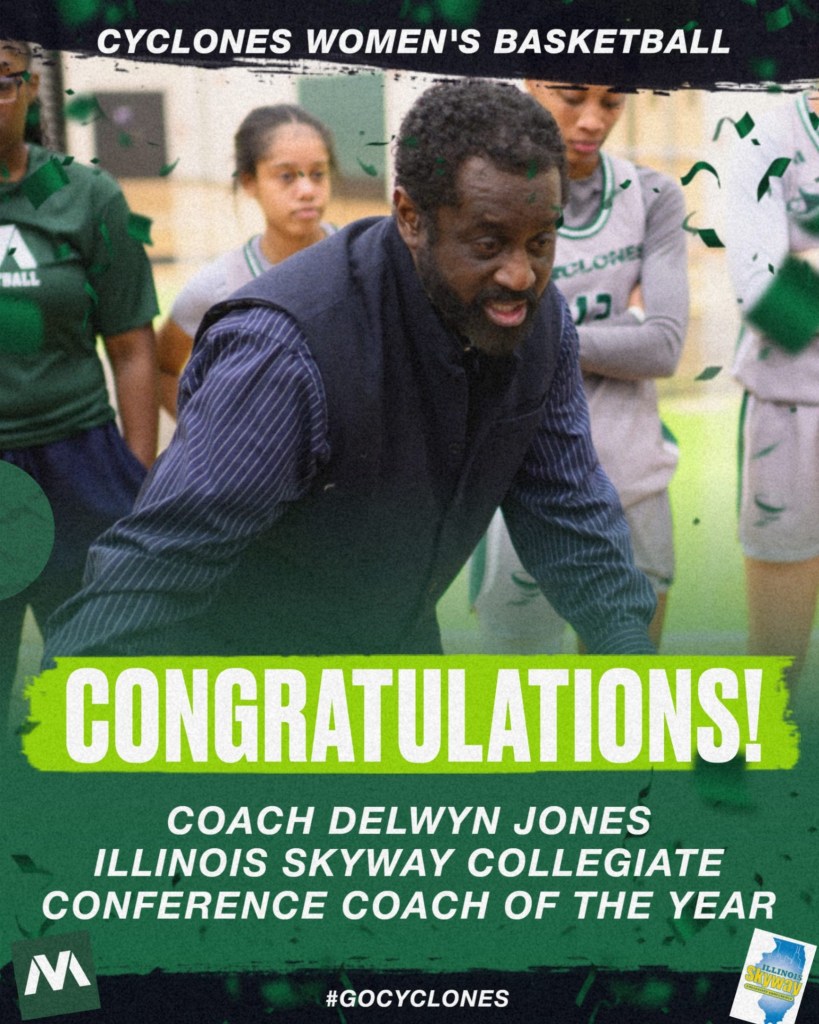
Jones was named Illinois Skyway Conference Coach of the Year, and Johnson was named Skyway Player of the Year.
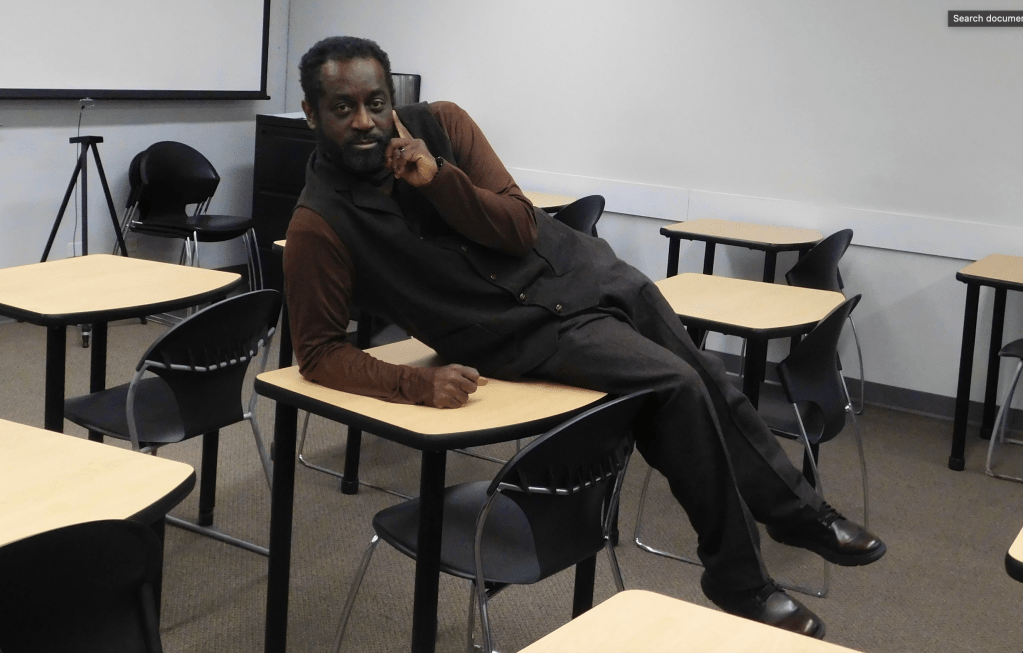
On campus, Jones’ presence is felt in multiple ways. He moves through the halls laid back and unbothered, sharply dressed in one of his many suits, always put together, always vibrant. He’s the kind of presence that fills a room without demanding attention. On his off days, you might catch him in the H building gym, hopping it up as if he were Adam Sandler.
When Jones took over as a co-head coach for the 2000-2001 season along with political science professor Deron Schreck, there was nothing to work with. One returning player who’d never actually played. A whole new roster, and no expectations.
The team went 5-21.
“But we had some good times,” Jones says. “I still talk to some of those players from that first year to this day.”
By the 2003-04 season, the team went 24-9. The program then went on a run of dominance, including four consecutive conference championships, a 13-1 conference record in each of those years, multiple undefeated seasons, and 20-plus win totals.
But the COVID-19 pandemic interrupted everything. Moraine Valley canceled its season while other schools didn’t, leaving Jones to help his players find opportunities somewhere else. When play resumed, those players were gone, and the program dipped for two seasons.
“A lot of new coaches in the region didn’t even recognize us as a winning program until recently,” Jones says. “Now, folks are starting to look at what we’ve done in the past. They’re starting to know we should be good.”
Jones never set out to be a teacher. After he earned his bachelor’s degree, he had a plan, and that was law school. He took his LSAT. He was ready. Then his department offered him a graduate assistantship, enabling him to obtain his master’s degree in exchange for teaching one class. He found himself enjoying teaching.
What followed was a path through academic advising, human resources and a stint as an air craft traffic controller, a job that paid well but left him miserable.
He told himself, “I need to get back into teaching.”
He spent years as an adjunct, teaching part time at Moraine Valley, Chicago State University, Joliet Junior College and Western Illinois University. He sometimes covered four classes across various campuses in a single day, driving between them to make start times. “I put a lot of miles on that car,” he says.
He became a full-time faculty member at Moraine Valley in 2000. His wife, whom he married before she went to law school, is now a supervisor of state administrative judges. He mentions it with a lot of quiet pride and a trace of amusement at how things turned out.
“If I sat down and started adding things up, it was dumb for me to coach, financially,” he says. “But I love doing it.”
Jones talks about basketball the way a teacher would, focusing on the person, not just the skill.
“When I’m recruiting, I’m looking for character,” he says. “I know all kinds of things come up, and you need people who are mature, intelligent, and have high character. To be champions, you need that.”
Sophomore guard/forward Shakila Brownlow values Jones’ approach. What drew her in, she says, was his ability to push without breaking.
“He’s hard on us but in a loving way,” Brownlow said. “He doesn’t go too hard on us where we put ourselves down.” More than that, she feels seen: “He makes me feel like a superstar. He tells me I’m a good player, he knows me, and he has high expectations for me.”
Jones helps his players develop not only as players but as people.
“Basketball is a microcosm for life,” he says. “How you handle basketball is kind of how I’ve noticed folks handle their life outside of it. It’s never going to be all roses. There are going to be times when things don’t go well. Learning how to deal with that, learning how to work through adversity–that builds character.
“I can really look and judge a person by when things are going bad, how they handle it. Everybody can be happy when you’re winning. It’s when things aren’t going well that I see who the person really is.”
This season offered a test. The Cyclones had won 21 consecutive games when they traveled to play Lake County, a team they had beaten by 26 points earlier in the year. They lost. Jones watched them respond.
“They took it seriously. They said, ‘We need to fix certain things, and let’s get better,’” he said. “We haven’t lost since.”
The relationship Jones builds with his players doesn’t just stay in the lines of a basketball court. For Jones, it has become something harder to define.
“He is like another father figure,” Johnson said. “He genuinely cares about us, our injuries, our outside life. I know when I committed here that he had my best interest at heart.”
Jones received that description with characteristic understatement. “That’s a beautiful thing,” he said. “I try to present an atmosphere where they feel good about how things are going here at the college.”
“He makes me feel like a superstar. He tells me I’m a good player, he knows me, and he has high expectations for me.”
Sophomore guard/forward Shakila Brownlow
The same instinct that drives Jones to advocate for his players, the sense that people deserve to be treated fairly, pulled him into union work. Earlier in his career, he had watched colleagues face situations he considered unjust. He joined the union and eventually became vice president of Local 1600, which represents faculty at community colleges across Cook County.
He is careful to distinguish Moraine Valley from the schools where the fights are harder.
“We have the best president,” he says. “We disagree. But we’re still friends. We have a conversation and we work things out.”
At other colleges, he says, that dynamic does not always exist, and that is where his role matters most.
“I’m looking for win-win solutions,” he says. “Just like in my interpersonal communications class.”
Every offseason, Jones asks himself whether he is coming back. He almost resigned after the 2016-17 season, but his eldest daughter told him to keep going. He did. The ongoing joke on campus, he says, is that Coach Jones announces he might resign and then returns the following year.
He acknowledges the toll. Late-night road trips. A commitment that dwarfs his salary. A schedule that would strain most marriages. His wife, he says, has been very understanding. His daughters come to the games.
“If I didn’t have the support, it would be hard,” he says. “I’ve seen a lot of coaches go through marital issues trying to coach.”
A few weeks ago, with a conference title secured and nationals ahead, Jones sent his team a text. He told them they were a group of high character and high academics, with a 3.3 GPA and good souls. He told them they deserved to win.
“I have enough accolades for myself,” he said. “I really truly want the young women on the team to win. I want that for them more than for myself.”



 Velocity
Leave a comment