
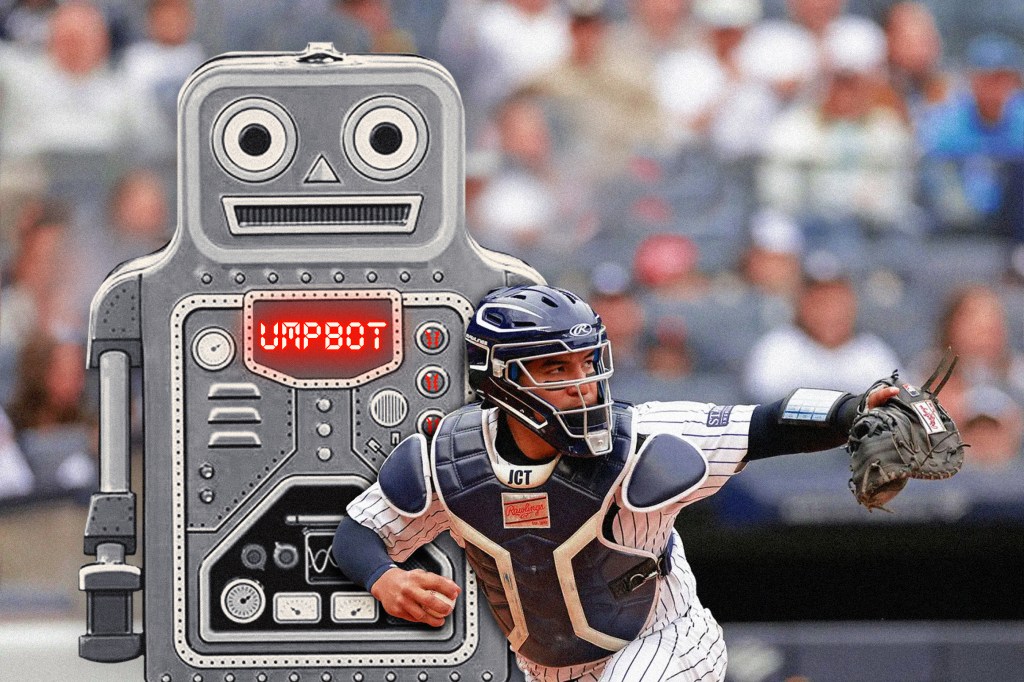
Major League Baseball has survived the steroid era, player strikes, and even notorious team scandals, but the new automated balls and strikes system is going to cause more problems than it solves. It will strip baseball of its authenticity for good.

In 2023, the MLB added a pitch clock. Pitchers had 15 seconds to get set and start their pitching motion. MLB did this to speed up games and prevent minutes from going by in between pitches, which caused games to drag on.
Within the pitch clock’s first year, average MLB game time was 2 hours and 40 minutes, a 24 minute decrease. MLB has adopted the ABS system to make ball and strike calls more accurate. With this system, the batter, pitcher or catcher can appeal the umpire’s ball and strike call.
But this spring, a training game between the Pittsburgh Pirates and Boston Red Sox (in which ABS was implemented) took 3 hours and 29 minutes.
The big question here is: if the MLB wanted to speed the game up, why implement another rule to slow it back down? The new ABS system is exactly what’s going to counteract the pitch clock.
Teams will have two ABS and video replay challenges a game, respectively. Teams can keep and reuse their ABS challenges if successful, but video replays are limited to a maximum of two a game regardless of appeal success.
Although similar to existing challenge systems, ABS differs in frequency and stakes. Instant replay was adopted by MLB in 2014, helping review key plays, close catches in the outfield, fair or foul balls, and plays around the bases to prevent major errors from deciding an inning or game. Replays aren’t used repeatedly, which makes them work. These reviews have helped protect big plays without taking control away from umpires.
But with the new ABS, close calls in the middle of at-bats are being challenged. Egregious calls, understandably, should be reviewed, but the new system seems bound for abuse by pitchers and batters who disagree with marginal umpire calls.
On Feb. 24, the first two innings of that Pirates-Red Sox game saw three ABS challenges. Yes, they were successful, but was the time taken away from the game worth it?
Sure, challenging umpire calls can be beneficial for players, but doing it over and over again? That’s where MLB is going to lose fans. Abusing the ABS system is going to drag games out and bore fans, undermining the pace difference the pitch clock brought.
MLB seems confused as to what they, and their fans, want. Fans complain about umpires and their calls, but is challenging every close call the solution?
Atlanta Braves pitcher and future Hall of Famer Chris Sale told reporters he will “never challenge a pitch,” simply because he “isn’t an umpire.” He makes a good point. As a pitcher, Sale thinks every pitch he throws is a strike, whether it’s down the middle or painted on the corner.
Sale explains how this era’s catchers utilize framing to make any pitch appear to be a strike. Catchers’ ability to move pitches into the strike zone with their glove has always been crucial to teams and coaches seeking out players for the position. Better framing, more strikes.
The best catchers excel at framing (which can be tracked on Baseball Savant), but does the ABS system make framing obsolete? Are poor framers going to be rewarded instead?

Red Sox catcher Matt Thaiss challenged a pitch originally ruled a ball against the Toronto Blue Jays on March 2. He lost the challenge by less than one tenth of an inch. That’s equal to two quarters stacked on top of each other. Is this really what we’re going to spend time disagreeing with umpires on?
The space in between the ball and strike zone in this case is so incredibly small that challenging the umpire doesn’t make sense. At that point, there’s no longer a place for umpires if something the human eye cannot see will be challenged and overturned.
Even though this system is going to accurately depict balls and strikes, no matter how close or far from the strike zone, what it’s removing from the game is, quite simply, not worth it. Sooner or later, the sport is going to be so heavily reliant on technology that there will be no more authenticity.



 Velocity
Leave a comment