
By JONAH marshall, JRN 111 student
When the United States removed Venezuelan leader Nicolás Maduro last month, it was with help from Moraine Valley students’ tax dollars.
“Our tax dollars pay for this,” said political science professor Kevin Navratil. “U.S. service personnel were in harm’s way, could have been killed, could have been captured, could have been held hostage.”
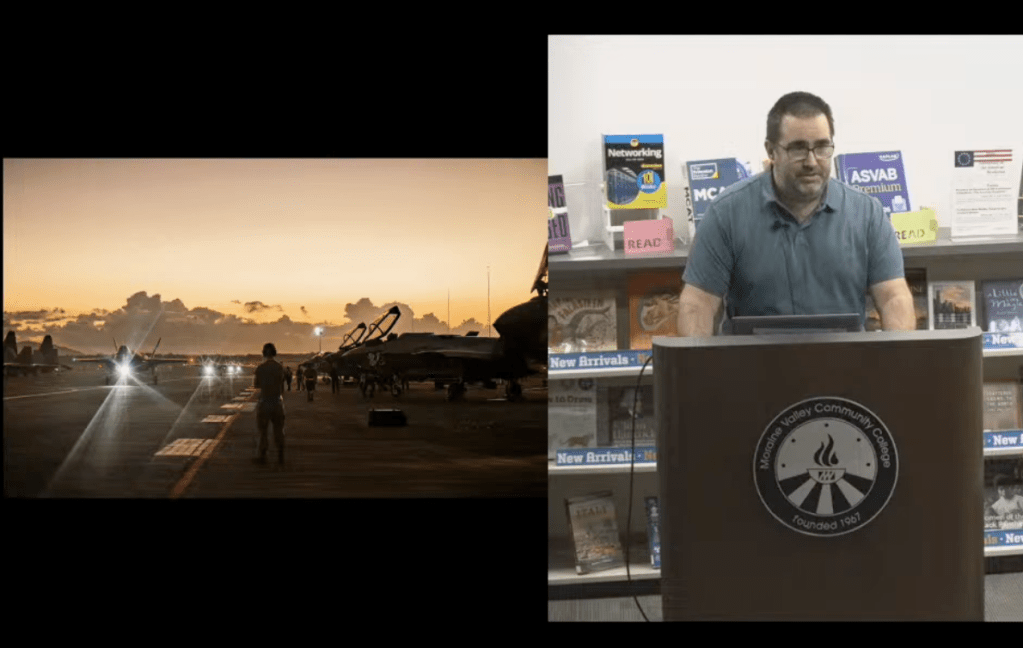
The implications of the U.S. incursion into Venezuela are not fully understood by most Americans. That’s why the Democracy Commitment program, led by Navratil, held a talk in the Moraine Valley library on Feb. 5 to discuss some of the historical, economic and political roots of the Venezuelan conflict. The event featured geography professor Jason King.
The event was live-streamed and recorded for the library’s YouTube channel. In attendance in person were about 20 students who were able to learn how the operation was handled, its effects and its impact on students directly. It was eye-opening for some, including Jahneisha Simmons, a freshman culinary arts major.
“It does concern me, if I’m paying this much and I’m filing taxes,” said Simmons. “I want my tax dollars to go to health care and children, and for a good cause. I don’t want it to go towards anything bad.”
On Jan. 3, the Department of Defense launched Operation Absolute Resolve after planting someone high up in the Venezuelan Government to act as a spy. For months, the person would monitor Maduro’s daily activity and map out where he went every day, gaining echo-location of each room he went in.
“The past 80-year structure of the international system is really being ruptured. It’s kind of back to the law of the jungle where the strong do as they will and the weak suffer as they must.”
Kevin Navratil, political science professor
The capture of Maduro involved 150 aircraft used to carry out large-scale strikes on multiple targets in Caracas, the capital of Venezuela.
Maduro rose to power after the death of Hugo Chavez in 2013. Under Maduro, corruption has flourished.
“Venezuela has used corruption. It has used drugs. But the other thing that happened was its people were asked to make tremendous sacrifices,” King said.
Venezuela is known as a petrostate, a country dependent on oil for its economy. King showed two graphs, one representing Venezuela’s GDP and the other showing the price of crude oil. The two graphs were very similar.
“The economy of Venezuela is almost entirely predicted by the price of oil,” King said. “When the price of oil is high, Venezuela does very well. When the price of oil is low, Venezuela does very low.”
Venezuela is the 6th highest producer of oil, but the price of oil has been decreasing, and Venezuela’s economy rarely has inflation below 7 or 8 percent.
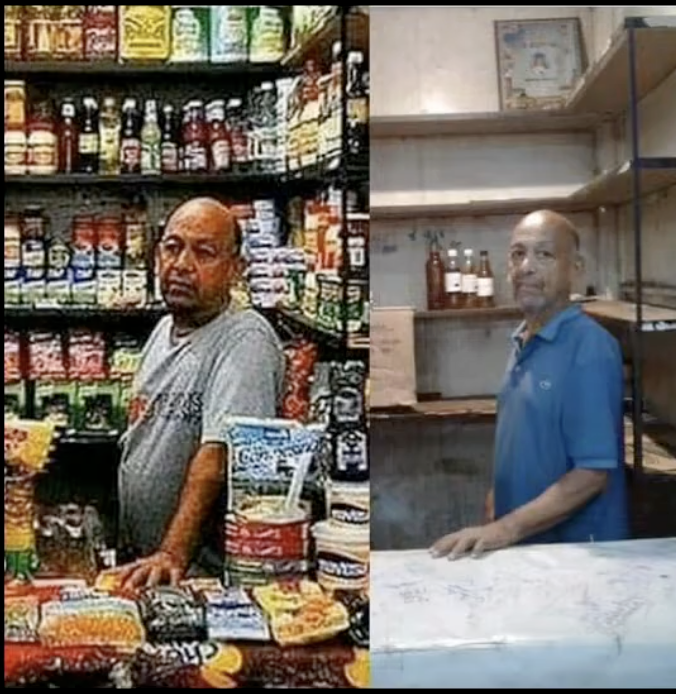
These economic conditions made way for the “Maduro diet.” King showed before and after pictures of a Venezuelan vendor.
“You can see that the wares have changed somewhat, but also you can see just the fact that he’s lost so much weight,” he said.
The “diet” meant that 75 percent of the people in Venezuela lost 20 pounds or more.
The unstable economy forced roughly 20 percent of the population to leave the country.
King’s presentation laid out both positives and negatives to the raid.
Positives are that no U.S. service members died, the stock market did well after the raid, and about 90 percent of Venezuelan citizens were happy to see Maduro’s capture.
However, negatives of the incursion go beyond the cost to U.S. taxpayers, as some of its goals appear to be going unmet.
President Trump said the raid was going to help the oil companies gain back money they lost in the 70s and 90s, but oil companies have other ideas, King said.
“Oil companies in general look at Venezuela and despite the fact that there is so much oil and so much natural resources, they seem to not be very interested in the concept of going back,” King said.
Restoring Venezuela’s oil infrastructure would cost billions of dollars, and low oil prices are making the companies question the investment.
Russia, also a petrostate, is also facing turmoil as the price of oil decreases. King said it’s believed Russia’s invasion of Ukraine has led to almost a million casualties. These factors have stalled Russia’s GDP growth, and it is expected to go into the negatives. Alliances with countries such as Kazakhstan, Armenia, Azerbaijan and Iran are also faltering.
“We may very well be witnessing the death of Russia as a world power,” King said. “I don’t think that it’s going too far to suggest that in the very near future, Russia will be a client state of China.”
The structure of the international system is changing, Navratil said.
“I think it’s just worth pointing out that in the last several weeks or months there’s been bombings by the United States in seven different countries,” he said. “The past 80-year structure of the international system is really being ruptured. It’s kind of back to the law of the jungle where the strong do as they will and the weak suffer as they must.”
Operation Absolute Resolve was not the first time the United States has removed a leader in the name of U.S. foreign policy, King said.
In 1983, Operation Urgent Fury was done in the name of deposing what America believed to be a Marxist organization in Grenada. In 1989, Operation Just Cause was done to depose Manuel Noriega, who allegedly ran drugs to and from Panama. And in 1994, Operation Uphold Democracy was done to remove Jean Bertrand Aristide from Haiti.
King explained that the Monroe Doctrine and America’s desire for a special relationship with other countries in the Western Hemisphere helps explain the U.S. history of invading countries with leaders that were believed to be a problem.
“This has been one of the ways that America has attempted to further its interests is not so much by gaining colonies, like Britain did or France did, but as far as making sure regimes in the Western Hemisphere are friendly to the U.S,” he said.
King raised concerns that the U.S. operation in Venezuela could send a message to other countries influencing them to try similar tactics, or lead the U.S. to think it could potentially do the same to any other world leader.
But, he said, “That doesn’t mean the next one will be successful. And sometimes hubris is a very dangerous thing.”
JRN 111 students Cela Brown, Keyairra Coleman, Eric Corriere, America Ginez, Briana Gomez, Ahmad Hadad, Jean Jungles and Melanie Velasquez contributed to this report.


 Velocity
Leave a comment