
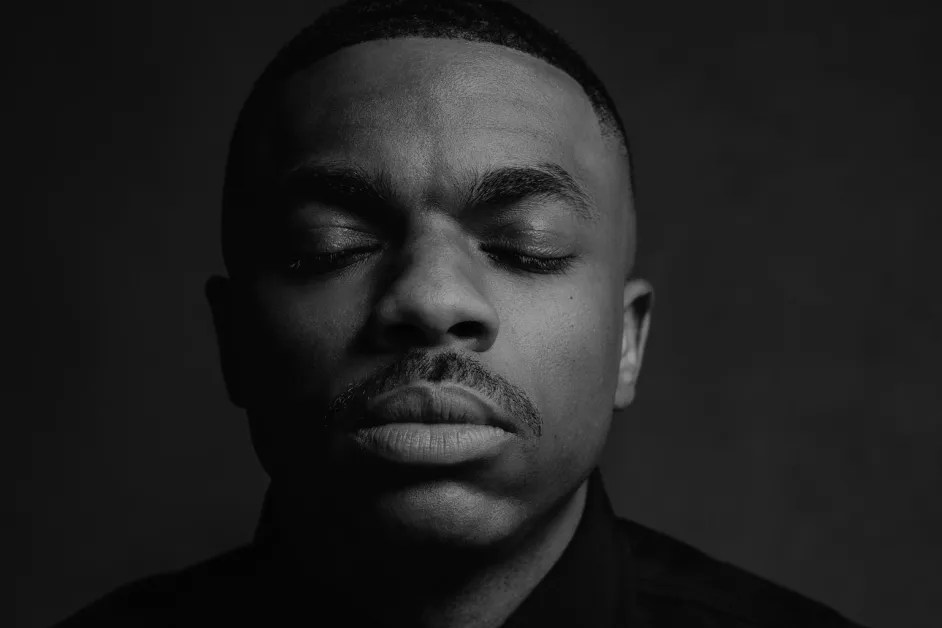
By DEYVION NICHOLS, JRN 101 STUDENT
There’s a peculiar loneliness that comes after you’ve “made it out” —the kind that doesn’t announce itself with chaos, but with silence.

On Dark Times, Vince Staples explores that silence with brutal clarity, tracing how success can estrange us from lovers, friends and even our own “come-up.” Rather than offering triumph or closure, the 2024 album lingers in emotional aftermath, portraying survival as something that leaves scars long after the dangers have ceased.
Released with little spectacle, Dark Times stands as what I believe to be Staples’ most restrained and introspective project to date. For readers unfamiliar with him, Vince Staples is an artist, actor and storyteller long-known for sharp observations of systemic violence and gang culture that are often delivered with a detached, almost journalistic tone.
Growing up in Long Beach, California, Staples was surrounded by gang culture from a young age—an environment that shaped his music and perspective. On Dark Times, Vince turns that detachment inward, trading aggression for reflection.

The focus shifts away from external threats and toward the emotional wreckage left behind by loss, failed relationships and the isolating consequences of being the “successful one.”
At its core, Dark Times argues that escaping the circumstances of your upbringing does not guarantee peace. Staples frames love not as comfort, but as absence—people who are gone, relationships that collapsed under pressure, and friendships warped by distance and resentment.
Throughout the project, love feels less like something to hold onto and more like something that slipped away long ago. This perspective gives the album its heavy, resigned mood: one that resists easy resolution.
That sense of emotional distance is immediately apparent on track two, “Black&Blue.” When Staples raps, “Jugglin’, thuggin’, depression, and pride,” he collapses survival into a single, uneasy balancing act. The line captures the album’s refusal to glorify escape. Success does not erase the weight of where he comes from; it merely forces him to carry it differently.
The title itself reflects that tension: “black” serves as a marker of pride and identity, and “blue” as an acknowledgment of depression that lingers beneath it. Over the song’s subdued, melancholic production, Staples sounds as if he is caught between honoring his resilience and admitting the emotional cost of it. Escape here is not triumphant; it is complicated, heavy and emotionally unresolved, reinforcing the album’s broader suggestion that making it out often means learning how to live with contradictions rather than leaving them behind.
Grief on Dark Times often surfaces through emotional numbness rather than mourning, most strikingly on track six, “Étouffée.” When Staples states, “I don’t need your flowers, I’m livin’,” the line reads less like bravado and more like exhaustion. Praise and congratulations ring hollow when survival itself has come at the cost of so many friends who never made it out. Staples frames success as something he is expected to celebrate, even as grief dulls his ability to feel pride in it.
That emotional disconnect resonated with me deeply as someone familiar with the particular guilt that comes with continuing forward—chasing achievement not out of joy, but obligation—especially when others are no longer here to share in it. On “Étouffée,” Staples captures that suffocating pressure perfectly, revealing how being alive can feel less like a victory and more like a responsibility you’re unsure how to carry.
Success itself becomes a source of tension rather than relief. On track five, “Shame On The Devil,” Staples explores how his upward trajectory has created emotional distance between him and the people he grew up with. He alludes to strained friendships and unspoken resentment, suggesting that success can feel like betrayal to those left behind.
What makes this reflection especially compelling is Staples’ refusal to place blame neatly. He doesn’t villainize old friends, nor does he fully absolve himself; instead, he presents alienation as an unavoidable consequence of his survival.
Romantic relationships fare no better under this emotional weight. On track nine, “Radio,” Staples reflects on intimacy strained by mistrust and emotional unavailability. His delivery is deliberately flat, pulling the listener in alongside layered Marvin Gaye samples that cast a bleak, gray atmosphere over the track.
Staples’ lyrics make love feel distant—almost clinical—as if he has grown tired of hoping things will work out differently. For these reasons, “Radio” stands out as my favorite song on the project.
Much of Dark Times’ power lies in its production. The beats are muted and stripped of excess with hazy synths, restrained drums and looping melodies that rarely resolve. This mirrors the emotional numbness Staples describes, but it also creates a sense of comfort that borders on entrapment. The album’s minimalism forces listeners to sit with the lyrics, deepening its themes of emotional fatigue and disconnection.
What makes Dark Times so affecting is its refusal to treat emotional distance as failure. Dark Times is Vince Staples’ most emotionally honest album—not because it offers healing, but because it refuses to pretend healing is guaranteed. Many of us are navigating grief, ambition, and the guilt of being left—or leaving others—behind. The album offers recognition rather than resolution.
Staples never promises healing; he documents the damage honestly, allowing listeners to feel less alone in carrying it. Ultimately, Dark Times is not an album about healing—it is about endurance. Staples positions himself as an observer of his own life, reporting on loss and disconnection without requesting sympathy.
For listeners expecting catharsis or celebration, Dark Times may feel uncomfortable. But for those willing to confront the quieter costs of survival, it offers a sobering and deeply introspective reflection on what it really means to “make it out.”
Dark Times is available on all major streaming platforms, including Spotify and Apple Music.




 Velocity
Leave a comment