Sixty years on, ‘Blonde on Blonde’ proves Bob Dylan’s influence
Sixty years later, the effects of Bob Dylan’s ‘Blonde on Blonde’ studio album can still be felt in today’s music and pop culture. Dylan is still touring, coming to the Chicago area at the end of March.
As Bob Dylan’s trailblazing album Blonde on Blonde turns 60 in June, it still proves to be one of the most influential pieces ever made, and its effects are still felt in pop culture today.
Dylan himself, still touring at 84 years old, continues to blaze trails across America. You can catch him at the Coronado Performing Arts Center in Rockford on March 28, or the Genessee Theater in Waukegan on March 30.
Blonde on Blonde capped off a trilogy of records beginning with Bringing It All Back Home in March 22, 1965, followed by Highway 61 Revisited on Aug. 30 that same year. These three albums are widely considered some of the greatest of all time, highly influential in both the industry and pop culture as a whole, influencing things like the modern pop song, the double album, and compositions over five minutes.
Dylan’s lyrics prior to the trilogy were more socially conscious and politically charged, detailing stories of his adventures through Americana. Now, that might sound strange on the surface level, but the storytelling was straightforward. Dylan detailed surrealist and unorthodox tales with an underbelly that, when poked with a yardstick, revealed the 50 facets of America, its people and its culture.
“Johnny’s in the basement, mixin’ up the medicine / I’m on the pavement, thinkin’ about the government.”
Subterranean Homesick Blues
The first thing people note about Bob Dylan’s music is his nasally drawl, and many have said he is “not a good singer.” His style of singing, however, works for the kind of music he performs. A frontrunner of the early ’60s New York folk scene, Dylan forces the listener to pay attention to what he is saying.
One of the things Dylan brought over from his days as a folk artist was more political lyricism. However, while he initially made up stories about the things going on in the American political climate with the Cold War and the threat of World War III, the songs on Blonde detail the feeling of anger and disillusionment of living in a post-World War II America at the cusp of the American counterculture and the Civil Rights movement.
Tracks like “Subterranean Homesick Blues,” “Maggie’s Farm,” and “Stuck Inside of Mobile with the Memphis Blues Again” all express Dylan’s lack of understanding of the current state of affairs, providing a caricature that’s strange, alluring and confusing to navigate. The Beatles followed suit in 1966 with “Taxman,” the opening track to their album Revolver, and many other rock bands went on to write more politically conscious songs, especially with the advent of the Vietnam War.
Its influence can still be felt today with modern indie acts like Fleet Foxes, The Crane Wives, and Mumford and Sons.
Another type of song morphed by Dylan’s new sense of poeticism was the love song. Hit singles prior to Dylan’s arrival were straightforward crooners spelling out the who, why and how of loving someone. Dylan was more focused on the unconscious feeling that love entailed, the kind of thing that could only be described with a metaphor.
Songs such as “She Belongs to Me,” “Queen Jane Approximately,” “Love Minus Zero/No Limit,” and “I Want You” capture the feeling of true love, something that Dylan’s contemporaries would try to match following the trilogy.
“My love she speaks like silence / Without ideals or violence / She doesn’t have to say she’s faithful / Yet she’s true, like ice, like fire.”
Love Minus Zero/No Limit
However, the type of song Dylan defined was the opposite of a love song. He wrote songs of repented love and dissatisfied scorn directed toward not just past relationships, but friends and people he generally disliked. But what made most of these songs work was that they didn’t mention anyone specific; they were completely up to the listener’s interpretation. They could even be applied to a person you hated.
Songs like “Leopard Skin Pill-Box Hat,” “Ballad of a Thin Man,” and “Like a Rolling Stone” all have this thick smog of disdain hovering over them, causing ecological disasters in the radios and record players of millions of people.
“How does it feel? / How does it feel? / To be on your own / With no direction home / A complete unknown / Like a rolling stone?”
Like a Rolling Stone
And on that note, Highway 61 Revisited’s lead single “Like a Rolling Stone” is notable for its financial successes. Prior to its release on July 20, 1965, songs were simplistic: two to three minutes about the most bare-bone topics. Dylan’s record label, Columbia, did not want to release it at the time due to its six minute runtime, raucous sound and thought provoking, cutthroat lyrics. Nevertheless, an acetate copy leaked, and demand rose until Columbia relented. The song reached number two on the US Billboard Hot 100 charts.
“The first time I heard Bob Dylan, I was in the car with my mother listening to WMCA, and on came that snare shot that sounded like somebody’d kicked open the door to your mind. […] The way that Elvis freed your body, Dylan freed your mind, and showed us that because the music was physical did not mean it was anti-intellect. […] He invented a new way a pop singer could sound, broke through the limitations of what a recording could achieve, and he changed the face of rock’n’roll forever and ever.”
–Bruce Springsteen’s induction speech for Bob Dylan, presented at the Rock and Roll Hall of Fame, 1988. His recent single “Streets of Minneapolis” has been compared to Dylan’s protest songs.
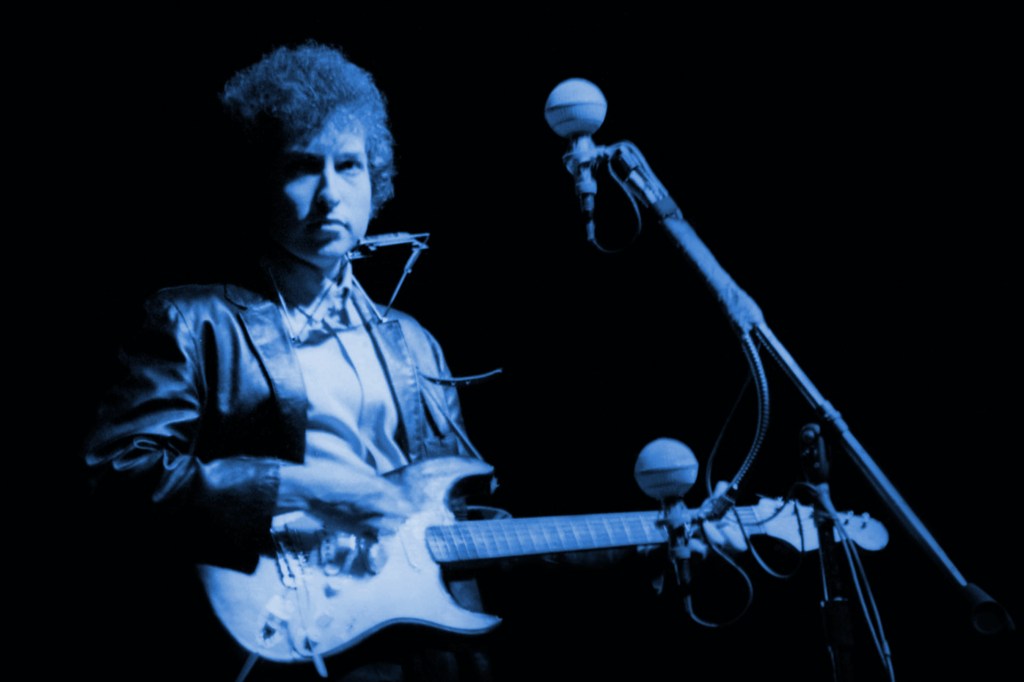
The raucous sound that Columbia was referring to was the fact that this trilogy was the first time Dylan used electric instrumentation in his songs. This sudden change inspired by The Beatles was met with considerable push back from people in the folk scene that he came from, thinking that he “betrayed them,” though it was quite the contrary.
Dylan’s use of instruments like the electric guitar, bass guitar and Hammond organ, in addition to using his folk sensibilities in a rock setting, gave rise to the genre known as folk rock, a genre that many would grow to accept with open arms. Trend-following adolescents known as “teenyboppers” would start to think for themselves as the more mature folk purists learned to have fun with their music.
“He invented a new way a pop singer could sound, broke through the limitations of what a recording could achieve, and he changed the face of rock’n’roll forever and ever.”
Bruce Springsteen
The rapid success of the genre gave way to artists like The Byrds, Jefferson Airplane, and the Lovin’ Spoonful. Its influence could still be felt today with modern indie acts like Fleet Foxes, The Crane Wives, and Mumford and Sons. Dylan would continue to expand the folk rock sound by incorporating more blues and country elements into his albums, inspiring people like Johnny Cash, Willie Nelson, Waylon Jennings, and The Band.
Another notable thing about the single’s success was, as previously mentioned, the six-minute runtime. Columbia records originally wanted to split it in half or edit it down but the demand for the full version was big enough for them to relent. It wasn’t the first or last time Dylan would play around with runtime. His most surreal and strange songs were all bordering on runtimes well over what “Like a Rolling Stone” was.
“They’re selling postcards of the hanging / They’re painting the passports brown / The beauty parlor is filled with sailors / The circus is in town.”
Desolation Row
The two most noticeable songs of extreme length (for the time) were the acoustic “Desolation Row” and the electric “Sad Eyed Lady of the Lowlands,” each sitting at just over 11 minutes. The songs function as poetic odysseys through two different planes of existence, one of grime and one of longing.
“It is like Beowulf…This song can make you leave home, work on the railroad … I think of a drifter around a fire with a tin cup under a bridge remembering a woman’s hair. The song is a dream, a riddle and a prayer.”
–Tom Waits on “Sad Eyed Lady of the Lowlands,” 1991
“[It] changed my life … When I heard that, I thought, ‘If Bob can do it, I can do it’ … it’s a whole album side! And it in no way gets dull or boring. It becomes more and more hypnotic.”
–Roger Waters on “Sad Eyed Lady of the Lowlands,” 2012
The runtimes of the albums they came from always hovered somewhere near 50 minutes, but Blonde on Blonde was 73 minutes in length. Nowadays it’s commonplace for artists to release two vinyl discs worth of material (sometimes two CDs as well), but Blonde on Blonde was the first major double album in rock music, because Dylan needed two discs to cover how fruitful the sessions were. This album set the stage for many artists to follow, most of them releasing double albums at the peaks of their careers: The Beatles’ White Album, The Rolling Stones’ Exile on Main St., Led Zeppelin’s Physical Graffiti, and Pink Floyd’s The Wall.
“Sad-eyed lady of the lowlands / Where the sad-eyed prophets say that no man comes / My warehouse eyes, my Arabian drums / Should I leave them by your gate? / Or, sad-eyed lady, should I wait?”
“Sad Eyed Lady of the Lowlands”
Despite his age, Bob Dylan continues to record and tour, even as the current state of America burns to the ground. He is a poet, a singer, a musician, and most importantly, a man raised on the traditions of folk with the rebellion of rock’n’roll.
His lyrics and style of music continue to amaze and confound listeners and musicians to the present day and beyond. His vivid imagery combined with his interplay with the session musicians behind him make these three works a continuing staple in the hearts of any music fan for all time.
“Strike another match, go start anew / And it’s all over now, Baby Blue.”



 Velocity
Leave a comment