
Binging Netflix is more convenient than a night out at the theatre watching a movie. A few clicks on Depop is more convenient than a trip to the thrift store. Doordash is more convenient than a drive to Wendy’s.
The outside world is losing its appeal.
Third spaces (otherwise known as third places), defined as “informal spots to gather outside of work and home for socializing,” are becoming increasingly inaccessible.
Between the slow death of mall culture, the rising prices of cafés and the preference for streaming services and online shopping, simply going out with friends is losing its potency as an antidote to the loneliness epidemic.

Third spaces’ decreased appeal especially hit young adults. They’re being priced out of many museums, concerts and festivals. Libraries, one of the most popular examples of third spaces, often target their events towards children or seniors. Places of worship cause apprehension in those who worry they may not be welcomed.
Suggest a hangout like walking around Target, getting food at a restaurant or playing at an arcade, and you’re met with the exasperation that they all require money. When’s the last time you went out with friends and didn’t spend anything?
Mental exhaustion from the never-ending horrible news that comes with scrolling and the stress of work seeping into everyday life is leaving more and more people willing to trade community for convenience.
During COVID lockdowns, fun, work and school were all virtually confined, making the convenience of this system appealing, even with the world’s progress towards a new normal.
It’s nice to be around like-minded people and indulge in creative pursuits, but barriers like cost, distance or lack of skill prevent many people from partaking.
Social media has become an enticing alternative to physical third spaces, offering infinite cost-free opportunities we can access from the comfort of our beds. Many people substitute potential face-to-face interactions with a text or phone call to a friend, messages and comments to strangers or endless scrolling.
Chatroom video games like VRChat and Webfishing are even praised as “online third-space simulators.” These exchanges for interaction with digital spaces over real-world ones extend far beyond sites where people simply chat with one another.
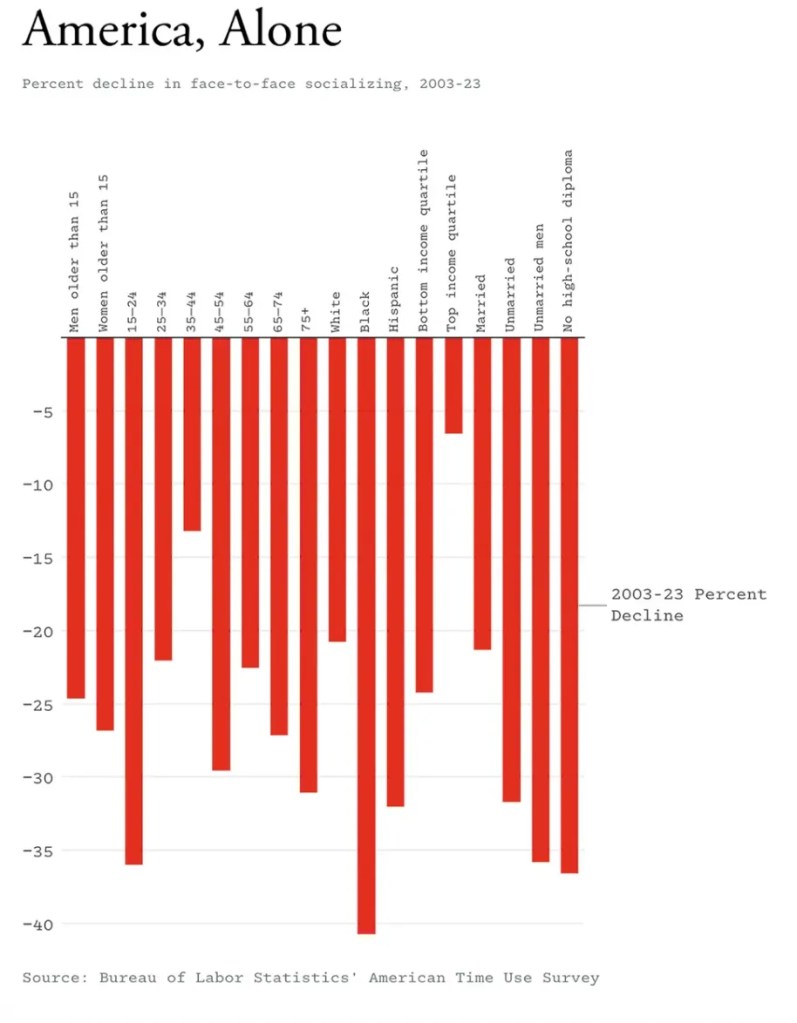

Not only are we going out with friends less often, but we’re increasingly missing out on crucial opportunities for small talk with cashiers or fellow shoppers.
Less positive interactions with strangers can be linked to their rarity. Since 2020, we are still spending more time at home and alone than we have in any other period on record. When people do go out, they often avoid conversation with strangers, reinforcing their sense of isolation.
In an interview with a social psychologist, journalist Derek Thompson states: “It seems to me like that biological instinct to cure our solitude with other people is being overridden in the age of ample entertainment, and especially phone-based entertainment. Loneliness is the wrong word there. It’s a phenomenon of solitude and highly sought solitude rather than a crisis of people feeling lonely and wanting to be around other people all the time.”
Thompson also cites the words of University of Chicago psychologist Nick Epley: “A fundamental paradox at the core of human life is that we are highly social and made better in every way by being around people. And yet over and over, we have opportunities to connect that we don’t take, or even actively reject, and it is a terrible mistake.”
Thompson goes on to explain that Epley conducted an experiment on train commuters in which some participants were instructed to keep to themselves and others were instructed to talk to a stranger. The participants then filled out a questionnaire on their feelings after the experience of the commute, and the latter group reported significantly more positive feelings.

The impact on our social life by recommending our favorite Alani to a stranger in the sports drink aisle far outweighs almost any dead-end conversation on Tinder, argument on Twitter or hour of scrolling through even the most relatable TikToks.
Hobbies, which are frequently seen as one of the only ways to make connections, have been heavily commodified. But combating solitude and isolation shouldn’t require signing up for a $150 pottery class.
While doing something new is one of the best ways to build connections and confidence, it often doesn’t feel feasible. It’s nice to be around like-minded people and indulge in creative pursuits, but barriers like cost, distance or lack of skill prevent many people from partaking.
The solution can start with small steps branching off the things we already do day to day. We can talk to our coworkers or regulars at work, our classmates or instructors at school, or just somebody walking down the same street.
Compliment someone’s hat, muse about the weather with them, or ask them what they’re reading. Small talk sounds boring in theory, but it reminds us we are all real human beings with passions experiencing life together.
When we have the resources, maybe we can take that pottery class, go to that concert or browse at that museum, but we have to remember that the hope for not being alone isn’t lost in the meantime. Beautiful experiences with humanity can be around any corner if we only care to look for them.




 Velocity
Leave a comment