
By alexa pilkington, jrn 111 student
There’s a certain fatigue that comes with showing up to campus every day. Moraine Valley student Abigail Winter knows it well. Between long days and dwindling motivation, she decided to make a change. Next semester, she’ll trade her classroom for a laptop screen and take almost all online classes in the hope that learning online will provide the freedom she’s been missing.
College students across the country are making a similar move. As NPR reports, for the first time in U.S. history, more college students are taking their classes entirely online than entirely in person.
Although Moraine Valley doesn’t completely reflect this shift, online enrollment has grown steadily in recent years, according to Sadya Khan, the college’s executive director of institutional research, planning and effectiveness.
Now, more than a quarter of the credit hours taken at Moraine Valley are online–a huge jump from just a few years ago. From 2017 to 2025, the percentage of all credit hours taken online jumped from 9.1 percent to 27.7 percent.
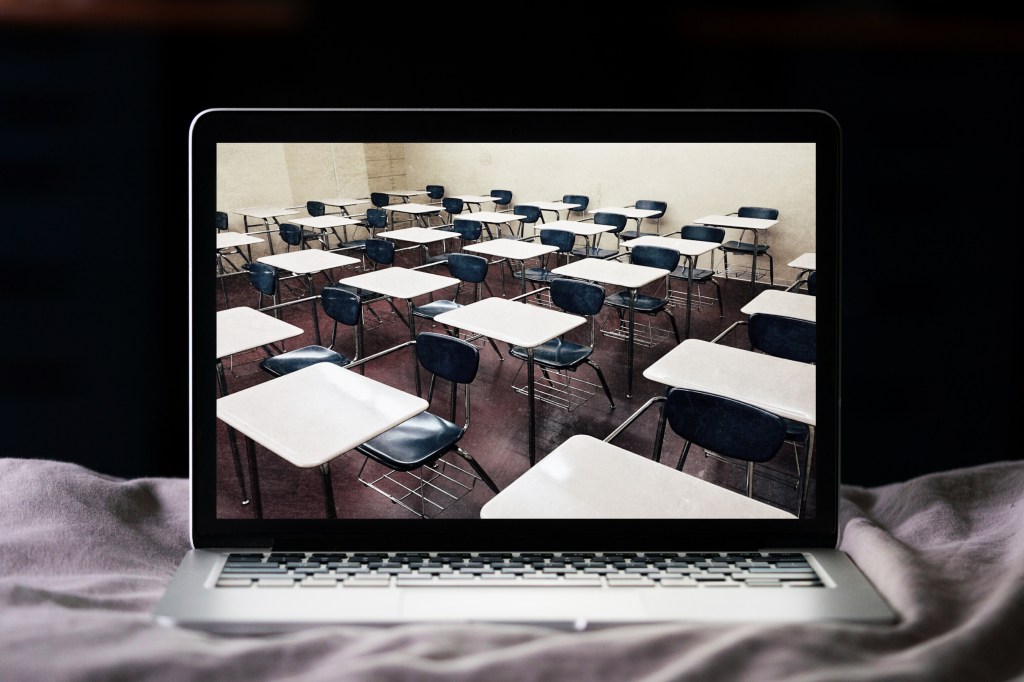
As more students trade classrooms for computer screens, faculty and students are weighing the benefits of convenience against the risk of reduced academic performance.
Students who take only traditional classes are 15.8 percent more likely to earn an associate’s degree compared to students enrolled only in online courses.
Source: University of Florida study
Since online learning gives students complete control over their schedules, many find it appealing.
“I’m making the switch because it’s more convenient and you can do schoolwork whenever,” Winter says. “You have more free time.”
Sophomore Annabelle Rush also appreciates the flexibility provided by online courses: “Everything is more open to your own time. A lot of my online classes are set out really nicely, so you know exactly what you have to do that week.”
The benefits of remote learning are apparent to professors as well.
“Learning completely online has changed how many students study,” psychology professor Julia Whalen-Musil said. “Online classes let students learn from anywhere and often at their own pace. This can be very helpful for students who have jobs or other responsibilities.”
Moraine Valley offers resources to make online learning even more convenient. The library “provides live chat and text message support in addition to email and phone support” for online students, according to the website. The college also offers a free online student success orientation through which students can learn more about “the expectations and strategies of a successful online student.”
More than 100 completely online programs are available at Moraine Valley, meaning you can earn a certificate or degree without ever setting foot on campus. The list includes a wide range of programs–from baking and pastry to criminal justice, from electric vehicle service and repair to small business management.
However, online learning also has its drawbacks, students and professors say.
“Some students find it hard to stay focused or keep up without a teacher or classmates in the same room,” Whalen-Musil said. And “spending so much time on a computer can make students tired or stressed, which can hurt their grades.”

Engagement and participation often declines in online classes, according to communications professor Eric DeVillez.
“It’s easier in that realm to not fully engage,” he notes.
In fact, about half of the students in DeVillez’s online classes drop by the end of the semester, compared to only a few students in his in-person classes.
Studies show that this trend extends beyond Moraine Valley. Taking an online class “reduces the probability of earning an A or higher by 12.2 percentage points [and] a B or higher by 13.5 points,” according to the journal American Economic Review.
Students taking in-person classes tend to perform better on exams than students in online classes—often significantly, according to a study published by the National Library of Medicine.
“If I do online, I think I would get lazy,” admits Cristal Amaro, a radiology major at Moraine Valley.
The maturity and self-discipline students develop through in-person classes are essential to becoming a successful online student, DeVillez argues: “If you come into school and you’ve never had face-to-face classes in a college setting with good instructors, I don’t think you’re set up to even remotely understand how to succeed in an online class.”
Moraine Valley student Trinity Wanda, who is taking only online classes, agrees that it may be a better idea to gain face-to-face experience first rather than jumping straight into exclusively online learning.
“Just ease into it,” Wanda recommends. “Start with one or two online classes. And still set aside time during the day for schoolwork.”
Evidence shows on-campus classes lead students to success. Students who take only traditional classes are 15.8 percent more likely to earn an associate’s degree compared to students enrolled only in online courses, according to a study conducted by the University of Florida.
Some of the advantages of face-to-face classes can’t be replicated online.
“I like the hands-on stuff in in-person classes,” says Rush. “Like the labs in [chemistry] class. And you get to meet people too.”
Amaro also finds the social interaction helpful: “In-person classes motivate me to get out of bed, get out of the house. I can meet new friends and talk to the professor.”
“I think if you want real learning, real human connection, I would recommend either face-to-face or hybrid.”
Communications professor Eric DeVillez
Professors also notice the difference that social interaction makes in students’ academic journeys. When students from his online classes visit him during office hours, DeVillez often finds that “just a few minutes of conversation changes the way they approach the class.”
Still, not every student finds comfort in the atmosphere of traditional classrooms.
“If you go in-person, you have to be sociable and raise your hand when no one else does,” Gabriel Yungaicela points out. “Not everybody wants to do that.”
Mustering the energy to commute to campus day after day can also be physically and mentally draining. In Winter’s experience, “going to school everyday gets very exhausting.”
“Sometimes, I’m so tired when I come in,” she said. “I lack motivation and don’t want to be here.”
When choosing their learning format, DeVillez advises students to seek balance: “I think online classes are a wonderful means to an end to get something done. And sometimes life serves us that. You have to, in a pinch, get something done on time. But I think if you want real learning, real human connection, I would recommend either face-to-face or hybrid.”
That balance often depends on the individual student. Online classes give students more flexibility but also require strong self-discipline, Whalen-Musil says.
“How well students do in online classes depends on how they manage their time, stay motivated, and get support from teachers.”




 Velocity
Leave a comment