
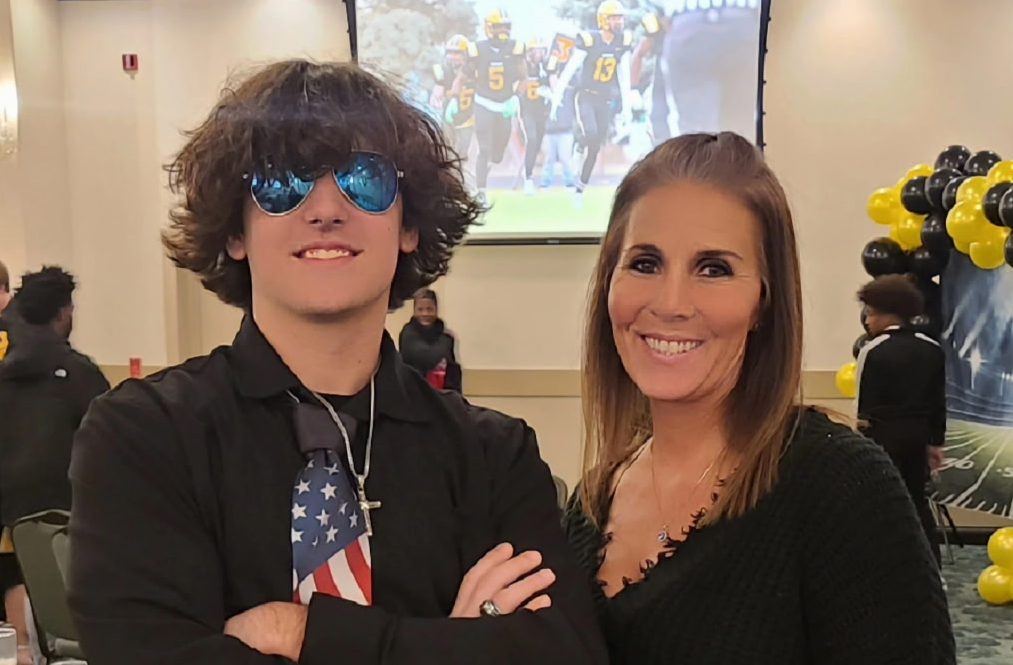
By Alexa Pilkington, JRN 111 Student
Angela Mateja went from flexing on stage to relearning how to make the most basic of movements. Eight years ago, Mateja’s life was irrevocably changed after she received a devastating diagnosis.
She went from competing in fitness shows to being paralyzed. “Nobody knew what was going on,” she says.
After a visit to her doctor, Mateja discovered that she had multiple sclerosis, an autoimmune disease in which the immune system attacks the protective myelin sheaths around the axons of neurons, impairing the neurons’ ability to send and receive electrical signals. Essentially, her body began attacking its own nerves, making it harder for the brain to send signals to the rest of the body.
The illness left her numb from her tongue to her toes, with several lesions on her brain and spinal cord, burdening her with crippling symptoms such as difficulty breathing, vision problems, coordination issues and loss of balance.
Mateja describes her daily battle with multiple sclerosis as “being tired and having to move through a bowl full of Jello.”
Each night she tosses and turns, unable to find relief. “It feels like there are nails that come up from my feet to my thighs,” she said. Sleep became near impossible. Even blinking became exhausting.
“I do feel like an inspiration to others because people watch me struggle and I still keep going. But I don’t want to inspire people to be like me; I would like to motivate them to do better than me.”
Angela Mateja
But no matter what, she refuses just to lie down and give up: “You could choose to not move, which would be the easiest choice, but lying still doesn’t help because I shake, and it’s equally uncomfortable. So, it’s like, ‘Well, if I’m gonna be uncomfortable, I may as well get up and try doing something.’”
Mateja’s resilience began in childhood; she was no stranger to physically taxing activities. She played sports throughout her childhood.
“I’ve played volleyball, fast pitch softball and basketball since I could walk,” she said. “I also was a cheerleader and did gymnastics competitively.”
However, by the time she was in seventh grade, she started undergoing surgeries. At only 15 years old, she had her first knee surgery. Since there were no physical therapists at the time, she joined the gym Women’s Workout World to rehabilitate her knee so she could get back to her active lifestyle.
But when Mateja played basketball during her freshman year of college, she tore her knee again, marking the end of her sports career. At that moment, all Mateja could think was, “What am I going to do if I can’t play sports?”
Rather than giving up, she decided to continue pursuing a career in physical fitness—not as an athlete, but as a gym owner. For nine years, she worked for Shari Whitey, the owner of the gym chain Women’s Workout World.
“She taught me everything I know about work and work ethic,” Mateja says. “It was a great foundation to build my career on.”
In 2001, she bought her first Gold’s Gym and earned her personal training license. After eight years, the gym closed, and she started her own personal training business at Crestwood Recreation & Wellness Center, where she still works to this day.
Throughout her career, Mateja has helped countless clients reach their fitness goals. Gail Gottner, one of Mateja’s clients and close friends, is one of her biggest success stories.
“She needed to lose 40 pounds to have her knee replaced,” Mateja said. “Not only did she lose that, she lost over a hundred pounds. She’s had both knees replaced. And she walked into physical therapy like she was making cake.”
A second client of Mateja’s, Jerzy Natanek, who has worked with her for over 12 years, commends Mateja’s commitment to her clients.
“She pays attention to what we do all the time,” Natanek said. “A lot of people don’t pay attention to the details. Angela pays attention. That’s why I’m still with her.”
Mateja not only pays attention to her clients’ fitness goals, but also looks to their emotional well-being. When training gets tough, Natanek says Mateja has a “specific way to motivate people. Sometimes she makes us laugh by saying something funny. She can see how tired we are, so she tries to cheer us up.”
Just as Mateja motivates her clients with humor, she supports her friends in the same way.
Heather Babcock, a chemistry professor at Moraine Valley and longtime friend, said Mateja helped her stay positive when she had to take care of both her parents.
“My father was physically disabled and my mom was mentally disabled,” Babcock says. “Between the two of them, it was very difficult, and I was definitely losing my sense of self because my focus was completely on them. But Angela helped keep things fun. Like, I would tell her the stories of the silly stuff my mom would do and we would laugh about it. Because if I didn’t laugh, I was gonna cry.”
In return, her clients have also motivated her.
“I used to teach a water aerobics class, and the ladies I taught were called the ‘mermaids.’ And they said, ‘Well, if you can’t walk on land, then get in the water like the rest of us mermaids!’ And I did. And it helped.”
Even now, after her condition has improved, her clients continue to support her, even outside of the gym.
“If I have to go to the doctor or have surgery, my clients make arrangements to take me to and from the hospital. I’m very fortunate,” she said.
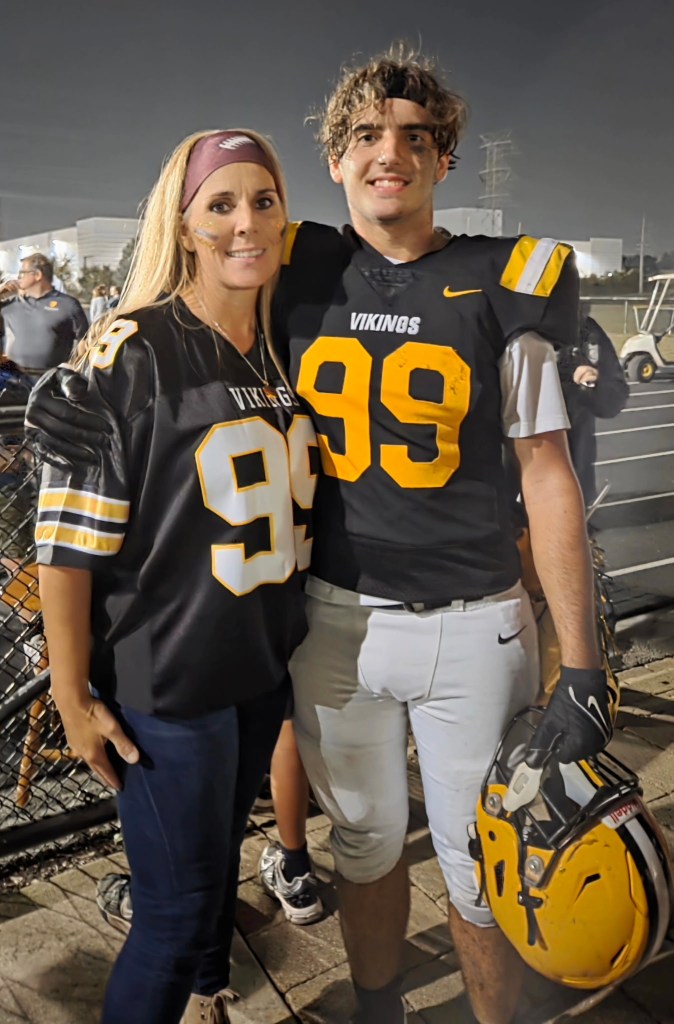
However, by far, her biggest support comes from her 18-year-old son Maximus.
In her childhood, she and her parents “didn’t do feelings,” she says. They “didn’t touch” and “didn’t hug.” But with her son, things are different.
“I have open communication with my son that I didn’t have with my family,” Mateja says. “My son, he won’t leave a room or have a conversation with me on the phone over texting without telling me he loves me before he ends the day…. It could be in front of the football team; he doesn’t care.”
Today, Mateja not only raises her son as a single mother but also cares for her father, all while managing her health issues and running a business.
Mateja’s resilience has inspired others, including her friend Babcock: “The fact that she’s been able to take care of her parents, raise her son, run a business, and deal with insane health issues…and to still get up and help others reach their fitness goals is pretty rockstar.”
Instead of inspiring, Mateja hopes she can motivate others to be the best versions of themselves.
“I do feel like an inspiration to others because people watch me struggle and I still keep going,” she says. “But I don’t want to inspire people to be like me; I would like to motivate them to do better than me.”




 Velocity
Leave a comment