
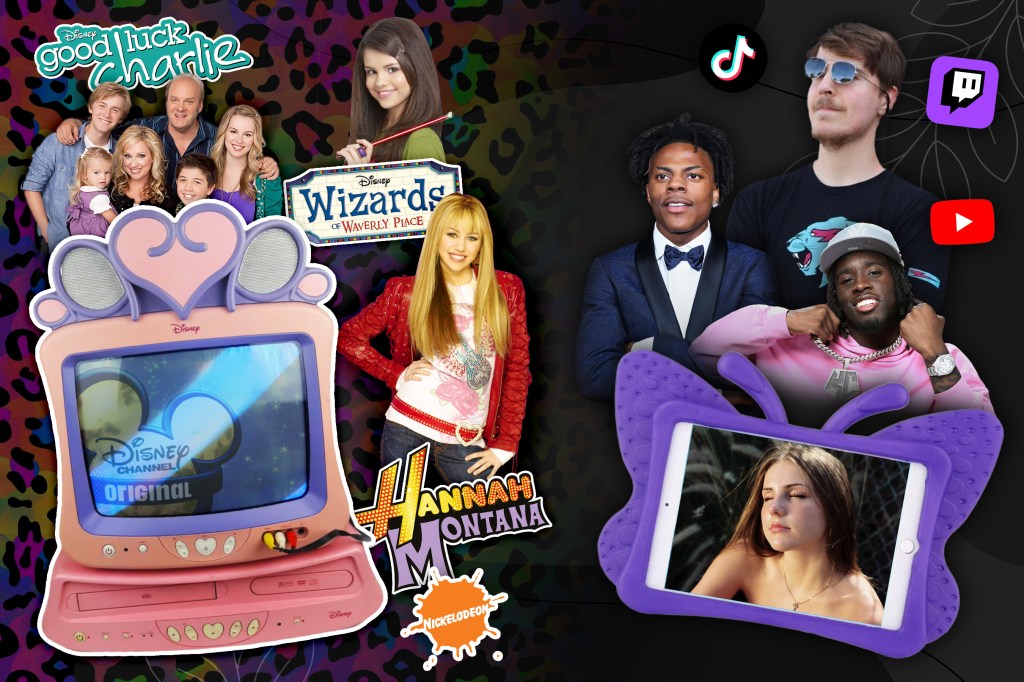
Watching Wizards of Waverly Place after a long hard day at summer camp while drinking an ice-cold Caprisun on grandma’s couch is a scene of pure ease. This was a peak summer experience in the childhoods of many Gen Zers; our brains had boundaries that made joy feel amplified.
Now, tweens are growing up on content creators like Piper Rockelle, Capri, Kai Cenat and iShowSpeed.
The tween age range is considered to be from around ages 8 to 13. For Gen Z tweens, sitcoms were put out there on platforms such as Disney Channel, Disney XD, Nickelodeon and Cartoon Network to reach their demographic. Back then, it was tweens on the screen, performing narratives created for their peers.
Seeing these types of relatable stories is essential at this stage of development, according to the American Psychology Association: “Starting around age 10, children’s brains undergo a fundamental shift that spurs them to seek social rewards, including attention and approval from their peers.”
But what happens when kids skip the tween phase entirely?
Gen Z shows such as Hannah Montana, Wizards of Waverly Place and Good Luck Charlie, dealt with themes such as honesty, family dynamics and identity, shaping the mental, emotional and social development of the tweens of the era.

Marco Cardenas, 23, a White Sheep barista at Moraine Valley, says one of the most important lessons he learned from Good Luck Charlie was simple but powerful: “Don’t cheat. That was a big one.” Reflecting on his childhood, he added, “I remember thinking I wasn’t learning anything bad.”
The thought that children as young as 9 could be exposed to the same content he sees on his TikTok For You page makes him feel “uncomfortable,” he says.
This age is a malleable period for the brain, and without proper guidance, children may be led into consuming mature content.
“What they’re trying to do is discover who they are, or who they want to be,” says Moraine Valley sociology professor Alison Lacny. “And if they don’t have that ability to be comfortable, to make mistakes, or see that there are other options, then they’re sort of pigeonholed.”
Rise of the influencer leads to new kind of peer pressure
With shifting trends and a new generation came the rise of influencers. Unlike traditional tween media, influencers often have no motivation outside of providing entertainment and making money off an impressionable audience.
Through platforms such as TikTok and YouTube, tweens now have unfiltered access to all types of media. For tweens, content that is created for older age groups is going to be more attractive. However, this spiral of events leads to tweens consuming content that is neither made for nor recommended for their engagement. It can even lead to adverse consequences on their mental and emotional development.
Tweens are more susceptible to this kind of peer pressure than adults, according to APA’s chief officer Mitch Prinstein: “First, adults tend to have a fixed sense of self that relies less on feedback from peers. Second, adults have a more mature prefrontal cortex, an area that can help regulate emotional responses to social rewards.”
During the tween age, the brain makes social rewards feel more satisfying. Things like being complimented or hearing someone laugh at your joke spike oxytocin and dopamine receptors in a part of the brain called the ventral stratum. This process is what makes tweens extra sensitive to the attention from others compared to other age groups.
Tweens satisfy this craving for attention through parasocial relationships with the influencers they watch.
Piper Rockelle is a prime example of how exposure to social media at a young age can affect your childhood and your brain. Recently, fans in TikTok comments named the influencer the “2020s Amanda Bynes.” She even dressed up as Bynes’s character, Viola, from She’s the Man for a Halloween video.
Capri Jones, her streamer ex-boyfriend, had reached out to her via a viral TikTok trend post. Quickly, fans began “shipping” them, so Rockelle and Jones began making “crush content,” the act of faking crushes and relationships to gain viewers. The two content creators ended up in a real relationship, which lasted until Jones cheated on Rockelle.
:max_bytes(150000):strip_icc():focal(749x0:751x2)/piper-rockelle-capri-jones-050125-2-85ba3409600b4c21a67ceda792ba087c.jpg)
Rockelle’s entire platform is based on curated drama, fake scenarios and pranks that result in emotional damage. She was put in beauty pageants and small YouTube shorts as a child to gain traction. Eventually, due to the alleged carelessness of those around her, she experienced obscene amounts of child sexualization. People used crush content and fabricated personas to comment on her and her friends’ bodies.
All this sexualization reached a tipping point when Rockelle was on Brand Army, a platform where adults could buy “custom content” of her as a minor. These are the new stars tweens are aspiring to emulate.
iShowSpeed is an influencer who specializes in gaming and traveling content. In recent years, he has adopted a slightly more child-friendly approach. However, he has a history of vulgar content, sexism and aggressive and disorderly behavior.
The hysterics of his past behavior may have been intended to simply entertain, but because tweens are still in the early stages of their mental development, they are unable to distinguish between the entertaining character and the influencer’s real personality. Thus, they’ll emulate the hysterical behavior of their idols.
Nipping bad influence in the bud
To address media exposure at its root, Claudia Nicolas, an early childhood teacher in Moraine Valley’s S building, emphasizes the importance of intention.
“Media and electronics are a big part of where we’re going now as the generation is developing,” she says, acknowledging the presence of technology in children’s lives. Nicolas is clear that the answer lies in balance. “It’s moderation. It’s about how long, how much, and how often.”
In the past, children were often steered away from creative careers such as music and art in favor of math and English. Now the wheel has turned, and the emphasis is on steering them away from electronics and digital engagement. In Nicolas’s classroom, children only receive 30 minutes of screen time daily, which is spent entirely on educational sites. Other than that, their time is entirely teacher-based.
Nicolas also recognizes the challenges families may face at home. Every household is different, and it is hard to have constant one-on-one time with a child during early developmental stages.
“The better structure you have–a plan–the better success you will have with the child,” she says. “Having a structure and letting them know the expectations for the house could help them reduce [the amount of time spent] on the iPad or on the TV. It’s possible to not crave the phone and media stimulation; it starts with structure and routine.”
So, what are tweens gaining from this new age of tween media?
“I do think they are more aware of each other’s feelings, they’re more empathetic,” Lacny says.
This new age of tween media has its benefits, but what’s been lost may be far greater: thoughtful, meaningful, impactful entertainment.
And maybe a lesson about understanding who you are and what you could become.



 Velocity
Leave a comment