
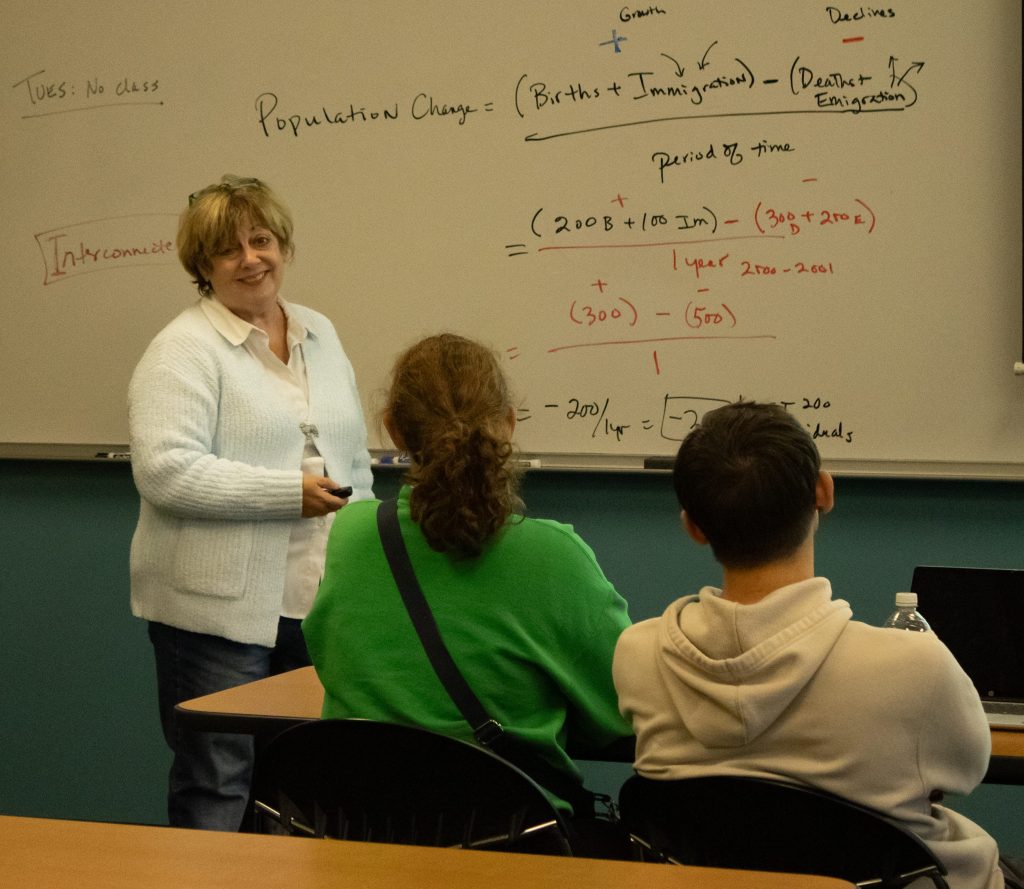
By Theo corrie, JRN 111 student
Growing up in the south and living near the Mississippi River, Sarah De la Rue saw firsthand how humans interacted with the local environment.
“I was always interested in nature and stuff, so my parents would take me to these creeks and we’d look for fossils,” said De La Rue, who is now a science professor at Moraine Valley. “There’s a petrified wood place, butterfly trees, and of course, we went camping every summer.”
But it wasn’t until she saw an alligator being killed for sport that she started taking care of the environment more seriously.
“We had a 20-foot alligator,” she said. “Everybody wanted to go and hunt, and they found her, and they killed her. And I was like 16 or something. It was like, why’d you do that?”
After earning her doctorate at the University of Idaho, De la Rue wanted to get into the lab instead of teaching.
“I wanted to research. I was geared for research,” she said.
She worked at the steel mills putting in product reports before she entered the world of teaching.
“And then a friend of mine said ‘Oh hey there’s a geology class listed at Triton College.’ and I got hired and I’ve been teaching ever since,” she said.
After a few years of working at different schools, she ended up at Moraine Valley in 2014. Here, De la Rue focuses on natural science. She also works at Purdue-Northwest in Hammond, Indiana, Prairie State in Chicago Heights, and Ivy Tech in Indiana.
Her Moraine Valley students appreciate her approach to teaching. “She actually provides a lot of information that we all need for the slides as well as some extra information,” says Dante Genis-Kennedy, 19.
One of the fun things that De la Rue does is field trips to science-based areas that can’t be accessed on the Moraine Valley campus. Some of these places include the Little Red School House, and the Knollwood Wastewater facility in Burr Ridge. Before the COVID pandemic, she would take other trips as well.
“We used to go to the Brookfield Zoo, do our little lab that’s in the lab manual, and then come back in time for the next class at five o’clock,” she said. “But…I don’t know. It seems like no one’s interested anymore. Half of this class didn’t even show up for our field trips.”
Even if the field trips are shrinking, the ones she still does are cherished. One of the main reasons she still does field trips is the people involved with them, like the tour guide at the water plant.
“He’s been there for a long time,” she said, pointing that he doesn’t talk down to students. “Yeah, he wasn’t snooty. You know what I mean; he’s just a good guy who likes what he does. I mean, that’s what you can hope for, you know, just having a person that cares about what they do and are willing to show, yes, share it.”
The commitment to the environment De La Rue has felt since childhood comes through today in her work with organizations on issues of land development.
“I went out with my bird watching group, the Tennessee Ornithological Society, and they would do surveys for areas of birds throughout the year at different seasons and send that report in,” she said. “Because, like there was a place where they wanted to put in a casino. Just across the Mississippi line, and we did the surveys for a couple years in a row.”
De la Rue has also worked on bird surveys in Louisiana and has done the same thing with frogs. But she doesn’t consider herself an activist.
“I’m not an activist by myself,” she said. “I don’t go up against the Corps of Engineers or a mayor. I’ve got a friend in Whiting, who does that.”
De la Rue hopes to pass along some of her passion for the environment to her students.
“What I really want to encourage is have an open mind,” she said. “Learn something new each day, and pass the course and go on and get a good job. And I’m happy to be a part of that journey for you.”


 Velocity
Leave a comment