
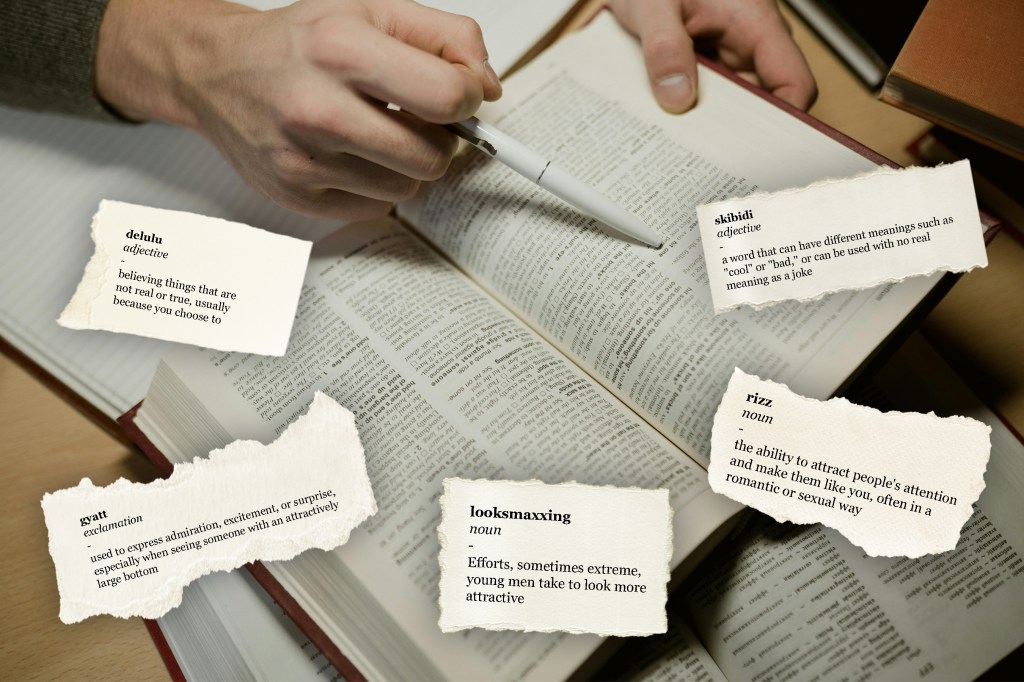
In my rizz yapper delulu maxxing era.
What the skibidi did I just say?
If you’re confused or curious, no worries, try looking up the words in the Cambridge Dictionary. There, you’ll find definitions of them and even more 2025 buzz words.
In the past twelve months, Cambridge Dictionary–known for being the most popular free online dictionary among English learners–has added more than 6,000 words to its lexicon. Added words include skibidi, tradwife, mewing, Fanum tax, inspo, and broligarchy. These absurd words you see in TikTok comment sections are now neighbors to sacreligious and photosynthesis.
“We only add words where we think they’ll have staying power,”’ explains Colin Mcintosh, lexical programme manager at Cambridge Dictionary. “Internet culture is changing the English language and the effect is fascinating to observe and capture in the dictionary.”
Some of the slang makes sense when you know the root. For example, sus means suspicious, delulu comes from delusional, and rizz is the modern charisma. However, skibidi stands out compared to the other neologisms because it means inherently…nothing.
As the dictionary entry states: “skibidi (adjective) • a word that can have different meanings such as ‘cool’ or ‘bad,’ or can be used with no real meaning as a joke.” The examples include: “What the skibidi are you doing?” and “That wasn’t very skibidi rizz of you.”
Skibidi is a stamp on our culture now because it’s captured through an official English dictionary. A revolutionary or cringeworthy statement, who’s to say? But one thing is certain: We are witnessing firsthand the evolution of language handcrafted by our generation.
Beyond words: internet’s impact
To go beyond the language point, the influence of internet culture is shaping behaviors and social norms in humorous and disruptive ways.
As The Guardian writer Lee Escobedo puts it, “Skibidi brainrot encapsulates a generation fluent in irony but starved for meaning.” Escobedo used the trolling of WNBA games with sex toys that started this past summer as an example of how the Internet can amplify absurd actions.
“Algorithms aren’t just giving us euphemistic substitutions; they’re playing a defining role in every aspect of modern etymology.”
Adam Aleksic
The incidents can reflect a broader pattern of how trends and memes spread quickly, capture attention and influence public conversation, where the meaning can be reshaped or disrupted through online communities. In both language and online actions, the focus is often on engagement and visibility rather than clarity. The pattern is showing how our generation’s interaction with media operates in an environment shaped by algorithms, irony and rapid cultural circulation.
We memeify rebellion, chaos and identity itself.
To clarify, this is far from the first time a dictionary has chased popular slang words. Oxford Dictionary’s Word of the Year in 2013 was selfie, 2023’s was rizz, and 2024’s was the infamous brain rot. Merriam-Webster Dictionary has hundreds of pages with acronyms and phrases such as LOL and swag.
The difference now is the speed. Social media accelerates a phrase’s rise from an inside joke to a mainstream impact. A word can go from a TikTok comment section to a dictionary entry in under a year. So when words can achieve official recognition in such a short timespan, what does it reveal about how society defines meaning?
Algorithmic evolution
To understand how this vocab goes viral, we can turn to Adam Aleksic, popularly known as the Etymology Nerd on social media. In an interview with NPR responding to Cambridge’s additions, he says, “It’s not new that we’re adding new words to the dictionary. We’ve always been doing that. What is new is all these words are coming directly through social media algorithms.”
In his 2025 book Algospeak: How Social Media Is Transforming the Future of Language, Aleksic further explains how slang spreads through online communities, then escapes via algorithms into the cultural bloodstream.
“Algorithms aren’t just giving us euphemistic substitutions; they’re playing a defining role in every aspect of modern etymology…The printing press increased literacy rates and brought the standardization of language. The internet itself marked another inflection point, broadening public information and allowing the written republication of informal speech. We’re now at a new inflection point, characterized by personally recommended, short-form video content.”
Highkey–skibidi is more than just brain rot, it is history in motion. Cavemen had wall carvings, monks had manuscripts, Gutenberg had the press, and we have Instagram reel comment sections. Skibidi, and all the similar silly phrases, is proof that humans will always adapt language to new technologies.
Aleksic said it best, “Language and memes and metadata are one and the same–all of it shaping our vocabulary and identities.”
We humans will never stop reshaping the words we use to fit the tools we create. As long as culture keeps evolving online, you can bet we’ll keep inventing new ways to speak it into existence. No cap. Period.
 Velocity
Leave a comment