
By DIANA PESCHEL, JRN 111 STUDENT
Imagine spending years learning the art of editing—adjusting every layer, spending hours in trial and error—only to watch a machine recreate your hard work in seconds. Mastering Photoshop once required skill, practice and patience. Today, a few keywords can summon an entire photograph.
As AI tools become more integrated into Photoshop, artists at Moraine Valley and beyond are navigating an evolving art world. Many use AI in small ways, but the technology remains controversial—valued for its convenience, but criticized for threatening jobs and authenticity. In photojournalism, where truth matters, AI’s influence raises ethical concerns. For some artists, it feels like progress toward an exciting future; for others, it’s a warning.
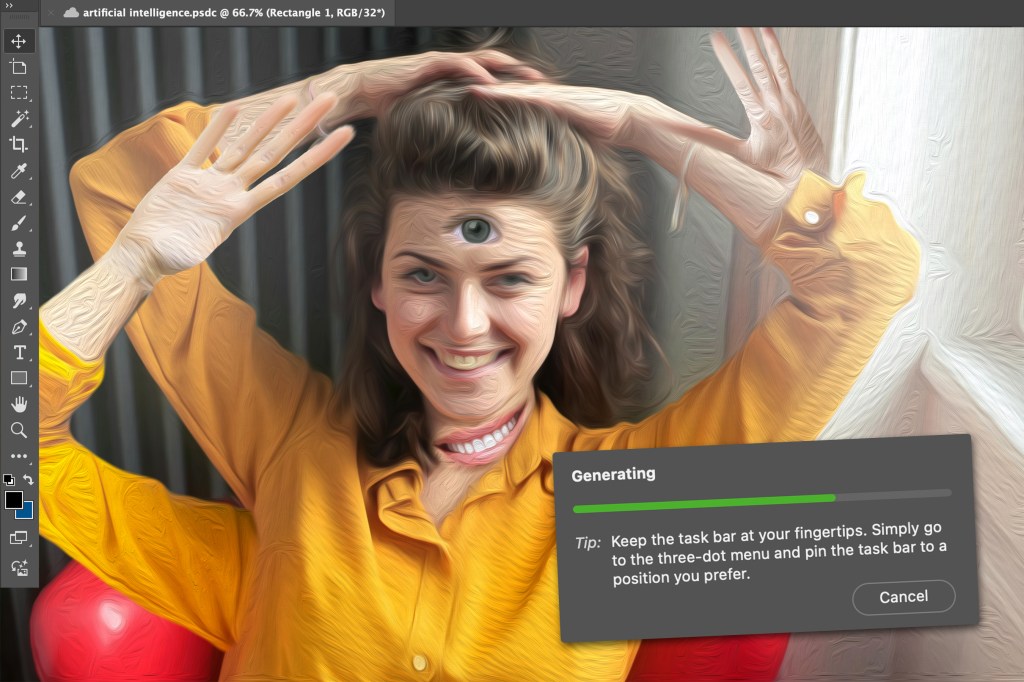
Describe a family scene, and within seconds, Photoshop will generate a random group of people. They might look like real people, but their symmetrical features and flawless skin create an unsettling feeling.
Over the past few years, Adobe introduced AI-driven tools such as generative fill and neural filters. These features allow artists to generate backgrounds, remove or replace objects, and even alter facial expressions with just a few clicks. But these barely scratch the surface of how Photoshop uses AI. Many artists don’t even realize that AI powers small tasks too—like the select subject tool, removal tool, and even subtle color adjustments.
A 2024 Adobe study shows that 83 percent of professional artists are using generative AI tools in their work, and the U.S. has the highest adoption rate of AI at 87 percent. This spread shows how deeply AI is already embedded in the creative industry.
Exciting future or threatened creativity?
Amanda Kross, a photography student at Moraine Valley Community College, admitted she hadn’t realized how much AI was involved in tools she uses every day. “I think some things are AI that I don’t really realize are AI, like the eraser tool,” Kross said.
Not every artist views AI as a threat. Kross is excited to see where AI in Photoshop could go, especially as the technology continues to evolve from human input. Since she is still new to Photoshop, she uses AI not to replace her creativity, but to help bring her visions to life.
“I’m excited to see where it goes as we feed AI more, like images and stuff,” Kross said. “It’ll only get better.”
But while some artists like Kross are optimistic for AI’s potential, others are worried about what it could mean for the future of creativity.
Mollie Burkiewicz, visual media specialist at MVCC, emphasized the need to slow down and focus on the fundamentals of editing.
“It’s scary to know that it’s going to go fast, with just how technology develops,” Burkiewicz said. “So eventually it’ll get harder to tell the difference.”
AI’s controversial and rapid expansion
You’ve probably seen AI-generated content without realizing it—whether in a piece of artwork, commercial, or even a social media video on your feed. Maybe it was a cat or dog dancing like a human. It’s cute, it’s entertaining—but it’s not real.
According to a study by Artificial Intelligence News, human participants could only identify fake images correctly 48.2 percent of the time, highlighting the difficulty for people to differentiate AI-generated media from reality.
With Photoshop’s generative fill, it’s as simple as typing a few words. You could describe a family scene, and within seconds, Photoshop will generate a random group of people. While the technology seems impressive, the results can sometimes be eerily off. They might look like real people, but their symmetrical features and flawless skin create an unsettling feeling. There’s no personality, no story behind them, and that’s what makes them so uncanny.
Paul Stephenson, a computer graphics imagery and Photoshop professor at MVCC, voiced his concerns, drawing attention to the potential challenges artists could face.
“If it stops a person from using a tool because it’s not an AI result that they liked, a person doesn’t learn the program by using AI completely,” Stephenson said.
Beyond technical skills, some are worried that AI is taking away the emotional and human aspect that artists bring to their work. While AI can recreate styles and techniques, many believe that it cannot replicate the emotional depth that comes from human experience.
Matthew Grotto, a videographer and producer at MVCC and former newspaper photojournalist, said that even though AI recreates realistic images, something important is still missing.
“It’s a technical thing that it seems to strive for. Perfectly even skin tones, perfectly even facial shapes,” Grotto said. “That human element is missing. ”
Burkiewicz also called upon how real human interaction adds layers of meaning that AI cannot capture.
“If you’re photographing a person, you’re talking to that person. If it’s a kid, you’re talking to the kid and trying to get them to smile,” Burkiewicz said. “That’s more energy and emotion than what AI could ever do.”
AI raises ethical concerns in journalism
In fields like photojournalism, this human connection becomes even more crucial.
Authenticity is critical to photojournalism, where truth and accuracy aren’t just artistic goals, but ethical responsibilities—and artists at MVCC warned that AI’s ability to create or manipulate realistic images could threaten the credibility of photography as a truthful medium.
Grotto added that AI’s growing presence has already changed the way he views the media.
“It does make me question a lot of what I’ll see on social media,” Grotto said. “It makes me think more now, what is real and what is generated.”
Related Coverage…
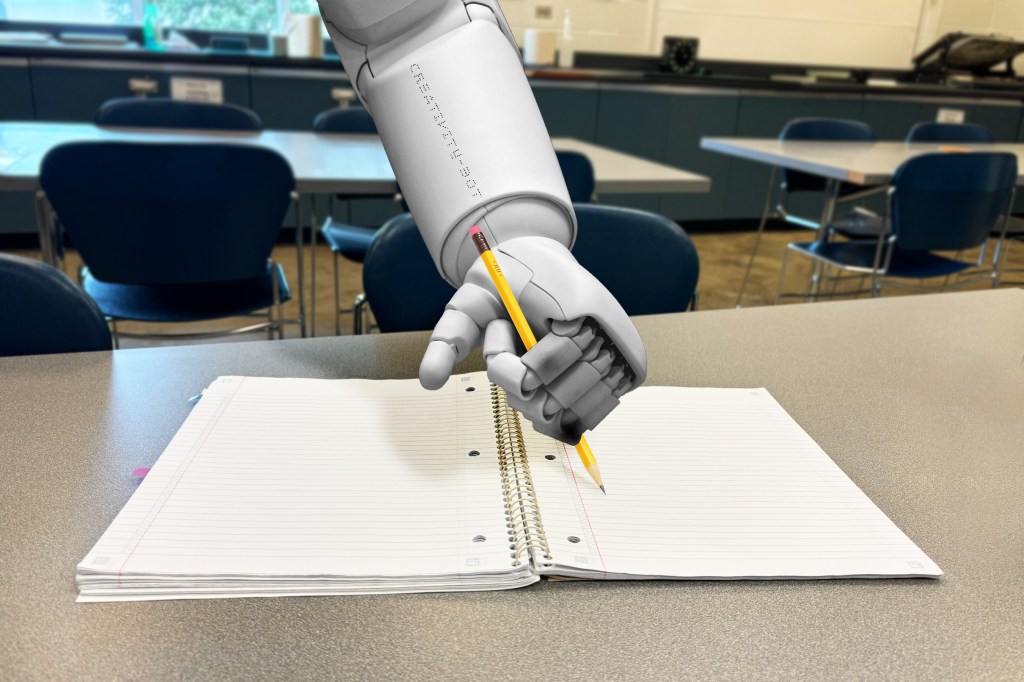
Authenticity over artifice: Human creativity prevails over AI
Glenn Carpenter, visual media coordinator at MVCC, raised a similar concern, wondering whether professionals might have an easier time spotting AI-generated content than the average consumer.
“But is it easier for us because we’re professionals and we know what to look for?” Carpenter said.
Carpenter believes that AI can blur the line between real and fake, and that the responsibility ultimately falls on the individual to think critically about what they view.
“Which one is right and which one is ethical, that’s for you to decide as a person,” Carpenter added.
Burkiewicz agreed, adding that the real problem lies in how easily the public could be misled.
“That’s where the danger is,” Burkiewicz warned.
Stephenson looks at it in a more complex way, saying it could be beneficial “if it’s taking the risk away from journalists who risk their life. But then that’s also contradicting the idea with AI replacing artists’ jobs out in the field anyway,” Stephenson said. “On one hand it’s ethical, keeping a person safe. On the other hand, it’s not accurate reporting either.”
Public reception
These ethical concerns aren’t only limited to artists; other people across the country share similar worries. According to the Pew Research Center, as of 2024, 52 percent of Americans are more concerned than excited about AI’s growing role in society.
Many artists at MVCC stressed that AI should remain a tool for creativity—not a replacement for human skill and vision.
“I feel like it should just be used as a tool to make some things easier in the day-to-day, but it shouldn’t be used as something that’s a replacement,” said Burkiewicz, emphasizing that learning the fundamentals of editing remains essential and that relying too much on AI could weaken an artist’s creative voice. “It shouldn’t replace people.”
“You gotta learn the basics, and you gotta learn the rules before you can break the rules,” Burkiewicz added. “You have to sit and think about it, and the outcome. Visualize the ending.”
Carpenter agreed, adding that students should first have a clear creative goal before reaching for shortcuts.
“Students would apply this filter and that filter, they didn’t have a vision for what they wanted to create,” Carpenter observed. “I think the difference is when I want to create this, how do I get there and then you pick the tools in Photoshop.”
Kross echoed these ideas, adding that even with AI’s convenience, the creative process still belongs to the artist and their voice.
“You still need the human for the creative process and to think through a story,” Kross said. “That temptation is going to be there. The interest is still there to learn. It helps to know the history. As humans, we’re always going to have this desire to create, so I hope that we just use it to augment what we’re already working on.”
“It’s scary to know that it’s going to go fast, with just how technology develops. So eventually it’ll get harder to tell the difference.”
Mollie Burkiewicz, Visual Media Specialist
Even with its quirks and limitations, Kross sees the potential in AI as something that will continue to grow and improve over time.
“Some of the images it’ll generate right now are pretty goofy. It does seem like there’s a lot to learn,” Kross added. “But I’m not really scared of it, I’m more excited to see where it goes.”
Looking ahead, artists at MVCC are thinking about how it might impact the future of creative industries in the long run—whether they will like it or not.
Some believe that AI’s role will become a basic part of editing, with future artists starting with AI tools before they learn the traditional editing methods. While AI offers ideas for a blueprint, many say that it should continue to be treated as a starting point, not a final product for art.
“There are painters who take a picture of a scene, and then use that photo as a reference photo,” Burkiewicz said. “We’re visual people, so we do need it as a tool sometimes.”
One of the biggest fears among artists at MVCC is the possibility of AI replacing visual media-related jobs altogether. While AI tools can make technical tasks faster, there’s a growing fear that it could reduce the need for skilled human artists as companies and consumers may prioritize speed and lower costs.
Potential threats to jobs and authenticity
A 2023 Goldman Sachs Report estimates that if generative AI lives up to its potential, it could impact around 300 million jobs worldwide as the technology continues to rapidly grow.
Burkiewicz said she’s already seen signs of that attitude, where people undervalue the work of professional photographers.
She shared a recent example: “I’ve had people come to me, ‘Could you find me a cheap photographer?’ But you’re not going to like the photos,” Burkiewicz said. “I could have beautiful photos that are $5,000, or I could have alright photos for $500.”
Joshua Edwards, graphic design major, said that although he experimented with AI once and found the results inaccurate, he still recognizes both sides of the debate. He believes there could be a balance between AI and human creativity.
“I understand why people don’t like it. It’s basically like replacing actual artists who actually worked hard to make masterpieces,” Edwards said. “But at the same time, not everyone is gifted in art. Maybe there could be a way that AI artists and authentic artists could coexist together.”
Still, many artists remain uneasy about what AI’s rapid growth could mean for the future of visual media.
“I hope it’s just a tool and not a replacement,” Stephenson said. “I’m worried about artists losing their jobs, including myself.”
He stressed that even as AI continues to learn and adapt, the creative process should always belong to the artist.
“Don’t let it control your overall ideas—use it as a tool if you have to use it at all,” he said. “You control the narrative; don’t let the computer do it for you.”
As AI reshapes the creative world, one thing stays constant: the heart of art—the human need to create, to share, to feel—is something technology can never replicate.

 Velocity
Leave a comment