

When I was 9, I attended my first concert, Taylor Swift’s Speak Now tour at Allstate Arena. After the concert, my mom and I went to my favorite restaurant.
Steak ‘n Shake.
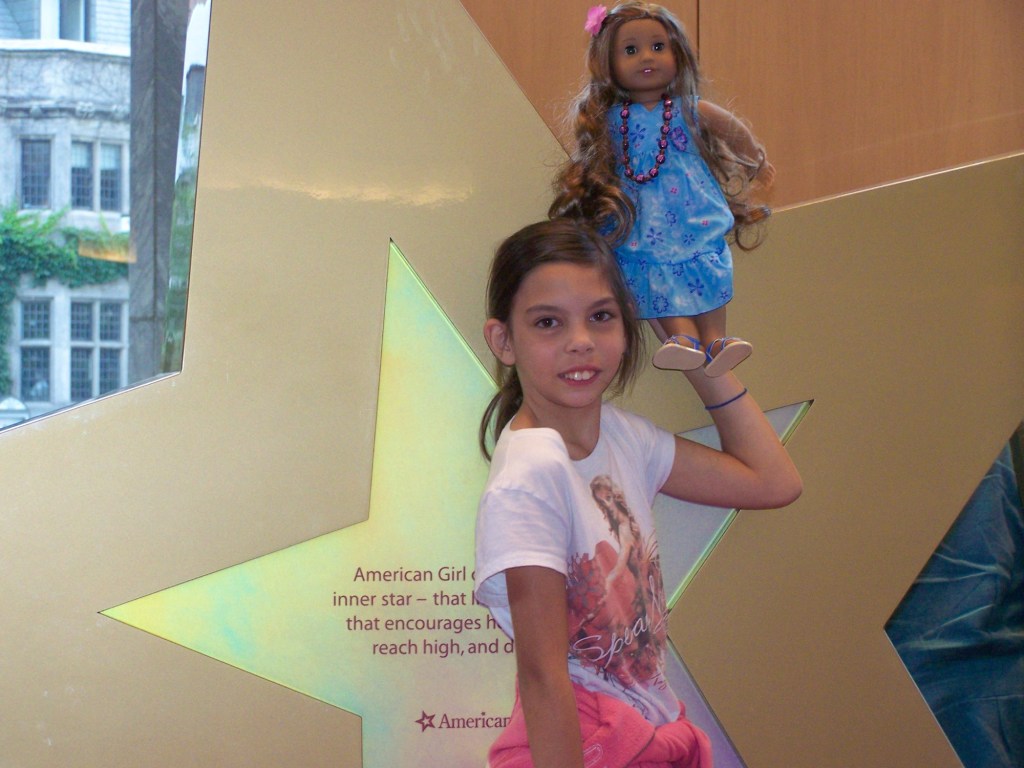
I don’t remember if it was crowded inside the restaurant. I don’t remember anything about anyone there, besides the one woman who talked to us while we were in line for our carryout order. I could not tell you what we were discussing or what color she was wearing, but I do recall a phrase she said to me: “You’ll remember this for a few days.”
I have no clue what she said before or after, but that phrase cut me like a knife. It really was my first time with the thought that memories are temporary. I remember nothing else from that concert. I just remember that phrase that came out of that woman’s mouth.
Over the past twelve years, the fact that we’re all like walking and talking memory banks has become more apparent in my life. Our memories shape our perspectives, influencing everything we encounter. Without memory, we wouldn’t be able to form language, communicate effectively, or even develop the Dunkin Donuts on the corner where someone met the love of their life.
Most scientists recognize at least four general categories of memory in the human brain: working memory, sensory memory, short-term memory and long-term memory. However, some researchers propose that these are not separate types of memory but rather stages of memory processing.
Psychologists conceptualize memory in terms of types, stages and processes. There are two types of memory, explicit memory and implicit memory, and then the three major memory stages: sensory, short-term and long-term.
Explicit memory pertains to knowledge or experiences that can be consciously recalled. Episodic memory encompasses firsthand experiences we have had, such as a day from last week or even the worst day of our life; we only remember it in sequences, not down to the very second. Semantic memory is based on facts and knowledge that have been proven, such as knowing that two times two is four or that Thomas Edison created the lightbulb.
Implicit memory also includes classical conditioning effects, where we associate neutral stimuli with other stimuli, leading to learned responses such as enjoyment, like how your mouth salivates from a photo of food that you know you already like and enjoy.
All of us go through these different types of memory every day without even knowing it. Our mind or our body will always remember things the other might have forgotten.
Trauma, whether physical or mental, can have lasting effects. Experiences such as abuse, betrayal, rejection and abandonment can lead to trauma, and even if you believe you have moved on from a frightening or painful event, your body may still carry the effects. Body memory is defined as the sum of all past bodily experiences that are stored in memory and influence behavior. As humans, we memorize negative bodily experiences such as past violence or moments of anger or fear.
You may not even realize this is happening to you. If every year, you feel like something sucks you up into a dark pit you can’t escape, it may feel like history repeating itself because you recall this happening a year ago, maybe even years in a row.
This is an anniversary reaction. An anniversary reaction can happen to anyone but it is commonly associated with PTSD. Anniversaries can be linked to private events, or traumas that are not in the media, like the date a loved one died or a prior sexual assault happened.
As psychological and scientific as memories can get, something that has changed the way I think is the reality that memories will eventually serve as evidence of our existence once we pass away.
Our entire legacies will live on in the minds of those who come after us. We will exist in memories far longer than we do on earth–in the memory of the way your grandpa last said he loved you or a friend hugged you goodbye for the last time.
My entire life, I’ve always wanted to be bigger than myself. I used to cry all the time over the fact that I wanted to leave a legacy. I don’t know the impact I’ve had on others– if any–but I do know that I am built up from fragments of everyone else in my life.
I have my mother’s face, almost a spitting image. I hold my father’s laugh and his same pain tolerance. If my online friend from when I was 11 never showed me one song, I never would have found my favorite band. My friend from high school and I both crossed our T’s and dotted our I’s the same simply because we wanted to be more like each other, something I do to this day. My other best friend is the reason I say pasta like “past-uh” because she has a Canadian accent.

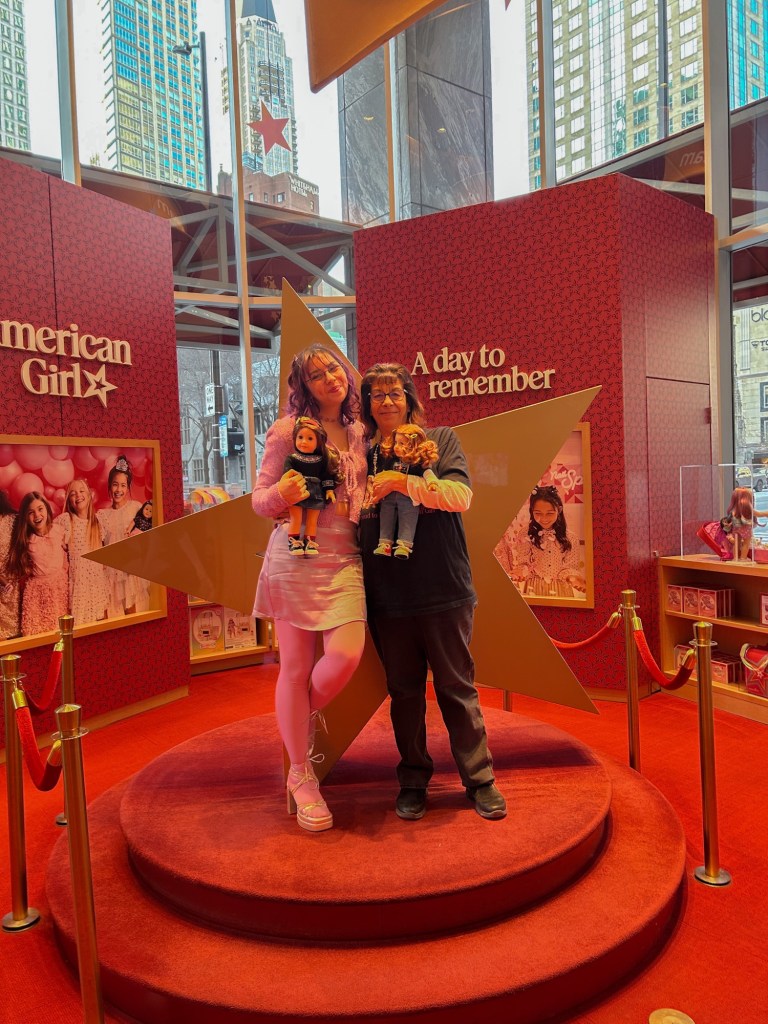
We are all simply made of fragments from each other and the memories from each other.
I was in my children’s literature class one day, not thinking much of the brisk Tuesday in February. My professor, Erika Dieters, set a day aside for an author’s study on someone named Amy Krouse Rosenthal. I read two books by Rosenthal, Friendshape and Little Miss, Big Sis. Both super cute books! But it wasn’t until Professor Dieters started talking about a book, one with a yellow cover that had a giant exclamation mark on it, that I felt something.
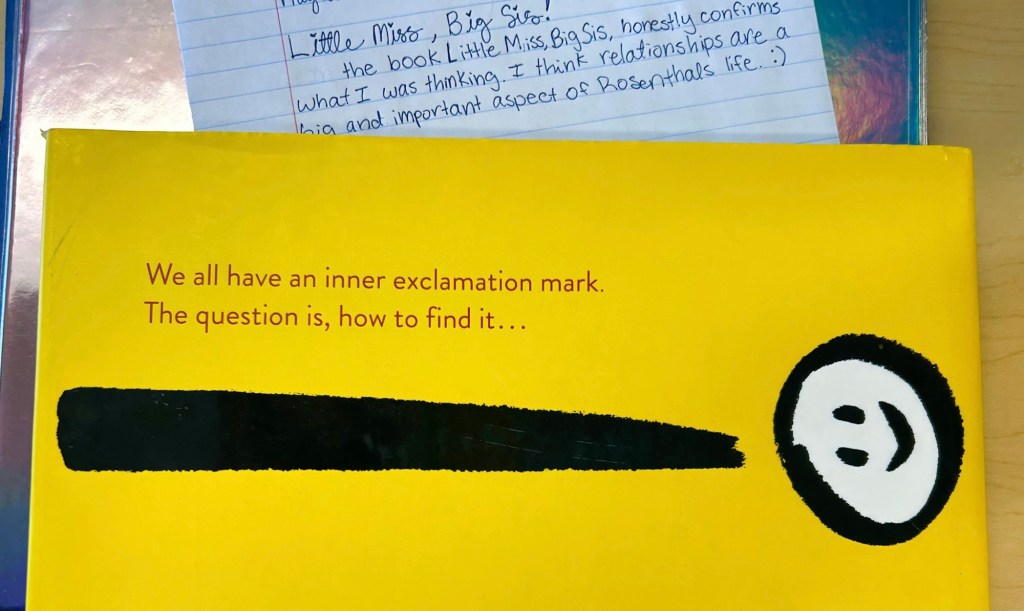
Throughout my life, exclamation marks have been my favorite form of punctuation. They conveyed my excitement about living. I often received feedback from friends (and even professors I contacted) that I used them too much and needed to tone it down, but it felt awful to contain my excitement like that.
I asked to see the book titled Exclamation Mark. It was a story about finding one’s place in the world, much like the exclamation mark finds its place at the end of a sentence to express excitement and happiness. And when he finally finds it, he feels like shouting from the rooftops that he’s happy. Just like this!!!!!!
It felt as though I was the exclamation mark in my own life, striving to find where I belonged.
I’ve always wanted to be a children’s book writer, and Rosenthal’s work felt exactly like what I wanted to create someday. The rest of the class continued, with Professor Deiters sharing videos of Rosenthal’s kindness projects and different things she did in her life that radiated sunshine. I knew I needed to meet her. I took my phone out during class, breaking the rules like I don’t typically do, just to Google this author’s name. Immediately, I was met with her biography page on Google.
Scanning the page, I saw her Wikipedia declaring what I already knew, that she was an author, short filmmaker, and radio host. I saw her birthday, April 29th, 1965, and directly below it.
Died: March 13, 2017 (age 51 years), Lake View, Chicago, IL.
I felt gutted by this knowledge. Words can not describe the way this hit me. It was heavy to find out someone whom I’d just met, very briefly through the windows of her life, was dead. Without memory, I would have never had the privilege to get to know her like I have. Without the memory of the people who have shown disdain for my punctuation, this connection would have never been forged.
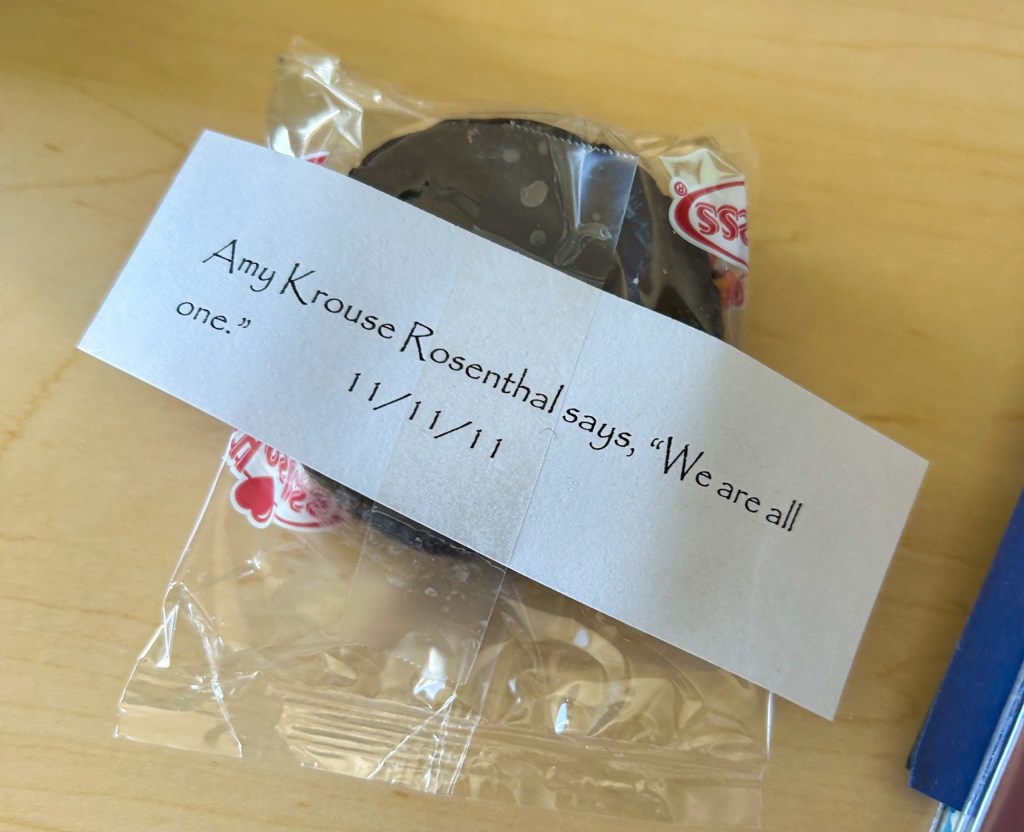
At the end of class, we all got a Ding-Dong from Professor Dieters, relating to what Rosenthal did, and a little note that said, ““We are all one. 11/11/11.” As a very superstitious person, I like to think that most things are signs. Little repeating numbers are angel numbers giving me a sign–like 111 meaning new beginnings and positive changes.
Another symbol that all derives from memory is the flower, forget-me-not.
The name originates from a German legend in which a knight, while dying, called out with his last breath, “Forget me not!” as he attempted to get the flowers for his lover. The Greek name, Myosotis, means “mouse’s ear,” as the oval, furry leaves resemble a mouse’s ear.
In other folklore, God went to each plant and animal and gave them a name and as God finished and was about to leave, he heard a little voice at his feet saying, “What about me?” He bent down, picked up the little plant he had forgotten, and said, “Because I forgot once, I shall never forget you again, and that shall be your name.”
But according to another legend, the Christ Child was sitting on Mary’s lap one day and expressed his wish that future generations could see her eyes. He touched her eyes and then waved his hand over the ground, causing blue forget-me-nots to appear, hence the name forget-me-not.
No matter what though, the forget-me-not is considered a symbol of love and remembrance more than any other flower. It’s a universal symbol for the idea that someone will not forget you if you are gifted this flower.
Even in every language the name remains the same, all meaning a version of “I won’t forget your presence in my life.”
The human mind is conditioned to remember things. Remember the saying, “sticks and stones may break my bones, but words can never hurt me”?
It evokes memories of childhood recess, when we pretended that hurtful words couldn’t affect us at all. That we were untouchable. However, the idea that physical injury is more painful than emotional injury isn’t entirely accurate.
When I was in 4th grade, I was told by a boy in my class that my legs were too hairy, my teeth were too big and I had to shave to look “actually pretty.” I went home that day begging my mom to let me shave and get braces (she said no).
I remember those words so vividly when I look in the mirror. I’m sure Carl doesn’t remember telling me about the dark hair on my legs–or even remembers my name.
In November of 2018, The Washington Post asked readers to anonymously share their most vivid memories. Some of the responses were, “sitting on my bathroom floor after my father died,” “my face being forced down to do something I didn’t want to do,” and “the day I heard the voice of God in my head that said, ‘My son, you have another chance.’ It happened moments before I was going to commit suicide.”
However, not all memories shared were about negative or challenging experiences. Some recalled peaceful Easter mornings from childhood, while others recounted the day they met their spouse. Nevertheless, the majority of readers’ responses centered around trauma or finding silver linings in their traumas.
Numerous studies indicate that we are more prone to remember negative experiences over positive ones. Laura Carstensen, a psychology professor at Stanford University, suggests that, overall, we tend to focus more on the negative aspects of life than the positive.
“We think what happens with age is that younger people, because they have these long and nebulous futures, really need to collect a lot of information, and so they remember many things that will possibly help them manage those futures,” Catstensen shared. “The older people get, the more they’re able to live in the present; and so, focusing on positive information makes that present feel good.”
TLDR: The older you are, the better you are at living in the moment.
In our lives, just like our memories, things are constantly changing, your Dunkin’ order, your favorite tee shirt to sleep in, and your favorite song to jump around to. We are beings that are ever-changing and evolving.
Some things don’t change, though, like the memory of the song that played on a cool summer day when you were driving on the freeway with your friends, or how your childhood stuffed animal has been on a plethora of family vacations, or in my case, a doll that has held all the memories of your good and bad days.
Approximately five years ago, a user on the website Quora asked the question, “What are the things/objects you’re keeping solely to hold on to memory but have no use or any other significance except nostalgia?”
I answer this question with receipts, straw wrappers, and the stick from the lollipop I ate during the fireworks on my first trip to Disney World. I have kept almost every single receipt I have ever accumulated dating back to 2018. They’re reminders that I’ve lived, I’ve laughed, I’ve loved, and I have been loved by so many people in my life.
Anyone else can look at my box of receipts and go holy shit! That’s a hoarder if I have ever seen one! And hey, maybe they are onto something there, but I like to think of it differently.
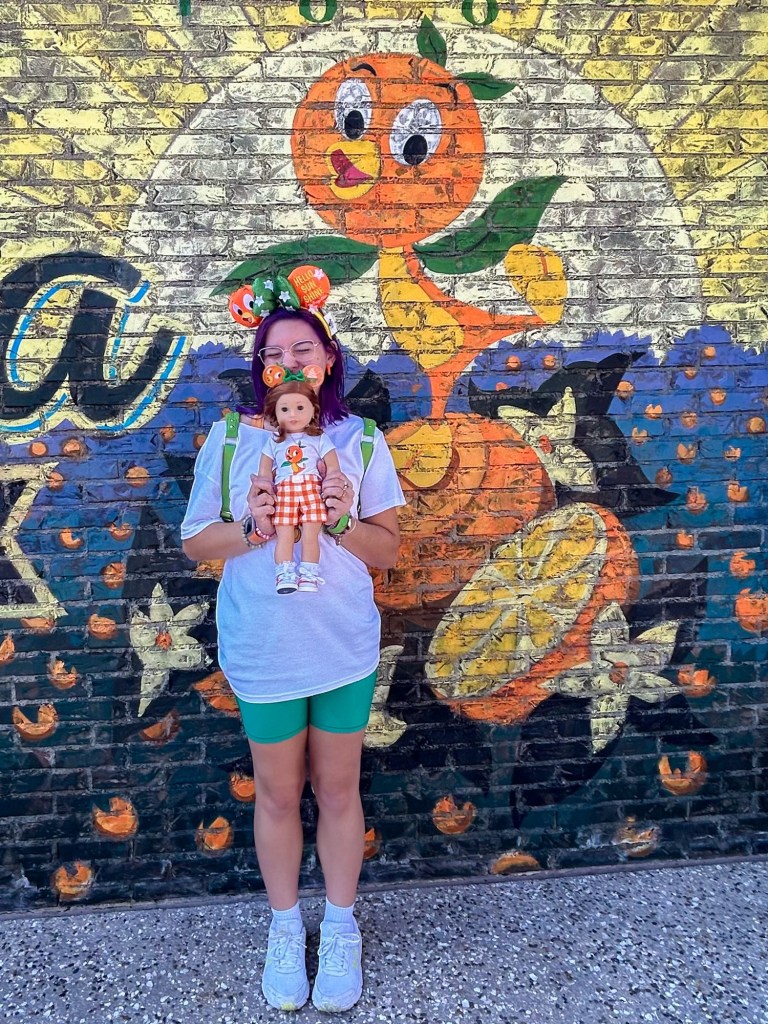
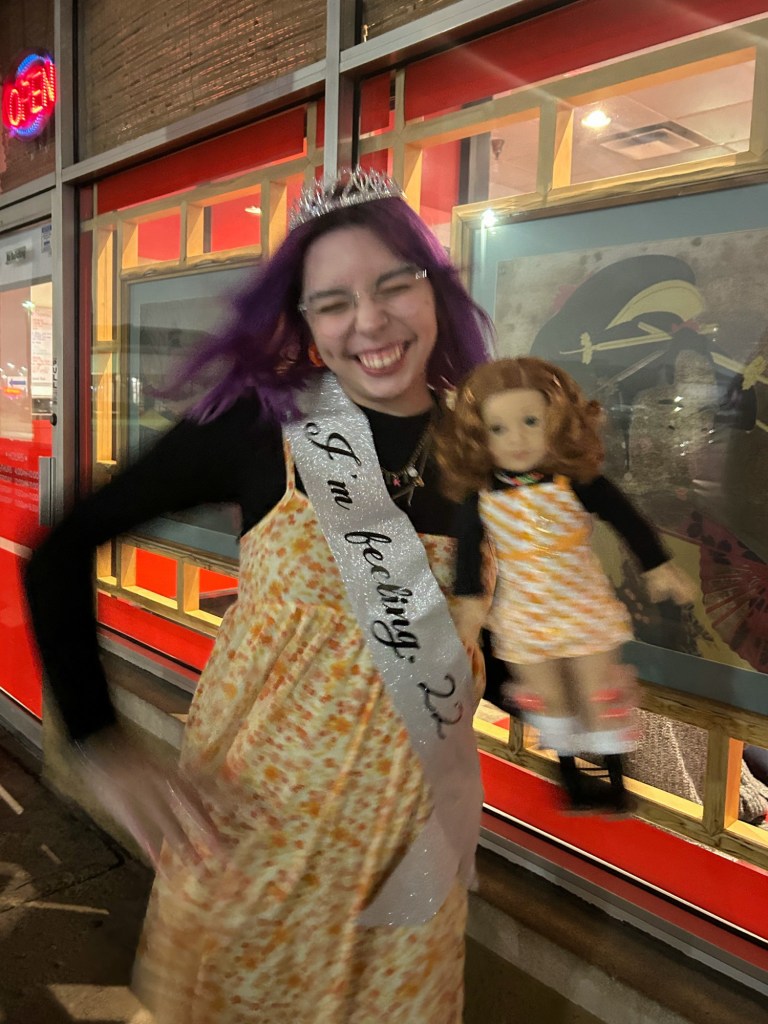
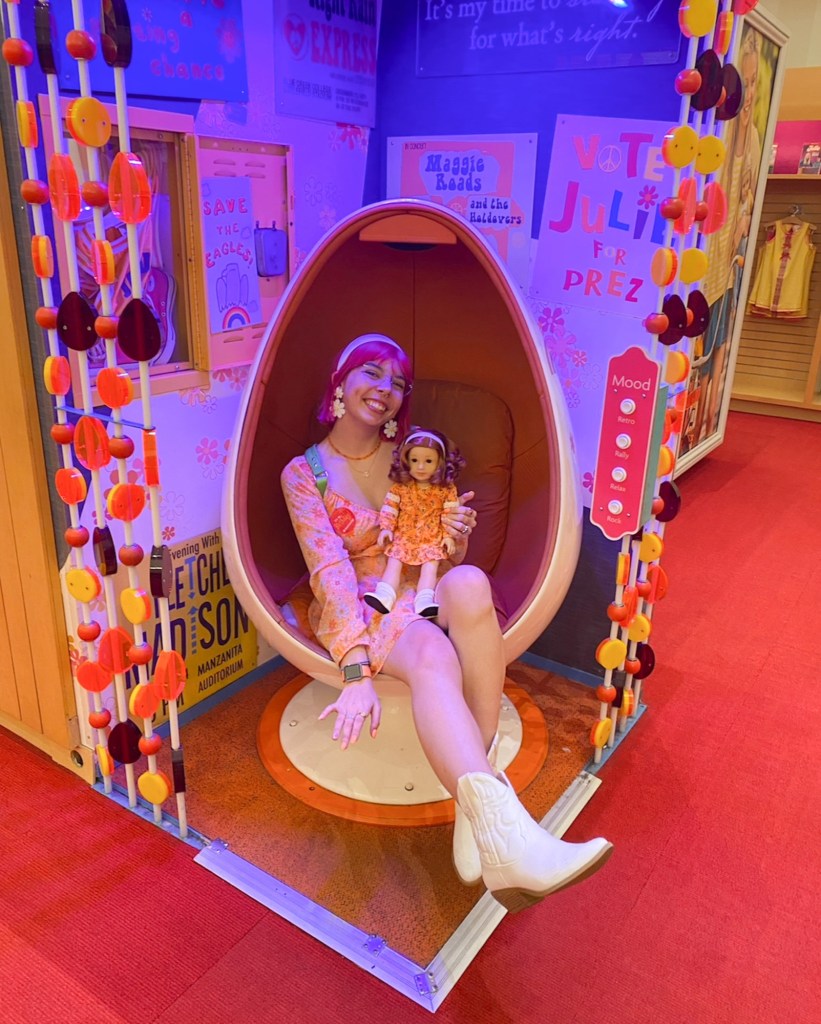
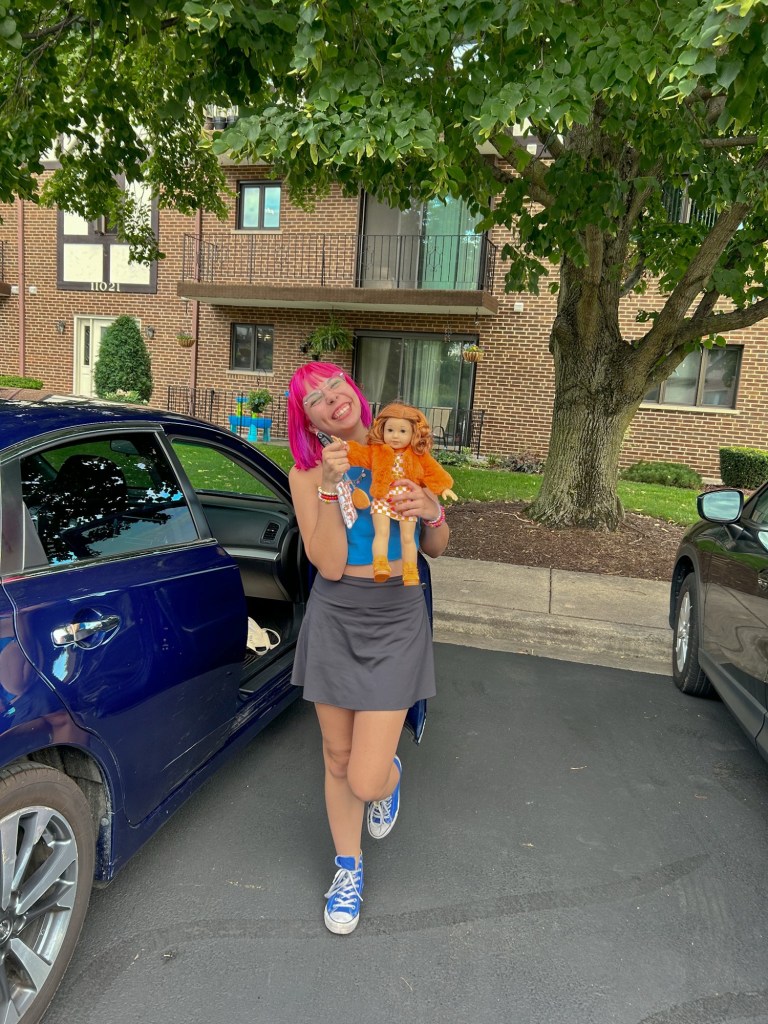
If you look around the room you are currently sitting in, there has to be something of significance to you that holds a memory. For me, it’s the laptop I got days before my grandpa passed away or the stuffed bunny that has been going on my newest endeavors with me, or the collection of American Girl Dolls that are scattered around me, on my bed, my shelves or the dollhouse my dad and I created together. To anyone else, these are pieces of vinyl. To me, these are the craft I’ve been perfecting for the past 16 years of my life.
When I was 10 my friend’s mother pulled me out of a playdate with my best friend and her younger cousin. I was 10, carrying my most prized possession at the time, my American Girl doll, in hand. She pulled me over to have a “talk” about how I needed to grow up and leave my dolls behind.
I thought my love for my dolls was long gone, until 2022 when I decided to make a doll that basically encapsulated all the things that made me who I am and something so important to me.
The color orange.
When I was 3, I begged my mom to have my birthday party theme be orange. To this day she tells me how hard it was to find orange decorations in January since I wasn’t born in October.

There have been two consistencies in my life. The color orange for 19 years, and American Girl Dolls for 16. The doll that I bought, I named her Clementine. Clementine has red hair (that’s definitely orange but I digress), the actual body of an orange. one green eye along with one gray. The green eye is the leaf. Grey just happens to be the most important person in my life, my mom’s favorite color, which represents her.
Clementine was made because of all of the things that have made me into who I am today which is why she is the most special thing I own. To most people, she is a scary doll, but because of my memories, she has become something so important to me.


This is the theory of memory reconsolidation which suggests that memories and their associated emotions can be changed after they are brought to the conscious mind. When these memories resurface, new emotional learning can be introduced to modify undesirable behavioral patterns. While memories are typically stable once consolidated into long-term memory, the retrieval of a memory can induce a labile phase, requiring an active process to stabilize the memory afterward.
This post-retrieval stabilization is considered distinct from the initial consolidation process, despite similarities in function (such as storage) and mechanisms of memory. Demonstrating memory modification during retrieval is crucial to validate this independent process. This is a very scientific way to say that memories are insanely malleable and can also fail us or change at the drop of a hat.
A simple aspect of memory is the fact that we all forget things, like what I said exactly 10 lines back in this paper. Memory is fragile and something we should not take for granted. As we grow old, we accumulate so many new experiences and relationships that we tend to forget little moments. The moments you may remember at age 18 are vastly different from what you remember at 38 because of the years of living. My years of experience have drawn apart, but there are things I can never forget.
Thirteen years later, my mom and I were sitting in Allstate Arena in the exact section where I saw Taylor Swift. Right before The 1975 came on, she uttered the words,
“Wanna go to Steak ‘n Shake after this?”



 Velocity
Leave a comment