

“Being on the ground in Gaza is execrable. It’s not ground. We’re walking on destroyed homes, people’s flesh, blood and dead animals, so being on the ground here is walking on a graveyard. It’s like I’m living through a horror show,” Moraine Valley student Malak Eldeirawi wrote in fall 2023 from Gaza, where she and her family had become trapped when fighting began.
In January, after 470 days of fighting that stems from a struggle some trace back centuries, there was a halt in the bloodshed between Israel and Palestine. Israel and Hamas at long last reached a ceasefire deal that went into effect on Jan. 19.
“When the announcement finally came — I don’t even know how to describe the feeling, but it was a historic moment I will never forget for the rest of my life,” Moraine Valley alum Yasmeen Nogura said.
“It was relief, joy and sadness mixed all together in one moment. I was so happy to finally see ease being brought upon the people of Gaza, but I was also mourning the loss of thousands of innocent children, sisters, brothers, mothers, fathers, grandparents, aunts and uncles and cousins that lost their lives to a war that should’ve stopped a year ago.”
The fragility of the ceasefire deal has been on display over the weekend, as President Donald Trump and Israeli prime minister Benjamin Netanyahu had threatened to end the agreement if Hamas didn’t release all remaining captives by midday on Saturday.
Hamas released three Israeli hostages on Saturday, and Israel “freed some 369 Palestinian prisoners and detainees in exchange, after mediators helped avert a collapse of the fragile ceasefire,” Reuters reported.
Moraine Valley is situated in an area with one of the highest concentrations of Palestinians in the United States. Nearby Orland Park has the fifth largest Palestinian population in the country, behind only large American cities.

Moraine Valley counselor Souzan Naser said that “while the immediate unrest in Palestine is thousands of miles away from Moraine Valley, our students with family or roots in Palestine are feeling overwhelmed with grief, fear and ongoing sadness and a sense of despair at the current humanitarian crisis in Gaza as they recognize the long struggle for self-determination of the Palestinian people.”
The ceasefire deal has evoked intense emotion in people from all different backgrounds–positive, negative and contradicting–but relations between the Trump administration and the Middle East have complicated matters.
President Donald Trump stated he wants to “clean out” the Gaza Strip and that the U.S. will “have” and “keep” it.
“Over the centuries, [that site has had] many, many conflicts. Something has to happen … Almost everything is demolished and people are dying there,” the president said on Jan. 26. “I rather get involved with some of the Arab nations and build housing in a different location where they can maybe live in peace.”
Mariam Chuli, president of Moraine Valley’s Arab Student Union, said she was “absolutely disgusted” by Trump’s comments.
“A homeland is not something to ‘clean out’ or ‘own,’” she said. “Palestinians have lived in Gaza and across historic Palestine for centuries, and generations have suffered displacement, apartheid, and now an ongoing genocide in Gaza over the past year.
“The president’s remarks suggest ethnic cleansing and forced removal, which is horrifying coming from the leader of our country. His words echo past colonial and imperialist rhetoric used to justify land theft and the destruction of indigenous peoples.”
A Moraine Valley student who wished to remain unnamed resents Trump’s plan and explains what they and people around them are feeling:
“How would you feel being kicked out of your home with nowhere to go? … How is taking people out of their own land the solution? My family and friends are disappointed, hurt, scared and more worried than I can even begin to explain.”
Trump suggested that Egypt and Jordan take displaced Palestinians, and both countries swiftly dismissed the idea. Trump has since threatened to stop giving the countries aid if they do not accept those displaced. Many labeled Trump’s plan as ethnic cleansing.
A sigh of relief for Israelis and Palestinians
Despite the manner in which the ceasefire finally came to fruition, Israelis and Palestinians alike could breathe a brief sigh of relief.
Hostages and prisoners held by Israel and Hamas are being released. Palestinians who fled their homes in Gaza can now return, and Israeli families are welcoming back their loved ones.
Hundreds of thousands of Palestinians returned to Northern Gaza not knowing if their homes had been destroyed, but millions of Palestinians around the world could only watch from afar. Israelis reunited with their family members and friends, but countless Israelis across the globe couldn’t be there in person.
Although for the moment gunfire is at a standstill, a decades-long strife continues to pain innocent bystanders caught in the midst.

Thousands of Palestinians begin returning home to a devastated Gaza. Source: NPR
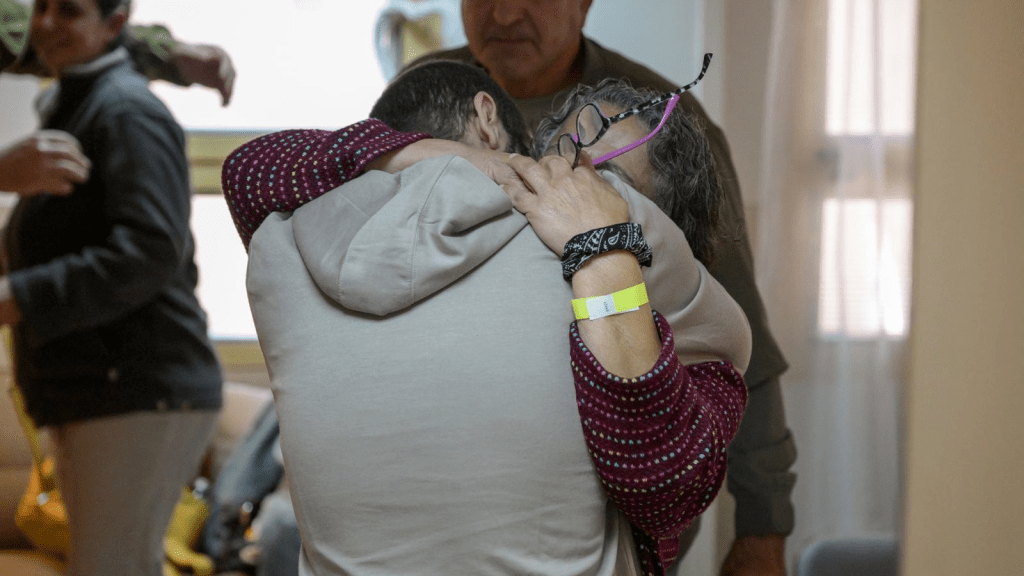
Israelis reunite with family members after being held by Hamas. Source: Sky News
The deal is structured in three phases, with each phase’s completion hinging on the completion of the previous, but ceasefires between Israel and Hamas have been broken in the past.
The first phase entails exchanges of captives, partial removal of Israeli soldiers in Gaza and aid towards Gaza. If the first phase of the deal is fulfilled, the second phase will see Hamas release all remaining hostages, Israel releasing more Palestinian prisoners and removing military presence from Gaza entirely. The third phase would see Hamas exchange the bodies of dead captives for a reconstruction plan for Gaza lasting three to five years under international supervision.
Given the history, the agreement is as fragile as ever, but with Donald Trump making his return to Washington, the dynamics have drastically shifted.
During Trump’s first term, he and Netanyahu were fond of each other, at least in public. After a testy relationship with former president Barack Obama, in which Obama and Netanyahu never saw eye-to-eye and had strong, public differences in policy, Trump was quite the change of pace for Netanyahu.
Trump recognized Jerusalem as Israel’s capital in 2017, a move that was widely seen as provocative. In a 2019 speech given in Florida, Trump declared, “the Jewish state has never had a better friend in the White House than your president, Donald J. Trump.” Netanyahu reciprocated the sentiment.
The ceasefire went into effect the day before Trump’s second inauguration. According to the Wall Street Journal, Trump’s Middle East envoy Steve Witkoff pressured both sides to come to a deal. In early December on Truth Social, Trump warned there’d be “all hell to pay” if hostages held in the Middle East were not released come the time he reassumed office:

The International Crisis Group attributes this development to Trump and his rise back to power: [Netanyahu] seems to have bowed to such pressure, likely out of a mix of motives that include deference to Trump’s political weight, concern with his unpredictability and desire to make a good-will gesture to the new president.”
They continue with a damning detail obtained from an Israeli official, “Netanyahu can say no to Biden, but he cannot say no to Trump.”
After not being able to reach a ceasefire deal from Oct. 7, 2023, to the time President Joe Biden left office, an agreement was reached and put into action between Israel and Hamas even prior to Trump’s inauguration. Two days before Trump’s inauguration, Netanyahu reaffirmed U.S. support for Israel from Trump and Biden.
“Both President Trump and President Biden gave full backing to Israel’s right to return to fighting if Israel reaches the conclusion that negotiations of the second stage is fruitless. I appreciate it very much. … If we need to resume fighting, we will do that in new ways, and we will do it with great force.”
If Palestinians are forcibly removed from Gaza, the United Nations has warned that it would be “tantamount to ethnic cleansing.” In a meeting with Jordan’s King Abdullah, Trump continued reinforcing his intention to “own” and rebuild Gaza.
“We’re going to take it. We’re going to hold it. We’re going to cherish it.”
Palestinian students vow to continue resilience
Regardless of how heavy the circumstances weigh, Palestinians say they are not giving into submission.
Chuli said she still feels hopeful going forward: “I have been attending protests for Palestine since early elementary school, and we as a people have never stopped fighting for what’s right. The movement has gained more awareness than ever before, and I hope others don’t let frustration or fatigue stop them from taking action.
“Protesting, calling representatives, posting on social media, donating and boycotting have historically pressured governments and corporations to change their policies. Even when times seem unhopeful, collective action has an impact, and we must keep going.”
Nogura spoke to the resilience of Palestinians, saying they “aren’t going anywhere.”
“The spirit and grit and determination that they have is stronger than whatever the administration or Israel will throw at them. You can threaten them, you can try to take everything away from them, but the people of Gaza have the strongest wills that will never be broken.”




 Velocity
Leave a comment