
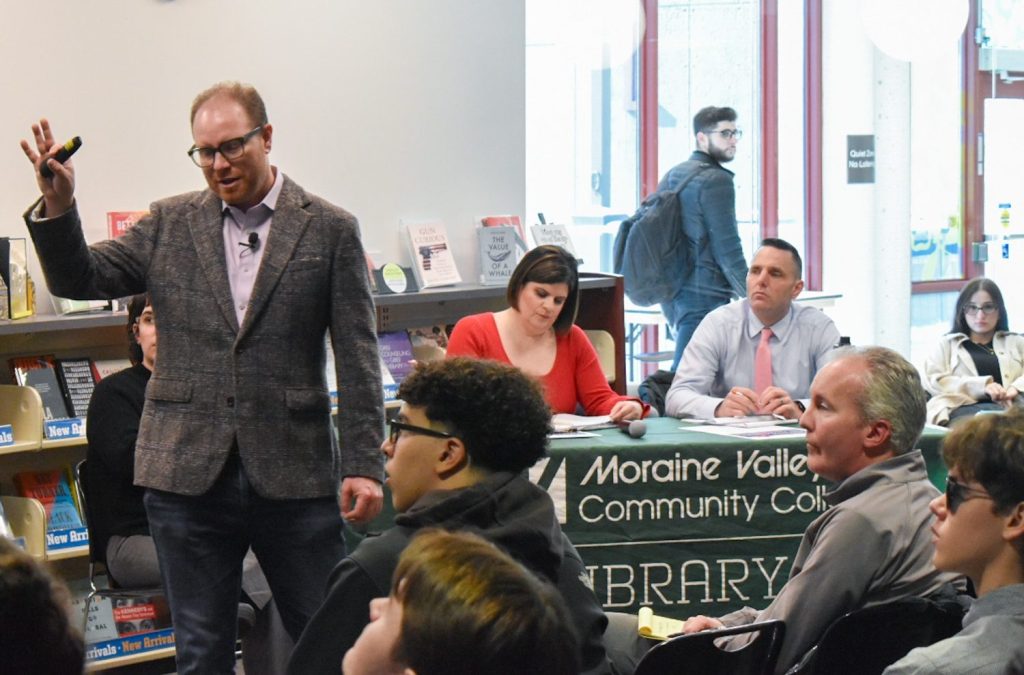
Renowned political analyst David Wasserman keeps a book on his desk as a reminder. The book is a “scouting report” sent to him by the Democratic super PAC American Bridge in late 2014.
“They sent me this book with all of their research, all their dirt-digging on the 20 Republicans they saw as most likely to be the Republican nominee in 2016,” he told an audience of 75 people crowded into the Moraine Valley library lounge to hear him speak on Thursday.
“And you know whose face is not on the cover of this book?”
Wasserman didn’t need to say Donald Trump’s name. Anyone seeing the book’s cover on the library’s projector screen knew who he was talking about.
The book serves as a fundamental reminder that “politics can take unexpected turns,” Wasserman said.
Wasserman is one of the most highly regarded political journalists and elections analysts in American media. He is known for his election forecasting, punchy “I’ve seen enough” tagline, which he uses when calling an election early, and according to Nate Silver, being “scrupulously nonpartisan.”
He visited Moraine Valley Community College on Feb. 13 to dive into the 2024 U.S. election results and more for an event hosted by The Democracy Commitment.
The event showcased Wasserman’s ability to analyze what transpired at the ballot box in November, including using Whole Foods and Cracker Barrel customers’ voting tendencies to quantify the culture gap in America. What Wasserman calls “Whole Foods Counties” tend to vote for the Democratic presidential candidate, while what he calls “Cracker Barrel Counties” tend to vote for the Republican presidential candidate.
In one of the “unexpected turns” of politics, after decades of a widening culture gap, Trump not only narrowed it in 2024, but he gained a bigger percentage of voters in Whole Foods counties (7 percent) than he did in Cracker Barrel counties (5 percent).
Despite Wasserman’s creative ways of crunching numbers and uncanny ability to get things right, he pointed out that even the people inside of American politics sometimes cannot predict what could happen next.
By 2028, he said, the issues that mattered the most in the 2024 election may be irrelevant. He hinted that artificial intelligence could become issue No. 1 in four years’ time. As what’s important to voters changes over time, so do the qualities a candidate needs to win an election.
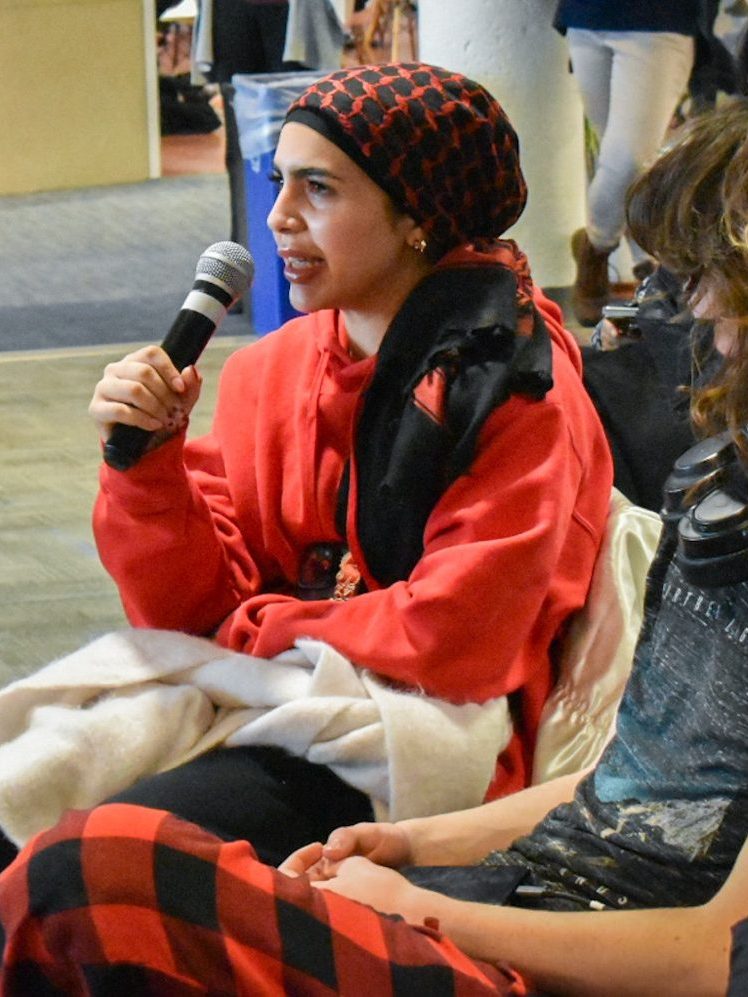
“The most valuable commodity in politics today is not necessarily being a certain point on the political spectrum where you’re closest to the media voter, but it’s authenticity,” Wasserman stated. “It’s the ability to convey to your audience that you believe what you say.”
Wasserman contributes to NBC News, has appeared on numerous major television networks and has more than 600,000 followers on X. So why come to Moraine Valley? Why come to a community college campus?
The event’s origin can be traced back to a botched Uber ride and a conversation with Moraine Valley history professor Merri Fefles-Dunkle at Oak Brook Mall.
“He was giving a lecture at the Illinois Manufacturers’ Association luncheon,” she said. “My husband was invited, and I came as his guest. Afterwards, we were all waiting outside for our respective modes of transport, and David’s Uber went to the wrong Gibson’s Steakhouse.”
Wasserman needed to get to the airport, so Fefles offered him a lift. Wasserman was initially worried that it was too big of a favor to ask, but Fefles’s husband insisted he take the ride because if not, she would have gone into Nordstrom’s and spent money.
Wasserman didn’t come to Moraine Valley just to do Fefles-Dunkle a favor. Doing the event had a deeper meaning to him.
“I’m much more eager to meet with a broader cross-section of students than a narrow one,” Wasserman said. “I feel like too many political journalists and analysts are going to the same rotation of colleges and universities, and it’s becoming an echo chamber that’s damaging discourse among our field, but also not promoting an exchange of information among a wide enough group of young people.”
He later shared that coming to Moraine Valley for the event was probably going to be his favorite thing he was going to get to do all month.
Fefles-Dunkle emphasized how great it was to have Wasserman at Moraine Valley: “David’s a pretty big deal … The fact he’s coming here and sharing information he’d usually share on the news or circuits, it’s a big honor for us … It’s a really great opportunity for us to have somebody who normally wouldn’t get a chance to come here.”
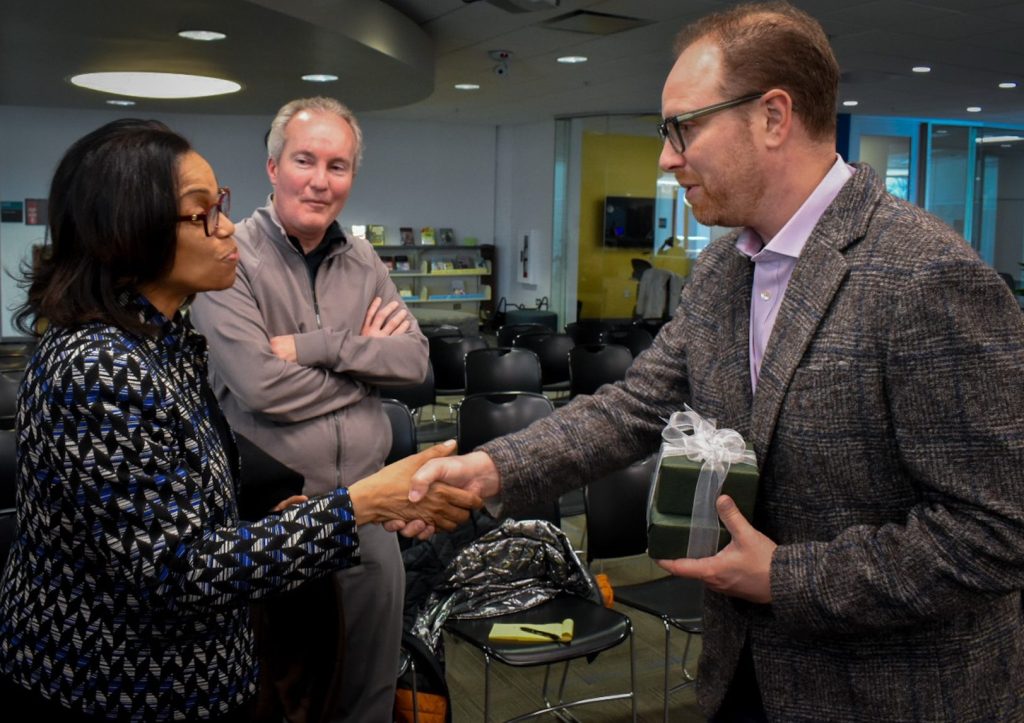
Moraine Valley President Pamela J. Haney echoed that sentiment: “We’re honored having him. It is very fortunate to hear his perspective on political matters in these times.”
Political science professor Kevin Navratil, who is the coordinator of The Democracy Commitment program, was thrilled Wasserman was able to come to campus.
“I think he cares deeply about civic engagement and highlighting civic literacy,” Navratil said. “I know it’s an event we’re going to be able to record and share with students for semesters to come.”
Moraine Valley student Joshua Arana appreciated some of the presentation’s main points, saying, “I thought it was very informative. I think it hit on a lot of key aspects of the election and the coming years of the new presidency.”
Wasserman examined why voters voted the way they did in this election, and some of that discussion resonated with Arana, a history major who found himself disinclined to vote for Kamala Harris.
“A big thing for me, my friends and family was Kamala’s stances – how she kept leaning more towards the left and more liberal. I don’t think me and a lot of the people I know were looking for that, we were looking for candidates coming more towards the center.”
The presentation broke down the 2024 election into several key points, including how cost of living impacted votes. Wasserman also pointed out that Trump’s base of supporters come out to vote mainly for him and not Republican down ballot. He injected humor and personal anecdotes into his presentation.
Audience members took note of Wasserman’s intention and ability to stay neutral.
“I think he did a good job at remaining unbiased, even if he had his own opinions — not really swaying to either side,” said Moraine Valley student Ayaa Mahmoud.
Sociology professor Alison Lacny described Wasserman’s talk as “straightforward” and “very objective.”
“I think the entire presentation presented real facts, the numbers and issues on both sides,” Lacny said. “Students who come from different political opinions were able to just understand the political voting patterns that happened across different elections.”
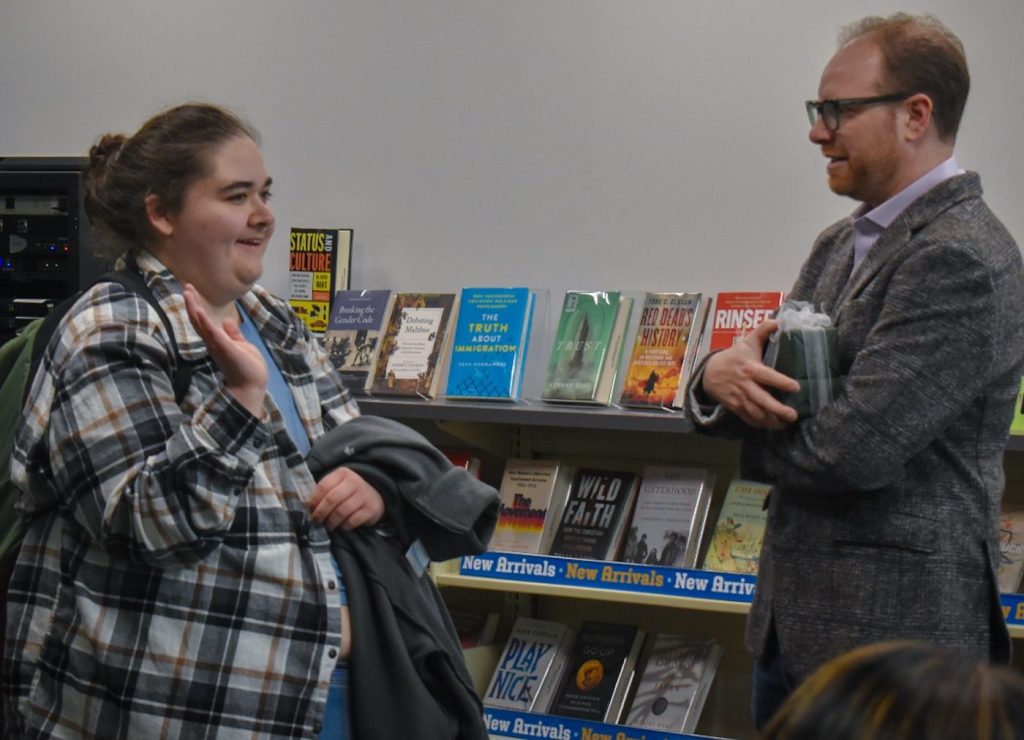
When asked if being nonpartisan is something he thinks is important to maintain today in today’s political media landscape, Wasserman said, “Yes, especially because it’s increasingly rare. I’m not going to tell you that I don’t have my own personal feelings and opinions, but I do believe that for the sake of our credibility and assessing what’s happening in politics, we have to be ironclad in keeping those to ourselves.”
Wasserman had a hopeful message for college students about what young people should be doing in the coming years.
“My biggest piece of advice to young people would be to approach as many politicians and advocates as you can,” he said. “Don’t assume that because you’re a college student they won’t want to talk to you. They were all in your shoes at one point. It never hurts to ask someone that you look up to for lunch or coffee.”


 Velocity
Leave a comment