
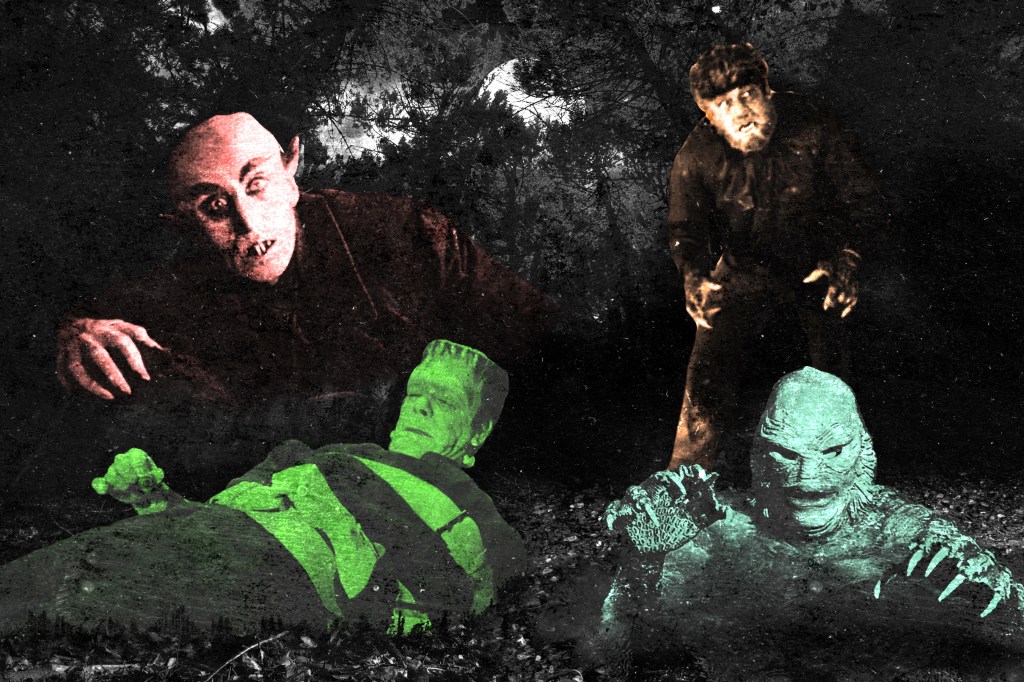
“It’s alive! It’s alive!”
These words first haunted audiences everywhere in 1931. The image of Frankenstein’s monster and the terror he represents became emblematic of an era. And in the 94 years since he was born on screen, our fascination with movie monsters has only continued to grow.
Nosferatu had just been remade, along with a Wolf Man adaptation, and monster fans can expect to see Frankenstein and even The Creature from the Black Lagoon return to the big screen in the near future, with Universal Studios Orlando also set to open a section of their park dedicated to these classic monsters on May 22.
Why is there so much emphasis placed on revisiting these frightening stories? The answer lies in ourselves, how we as people fuel the need for these fiends to rise from the dead.
“The monster’s body is a cultural body” is the simple explanation from Jeffrey Jerome Cohen, author of Monster Theory: Reading Culture. Interestingly, taking a deeper look into why we’re getting these tales are being resurrected can help us take a deeper look at ourselves and our current frame of mind.
What we’ve seen
Nosferatu
1922: The original telling of this story follows the vampire Count Orlok, as he preys on the wife of his real estate agent, with deaths following the count’s arrival into the small town of Wisborg. The 1922 version of the movie was released just a few years after 50 million lives were lost worldwide to the Spanish flu in 1918-1919. It’s clear to see how the invasive nature of the Count mimics that of an infectious disease: Rats surround his every move, and even more directly, illness spreads through the town upon his arrival. The dread of deadly plague was still present in people’s lives upon the release of the film, meaning that audiences everywhere could see that reflected by the count’s sickly presence.
2024: The current retelling follows the same story. However, it does not maintain its focus on an external fear but instead shifts its attention towards an internal threat. People may find that the fears are more emphasized on the shifting perspective on women. Ellen, the wife of the real estate agent, is not portrayed as innocently as she was in the original. Instead, she seems to be much more torn between her internal world and the outside. She faces inner turmoil with her shame and sexual desires. This reinvention of the story gives us a further glimpse into the female reality of being viewed as a one-dimensional entity, rather than a fully formed individual. She’s continuously seen as “unruly,” while in reality she’s battling torment from an outside source. People still perceive women’s issues as overlooked and fear that more restrictions will be put in place. This version of the tale turns its attention from that classic romanticism found in vampire movies to instead showcase the growing concern over the social status of women as a group.
Wolf Man
1941: The most famous werewolf movie of all follows a simple blueprint. In the early version, The Wolf Man, we witness Larry Talbot, our main character, as he battles with his morals between his two forms, wanting to stop the inevitable evil he brings upon people. The movie places emphasis on an original poem, stating, “Even a man who is pure in heart and says his prayers by night may become a wolf when the wolfbane blooms and the autumn moon is bright” — a direct reference to the idea of an inseparable dual personality. This film’s message is one that transcends time. People will always be multidimensional, showcasing both positive and negative characteristics of each other, and while we may try to constantly present ourselves to be perfect, the reality is far more complex.
2025: The reboot, Wolf Man, more definitively reflects our time, providing a commentary on the cycle of generational trauma. We see the consequences of being a flawed parent in scenes showing a few different generations. As these flaws become highlighted, so does the separation from being human and becoming more of a monster. This telling seems to be more clear on its metaphor toward its audiences, and attempts to tie the image of the werewolf to something its viewers may be more familiar with. In our current time, many people are focusing on the topic of generational trauma, advocating for change and awareness.
What to expect
Frankenstein
1931: The original film depicting Mary Shelley’s famous tale showcases the monster as a misunderstood figure with a limited understanding of the world around him. Due to the monster’s grotesque appearance, many people, including the film’s Henry Frankenstein himself, have been quick to dismiss the monster, causing his behavior to swing from innocent to hostile. This film was released just before the Hays Code, which was written by a Catholic publisher to enforce the presentation of certain morals in film. This specific telling was shocking as it chose to explore the religious themes of man vs. God at a time when daring to ask such questions was frowned upon in the industry. The film is not only an outcast story but a significant symbol in moral exploration at the time.
2025: Needless to say, we can expect to see another outcast story following the monster. After the social barricade that occurred due to the COVID-19 pandemic, many people have found themselves facing challenges reconnecting with people or learning how to communicate in a face-to-face setting. Additionally, the decline of religion in the western world means fewer constraints on exploring and evaluating religious topics. Although this film has been in the works for some time, the release of it now seems more fitting due changes in culture.
The Creature from the Black Lagoon
1954: The original version of this tale was released in the 1950s, the peak of America’s scientific curiosity. The structure of DNA, the polio vaccine and even the Mid-Atlantic Ridge’s role in continental drift were all discovered just prior to this film’s release. The story follows a group of scientists and their discovery of an anthropomorphic amphibious species in South America. As they investigate the creature and its potential to be studied, it fights back and will not allow the scientists to leave its habitat alive. The film highlights the potential danger in the unknown nature of these scientific encounters and even urges audiences to question the ethics of these discoveries.
202?: With today’s fears of the effects of climate change and rapid depletion of resources, a remake of The Creature from the Black Lagoon can be expected to be told from an environmental perspective. A retelling would follow Gil-Man’s retaliation against people’s invasion of his home. As we experience the effects of human tampering in the world firsthand, reframing the image of this classic creature could help to highlight the panic and the calls for action about the perseverance of the natural world.
Fear will always remain a human emotion, and no other storytelling method could encapsulate this as well as Gothic horror. As we grow more aware of our anxieties, a story will always come along to memorialize that terror. The recycling of these tales should not be seen as just a matter of making money, but as a reflection that we’re not as different from people decades ago as we may think ourselves to be.

 Velocity
Leave a comment