
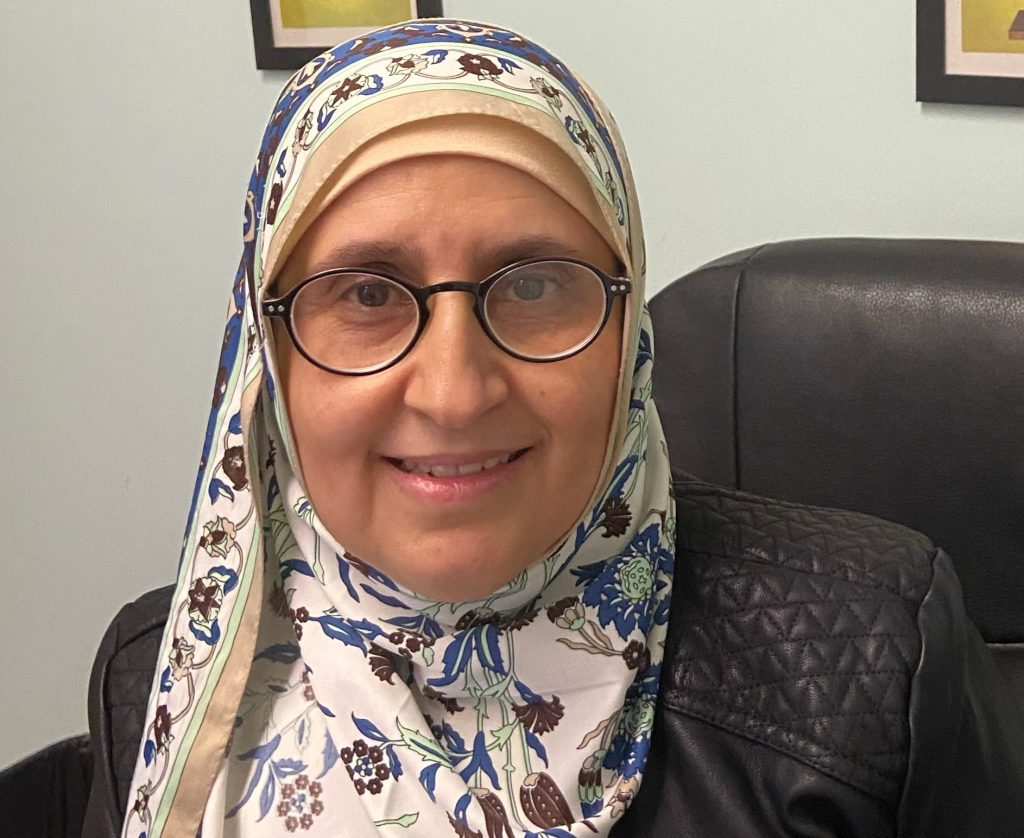
Dalila Benameur, an admired figure at Universal School, humbly described herself as “not always a leader.” Despite the tough persona her students often see, she thoroughly broke her life into bits and pieces that revealed an incredible transformation into the confident figure she is now.
The chaos of papers and books covering her desk were a testament to college application season and the weight of her responsibilities as the school’s only academic adviser. Universal School is an Islamic, religious, K-12 private school located in Bridgeview.
The stress momentarily left her face when asked about her childhood. She reflected on the earlier moments in her life, the moments when she played the role of a follower. This image of her was so inconsistent compared to the confident educator, mentor, and courageous woman she is known as, it was difficult to picture her differently, a more submissive version of her.
Born in Algeria, Benameur recounted that she spent much of her early life in the Parisian suburbs where she was constantly trying to “fit in.”
“I was always in the background,” she confessed, shaking her head in disapproval of her past self.
She moved constantly in her younger years because her father was an electrician, and he would work on different construction sites. Despite the societal expectations for immigrant children to pursue vocational paths, her mother had encouraged her children to graduate high school and earn a university degree.
Although her mother was illiterate, she attended every event, every parent-teacher conference, and constantly advocated for her children’s education. More than just focusing on education, her parents instilled values that kept her disciplined and on the right path.
About the author
Yasmine Aljuba is currently studying to become a Physician Assistant. A proud Muslim, she’s the first in her family to pursue a career in the medical field, having a passion for wellness and skincare.
“I’ve always said, I don’t know what it is that my parents did for us to be protected,” she said, her voice softening, “because I can tell you that I had friends who did drugs. I had friends who were very promiscuous and got sick. I had friends who were forced to go through an abortion after four months.”
Her parents had instilled in her and her siblings a keen sense of responsibility and respect for their values, helping them avoid temptations: “I always knew. My mom made it clear. My dad made it clear. There is only one way, one direction.”
She mimicked a familiar gesture, pointing her hand forward like an arrow. It was a gesture she often used while teaching me AP U.S. History in tenth grade. “I got that from my father, and it’s always stuck with me.” Her parents always emphasized that the path their children were on was for their own good. “What my siblings and I did wasn’t for our parents—it was for ourselves, for our future.”
After high school, Benameur initially planned to study International Commerce due to her love for diversity and desire to travel the world. However, during the program she discovered she was most fascinated by history and law. “I loved everything about the program except the business and marketing part,” she laughed. This realization led her to transfer to the history department, a time that she described as the hardest-working, but most fulfilling, period of her life.
“Every paper, every assignment, I loved it,” she explained, showing how, when someone finds their true path, the amount of effort does not matter if they are passionate about it. From the University of Paris, Benameur obtained a master’s degree in British and American Civilizations and Literature, followed by a post master’s degree in Women’s Studies.
Although her parents prioritized education, faith was not something they strongly emphasized. For Benameur, being Muslim was merely a label, something she never deeply understood.
While she adhered to basic practices like avoiding pork and fasting Ramadan, that was the entirety of her connection to Islam. She admitted that, growing up in France, she had a fundamentalist mindset, lacking a true spiritual connection. Her family had never particularly embraced Islam as a sense of spirituality. Islam as she knew it was shaped by cultural values rather than the authentic teachings of the Quran or the Sunnah.
Her time in Chicago, however, proved to be a spiritual turning point in her life. Leaving France alone for the first time to go to Chicago for her master’s research on African American culture, she was immediately hit by the cultural shift. In France, religion was disconnected from daily life, but in Chicago, she encountered a Muslim community that practiced Islam openly.
For the first time, she visited her local mosque, surprised to meet women who, despite wearing the hijab, held professional positions in various fields. These women were not limited by their hijab; they wore it proudly in their professions. She came to the liberating realization that one could have both professional ambition and religious devotion—it did not have to be one or the other.
In France, she had viewed professional success and religious devotion as opposing forces, but in Chicago they complemented one another: pausing from work to pray, to remember God, added more purpose to her day.
She found herself surrounded by the Muslim community more, attending lectures at the Mosque and engaging in discussions about faith and life. She recalled a time her understanding of her faith was completely altered when she attended a lecture at a mosque that clarified the difference between culture and Islamic values. She explained that through a cultural lens, Islam presented itself in a way that lacked true connection. “The culture is totally detached from the religion,” she said, her eyes widening as she elaborated that she was, “fascinated when [the lecturer] started talking to us about women in Islam. It broke down everything that I had been taught.”
What amazed her most was learning about the rights that women hold in Islam. It was as if a veil had been lifted as she realized for the first time that they had a seat at the bargaining table. She thought, “Oh my goodness. You’re saying that we have lots of rights?”
The lecture cleared up the misconception that wearing the hijab was an act of oppression, revealing that it was a symbol of autonomy and identity. She gestured a circular motion with her hands, indicating a complete change in perspective, a sense of connectedness that reversed her thinking.
In Chicago, she admired the peacefulness she found in the mosque, the warmth of fellow Muslims who would pass by saying “Salam.” Inspired by their faith, she felt compelled to pick up her own books and study Islamic teachings. Yet, as she began this journey, she was both confused and excited.
This was all so new to her; she did not know which teachings were considered “authentic.” Most of all, she was eager to clear the misconceptions she’d held in France, to be free of the fundamentalist mindset she held.
The impact of the Islamic teachings was so profound that she “embraced it” and it was this deepened understanding that marked the beginning of her spiritual and personal growth. She decided to wear the hijab – one of the most defining moments of her life.
She was living with her cousin and his wife. One day, her cousin knocked on the door to call her for prayer, waking her from a nap. “Get out of here, I’m hijabi now,” she proclaimed. She laughed at the memory of how surprised her cousin and his wife looked: “Even I didn’t quite know what happened, but that was it.”
Although she committed to wearing the hijab from that day forward, she worried she would take it off when she returned to Paris, knowing that she would be the only woman in her family and her community who wore it. Internally, she loved the hijab and did not want to remove it, but the pressure of society intimidated her, making her feel isolated.
She imagined she would lose so much in France – her job at the airport, her friends, and even the support of her relatives. The weight of these potential losses took a toll on her, but nothing would overcome her reclaiming her identity. She was making a powerful statement about her devotion to God.
She knew that her freedom would be conditional in France. Wearing the hijab there would be seen as an act of defiance against a system that claimed to preach and uphold freedom. It was a challenge to the unspoken rules of how women, particularly Muslim women, should present themselves.
Her parents, in France, concerned for her safety, were not in favor. Her mother worried that the hijab might limit her educational opportunities and diminish the respect she received from those in charge. Everything her mother had worked so hard for – her education and future – could potentially be jeopardized. But it was not just a piece of cloth to Benameur; it was her identity, part of the woman she was becoming.
One night, as she lay in bed thinking about who she was, she had a moment of clarity: “You know what? That is it. I will never separate from my scarf until death.” She no longer had fears about her hijab when going back to Paris. She continued with the same assertiveness and said, “I knew I might lose my job, might be kicked out of college, but I also knew that God would open doors for me.”
Upon completing her research on African American history, she returned to France. “Of course I lost my job,” she said with a casual shrug, brushing off the memory as if it was no longer painful to recall, simply another part of the bumpy road she endured to become who she is today. Prayer calmed her and restrengthened her with the knowledge that all of this would be temporary.
“The airport would never accept a woman in a hijab. It was the late 1990s, and they were not ready for that.” She would not find a job for another year and a half. The struggle was challenging, yet somehow, it also reinforced her faith. The decision to wear the hijab was more important than her job.
She lost her closest friends, who could not accept her decision not to join them at bars, and faced hostility from professors who gave her a tough time, though they could not fail her because her work was flawless and on time. The isolation she felt was overwhelming. Every day, she endured these challenges alone, hiding her emotional struggle.
She spoke with disgust as she talked about the hypocrisy of a society that claimed to know democracy while denying her freedom to practice her faith. She recounted a time during her post-master’s degree in Women’s Studies in France when she defended her thesis. The head of the program asked about her plans after the program, and when she mentioned applying for a PhD, the head bluntly responded, “I do not think this is the institution for you. We do not share the same values.”
She replied sharply, “I find it quite sad and shameful that someone who works in Women’s Studies would say that to me. I guess you are right. This is not the institution for me.”
She walked out of the room with a sense of clarity—that nothing about her had changed—it was the people around her who could not look past their shallow, hypocritical perceptions of her. “If anything, I was better, but all they saw was the scarf.” From that moment, she fully recognized her worth and planned to return to the United States to continue pursuing her path, knowing she had nothing to prove to anyone but herself.
Once she arrived in Chicago, she said she had given herself the length of her visa to find a job in the United States. Within five days, she had secured a job at Universal School, not expecting it to be long term. She explained that she planned for it to be temporary, that college-level education was her goal, “but my heart kept me here,” she confessed.
She loved the community and wanted to give back to them, teaching from her own experience. She did not just want to educate her students, but guide them through the same struggles of identity and faith that she went through. “You don’t stay in a position that does not pay unless you have a calling,” she said. It was her time in France, where she lacked a supportive community as her backbone, that fueled her desire to become a source of guidance for others.
She mentored students and reminded them of the potential they have, regardless of where they come from. For Benameur, leadership was not just about guiding others but learning from them to better yourself. She learned so much from the students at Universal School. Watching them read and write Arabic fluently inspired her to learn the language as an adult.
“My number one regret was not discovering my faith earlier,” she said. “I wish I had known then what I know now.”
Benameur did not regret her actions or sins–her parents raised her with disciplined and strong values. What she regretted was not having the deep connection with God sooner. It was not about mistakes she made, but about the missed chances to experience the fulfillment her faith now brought her.
Every morning, she now wakes up with a sense of purpose. If something did not go her way, she knows it was part of God’s plan. The community she found embraced her fully, encouraging her to grow, never showing cruelty or hostility. Learning about her faith empowered her, guiding her to be the best version of herself. What she once saw as obligation after obligation was a source of happiness, equality and purpose. Islam, she realized, sets the path for people to be successful in this life and the next.
Has she ever regretted wearing the hijab? “Absolutely not. I am the happiest ever because I know one thing. That hijab is what empowered me.”
Later, her mother also began wearing the hijab, realizing it was not a barrier to success, instead a symbol of strength.
Benameur’s leadership extends into the role she plays in Universal School as an academic adviser. She encourages students to embrace who they are and to follow the path they are passionate about.
“Never be afraid to be yourself, It’s easy to want to fit in, to be just like everybody else,” she says. “But then, what kind of diversity do you bring? What experiences do you offer if you are just like everyone else? Can you imagine a society where everyone is the same?”
Today, Benameur ensures her students learn about their faith early on and organizes the annual senior trip to Makkah and Madinah for Umrah. She transforms her past regrets into future possibilities for her students.
I was fortunate to be one of those students.
This trip is no ordinary journey. It requires spiritual connection long before leaving Chicago for Saudi Arabia. Benameur organizes workshops to prepare students spiritually for Umrah, ensuring they experience a genuine connection with God. During one workshop, a Sheikh, while speaking about the Prophet (PBUH), broke into tears, leaving everyone moved. It truly put everything into perspective for everyone, making them realize we could all be doing better.
As soon as one trip ends in May, she begins preparing for the next. She handles everything—from tickets and hotels to chaperones, passports, and reservations. She takes on the role of the students’ safety, particularly for the girls. With nearly two decades of experience leading the trip, Benameur knows exactly the protocol in challenging times. For example, she dealt with students who needed to go to the hospital from sickness or fatigue. Saudi Arabia is like her second home, as she returns every year. Her calmness and leadership ensure that no matter the difficulty, she will get through it.
Thanks to Benameur, the senior trip was much more than just a ‘vacation’ – it became an experience that allowed me to bond spiritually with my friends and create unforgettable memories. I saw the Kaaba, the House of God, standing beside the girls I grew up with. I prayed in the Rawda, the place where the Prophet (PBUH) is buried, beside my friends, sharing an incredibly vulnerable moment as we all cried.
I will never forget when one of my friends, sobbing, said, “Everything in this life is just a delusion; the only thing that matters is our relationship with God.” It was a surreal moment that touched us all deeply.
Praying in the Rawda was the highlight of the trip for me. Benameur had told me beforehand that it was her favorite part as well. Though it lasted only five minutes, it felt as though my whole life flashed before my eyes. In that brief moment, I became aware of everything that I needed to change to better myself. That single moment inspired me to put everything into perspective and prioritize my religion.
When I returned to Chicago, I became more conscious of my actions, the way I dressed, and how I spoke to people. Most importantly, I learned the value of patience. The trip required a lot of patience, especially in such a large group. Whether it was walking around the Kaaba (tawaf) and being pushed by the crowds, or waiting as the entire class stopped for one person to use the bathroom, there were frustrating moments, but we all had to deal with it.
The senior trip was not always inclusive, Benameur said: “I wanted to extend the trip to the girls because I had great memories of my educational trips in France. I remember how much we learned about ourselves, science, and history.” At that time, Saudi Arabian laws prohibited women from traveling, eliminating Saudi Arabia as an option for the trip.
Determined to make it happen, she planned to start the first trip to Paris, because she was familiar with it and her family was there in case of emergencies. She proposed it to the board, but it took two years to gain their approval. The community would not respond well, saying things like “How do you want to take our girls overseas? Are you crazy?” It was atypical for families to let their daughters travel, let alone abroad.
To gain community support, the founder of Universal School joined the trips with his wife during the initial years. Since 2016, following changes in the Saudi law regarding women, Benameur has been able to include the senior girls. This year’s trip included more than 60 students, both boys and girls.
If it were not for Benameur’s selflessness and management in organizing the senior trip, I might not have embraced my faith or discovered my identity at an early age. The trip not only inspired me; it touched so many others, including my older brother, who went in 2022.
When he returned, I remember him saying, “That was undoubtedly the best time of my life. I never felt more at peace. It was as if all my years at Universal School were leading up to that moment of seeing the Kaaba and experiencing Umrah with my closest friends.” I did not know what he meant until I experienced the trip myself, and I wholeheartedly feel with him.
The trip has also inspired several of my classmates, some of whom came back from Umrah and decided to wear the hijab, demonstrating their commitment to God.
I am deeply grateful for Benameur’s time and effort, not just for what she has done for me, but for the countless lives she has touched. Through her dedication, she continues to light the way for others to find their own identities.



 Velocity
Leave a comment