
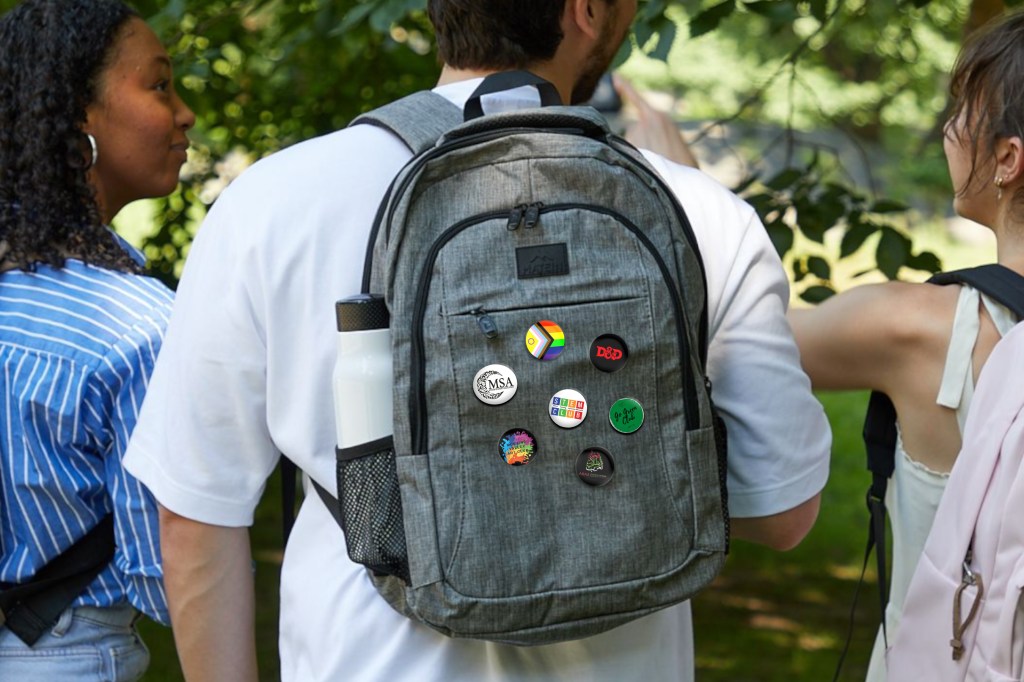
Artist. D&D Nerd. Arab Student. Baseball Player. Autistic. Writer. As we grow up, we all label ourselves in different ways.
For most students, college is a continuation of their identity formation. They seek out which labels to embrace as individuals and which groups they want to belong to. But that process actually started long ago, when they first became aware of who they are and the world around them.
“A lot of an individual’s identity is going to come either from their family, or their friends, their upbringing, maybe their religion,” says Sharon Brennan, a counselor in both the Counseling and Career Development Center and the Disability Services Center.
“Someone’s identity might also be coming from their personal mental health and how they see that.”
If you spend five minutes in a Moraine Valley classroom or anywhere else on campus, you will see students from all walks of life—all ages, ethnicities, religions and career paths. There will also be identities you wouldn’t immediately see– “invisible” identities such as mental health disorders, neurodivergence or specific interests.
“I think that identity is individual and personal. And people identify themselves in the ways that are the most important to them, or are the most reflective of who they are and what represents them.”
Sharon Brennan, Faculty Counselor
Pre-existing identities carry over into college, affecting students’ self-perceptions, interactions and behaviors. If someone is an athlete, for example, they might hang out with other student athletes. Every college student wants to belong in a group that helps them figure out who they are.
In fact, seeking out community and belonging is a fundamental part of identity formation. People pick up their values and beliefs from the society around them, whether consciously or not. The resulting mindset then becomes a core part of that individual’s identity, and labels are chosen based on these viewpoints.
People then interact in a way that seeks to confirm these identities, leading to a self-reinforcing pathway between the individual’s society and their identity.
“It’s making sense of themselves,” says Brennan. “And I think that identity is individual and personal. And people identify themselves in the ways that are the most important to them, or are the most reflective of who they are, and what represents them.”
Education is one way that people form their identities. College accelerates the process by providing numerous opportunities for self-discovery and growth in every field. Whether that is discovering a dream career, engaging with favorite subjects, or spending time with peers, college students have plenty of identities and communities to explore in that period of their lives.
“Since I’ve become a student at Moraine, I was always very interested in the clubs here, and one of the clubs was Arab Student Union,” says Latifa Almatahen, head of the ASU. “And as a part of that club, I’ve developed many friendships, skills and memories. I’ve made so many memories. And through that club, I’ve learned so much about Arab cultures. I’ve connected to it personally.”
Our brain plays a role in shaping our identities, as it controls what values and traits we regard as most important, based largely on its unique composition. For example, if someone is more involved with creative endeavors, then those traits will be predominant in their behavior and identity. That will make them seek out further opportunities to explore and expand their creative mindset, such as hanging out with other artists and taking Humanities courses.
“There is this part of the brain called the ‘default mode network,’” says psychology professor Laura Lauzen-Collins. “And the default mode network plays an important role in identity, and how we see ourselves. We do need to have time when we are accessing the default mode network. That network seems to be activated when we are bored, and we are not thinking about other things.”
Labels can be helpful or harmful
Of course, that is a normal part of brain function. But what about students whose brains work differently, whether due to mental disorders or neurodivergence? Actually, they still have identity formation, just in a different manner from most people. And that makes their cognitive differences a big part of their identities.
“Commonly with neurodivergence, with individuals who have autism, they might actually prefer me to say that they’re autistic, because it’s such a big part of their identity,” Brennan says. “It’s such a big part of the way they may live their life, and the way they interact.”
Despite what some people think, neurodivergent people and those struggling with their mental health absolutely want to have some sense of community and belonging in their lives. But the negative labels they face, both from society and themselves, can hamper that process.
For example, if someone is dealing with depression or anxiety, people might label them a “weirdo” or “anti-social” and avoid associating with that person. That student then feels rejected by their peers. They might even accept these labels as an excuse to not do their best in college.
“Mental health is something that if it is not being managed and taken care of, the ways it could negatively impact your identity are that you’re not able to be your best self, you’re not able to show what you can do, you’re not able to show up to work or class the same way that you know you can,” Brennan says.
But the good news is that awareness of mental health, and support for students with these issues, have grown exponentially over the past decade. This awareness has led more college students to be open about their mental health and build communities around these shared issues.
“There is much greater knowledge and accessibility to these labels than there was in the past,” says Brennan. “Oftentimes, I will hear students talking about mental health issues, and labeling themselves or labeling others with these labels that were not as well known in the culture 20 years ago.”
This is also the case for neurodivergence in college. More campuses are providing accommodations for different ways of processing information, and more students are open to asking for these aids. Besides facilitating academic success, these accommodations enable neurodiverse students to spend more time both with each other and with their neurotypical peers.
Socialization in college builds identity
College students interact with each other in all sorts of ways. Whether through quick greetings in the hallways, in-depth conversations about shared interests, or comments on a classmate’s online assignment, socialization is as much a part of identity as it is a contributor to it.
And Moraine Valley offers lots of opportunities for its students to spend time with each other. From classes with small sizes, to campus sports and plays, to library events and even in Canvas classes, people are building identities and relationships constantly at Moraine.
In addition, there are multiple college groups for pre-existing identities, from the Arab Student Union to the Dungeons & Dragons club.
Clubs may have a lot of member crossover, owing to students’ component identities interacting with each other. Engaging across interests leads to more diversity, both in participant identities and viewpoints.
“When you start to get greater diversity, in terms of gender, in terms of ethnicity, country of origin, age as well, that can lead to a richer community,” says Lauzen-Collins. “You’ve got more diversity of experiences. That would also lead to more interesting gameplay.”
Increased diversity often changes both individuals’ and groups’ identities in a positive way. When Dungeons & Dragons first came out, it was confined to a small audience of “nerds” who were shunned from youth society.
“It’s considered a ‘nerd game’,” says Kipp Cozad, manager of tutoring and literacy at Moraine Valley, who is the adviser for the D&D club. “Only nerds play this game because it’s a game of the imagination. And it’s made up of all these different rulesets that you have to know.”
But now that “nerd stuff” is mainstream culture, players can openly express that identity and connect over it regardless of factors such as age, race or gender.
“Changes within the group can also change how you label yourself,” says Lauzen-Collins. “You might feel more or less connected to a group, and thus more or less likely to use the label, depending on how the group itself has changed.”
Communication between different groups and their members can also help to dispel harmful stereotypes, enabling students to understand each other better.
“It’s not wrong to also have other cultures and ethnicities, to collaborate together and share experiences,” says Almatahen. “And I think that helps us understand each other on a worldly level.”
No matter what identities a student has, or which ones are most important to them, they all have something in common—looking for a group, a tribe to call their own.
“In terms of the individual, is there a benefit to belonging to a community, or several communities?” Lauzen-Collins says. “Absolutely! It gives people a sense of belonging. And that sense of belonging is something that everybody craves.”


 Velocity
Leave a comment