

Many significant contributors to culture over time, such as Francis Ford Coppola and Angelina Jolie, have dealt with mental health issues. And some audiences are completely unaware.
Despite progress being made in recent years, mental health issues are still stigmatized. People who struggle are often backed into a corner, only allowed to live their lives according to society’s rules.
But mental health issues do not define a person. Some people overcome them and even use them to their advantage.
We are talking about some of the most influential people in pop culture. With some, their issues are not well-known. With others, their problems are in the spotlight and sometimes even integral to their art.
Francis Ford Coppola, director of The Godfather series and other critically-acclaimed films, was diagnosed with bipolar disorder in 1977. According to the book, Godfather: The Intimate Francis Ford Coppola, Coppola struggled with a deteriorating mental state during the production of 1979’s Apocalypse Now.
“During postproduction, in the fall of 1977,” the author writes, “Coppola was diagnosed by a psychiatrist as having manic-depressive tendencies, for which lithium, a tranquilizer, was prescribed. Because Coppola did not want it bandied about Hollywood that he was taking medication, he arranged to have the prescription written under the name of Kurtz.”
Outside of this excerpt, there isn’t much information available on Coppola’s condition. Coppola dealt with a string of problems and crises during the making of Apocalypse Now, but the culmination of it all appears to land on this diagnosis.
Mental health issues do not define a person. Some people overcome their mental health struggles and even use them to their advantage.
Coppola is universally regarded as one of the best directors to ever live. His movies, specifically the first and second Godfather movies, have left legacies essential for any film lover. It’s difficult to have a conversation about the history of cinema without mentioning Coppola’s name. His work will continue to be passed on from generation to generation long after his time as a director, and his time on Earth.
But Coppola wasn’t the only major contributor to pop culture to have suffered from mental health issues, as evidenced by the movie Girl, Interrupted, directed by James Mangold.
Winona Ryder and Angelina Jolie, costars in the drama, both managed depression. Ryder also had anxiety, while Jolie struggled with self-harm and obsessive-compulsive disorder (OCD).
There is much overlap between the plot of Girl, Interrupted and the real-life conditions of Ryder and Jolie. The plot follows Susanna Kaysen, played by Ryder, and Lisa Rowe, played by Jolie, both patients at a psychiatric hospital. Kaysen is admitted to the hospital aftering attempting suicide and is diagnosed with borderline personality disorder. Rowe is a diagnosed sociopath.
Kaysen and Rowe have an up-and-down relationship throughout the film, and some read their characters’ interactions and evolving dynamic as having queer undertones. Rowe is charismatic and disobedient, and Kaysen seemingly has an infatuation with her. The two of them get to know each other, and Rowe influences Kaysen to rebel against the hospital’s rules, staff and treatment.
As the film goes on, Kaysen begins to realize the things she doesn’t like about Rowe. Rowe exemplifies tendencies to be inconsiderate, selfish and heartless, especially at the most crucial moment in the film. Kaysen changes her ways, cooperating with her treatment and making real progress in an effort to be released from the hospital. When leaving the hospital, Kaysen departs on good terms with Rowe.
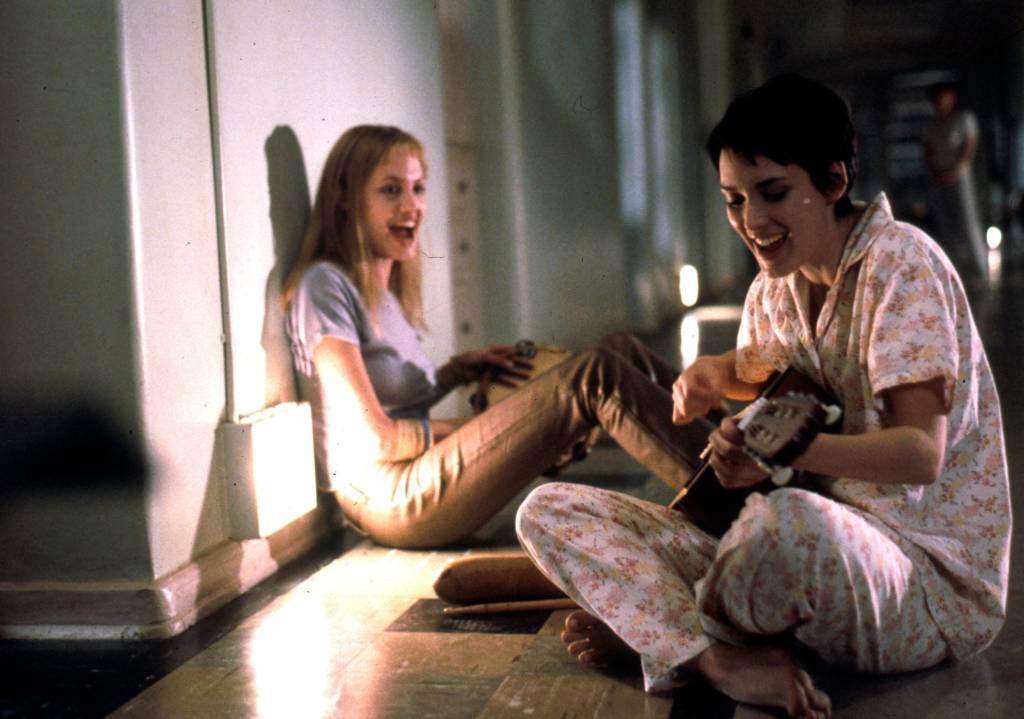
Girl, Interrupted has become a cult classic of sorts after getting lukewarm reception upon release. One thing that has remained constant is the acclaim for Ryder’s and Jolie’s performances, for which both actors were nominated for awards, Jolie winning numerous. The film also holds importance to some in queer communities, as several aspects of Kaysen’s character could suggest she’s queer herself.
The impact of the film has only grown over recent years, and so has its analysis. Some question if the depiction of people with mental illnesses is positive. Rowe, who is a sociopath, is destructive and damaging to herself and her peers. Many of the patients at the hospital are only known for their mental illnesses, and that’s as far as their character gets developed. While there are negatives in this regard, Kaysen, the main character, is depicted as a symbol of optimism and recovery – someone who made real strides in coping with a mental illness and suicide attempt.
The legend of Girl, Interrupted is something that will likely continue to grow and impact others in coming years.
In music, many prominent artists with mental health issues have been crucial to the culture. Music has long been a form of expression for those struggling with mental health.
Britney Spears, one of the most iconic pop stars of the 2000s, has dealt with bipolar disorder and postnatal depression. Janet Jackson, whose genreless creativity and innovation knew no bounds, dealt with clinical depression. Elliott Smith, who has become one of the most influential voices for modern musicians since his passing, experienced a string of problems during his life.
Smith had attention-deficit/hyperactivity disorder (ADHD) and depression, and struggled with suicidal thoughts and substance abuse. Smith’s life eerily came to an end at the age of 34 on Oct. 21, 2003. He died from stab wounds in his chest, and at the time of his death, left an ominous note that was apologizing for something, although what is not completely clear. To this day, his death hasn’t been ruled a suicide or homicide. The investigation is still open.
Smith’s death came after years of drug addiction and mental health problems. After his death, fans and fellow artists paid their respect in a variety of ways. Smith’s issues heavily influenced his work.
His music is somber, and his lyrics often cover the state of his mental health. Smith’s lyrics included vivid description while being purposefully vague at other points, leaving much open for interpretation. Smith often was transparent and raw with his audience.
Much like Girl, Interrupted, Elliott Smith’s music has gained new importance in recent times.
Smith appears on the album credits for Frank Ocean’s 2016 album Blonde, a record many consider to be one of the best of the 2010s. Beabadoobee, an artist who has experienced a significant rise in popularity in the last couple years and released her newest album This Is How Tomorrow Moves in August 2024, mentioned Smith on the album and released an Elliott Smith cover in 2020.
People with mental health issues are not alone. They may have trouble coping, but they are just as capable of contributing to society and culture as “normal” people are. Despite the stigmatization, mental health issues are normal. Millions of people are affected by them every year.
Mental health discourse has improved this century, but we still have a long way to go. People with mental health struggles are frequently minimized, as if those are the only things that define them.
These people are creative. They have things to say. They are innovative. They should be celebrated for their ability to create, contribute and thrive despite their difficulties–or maybe because of them.



 Velocity
Leave a comment