
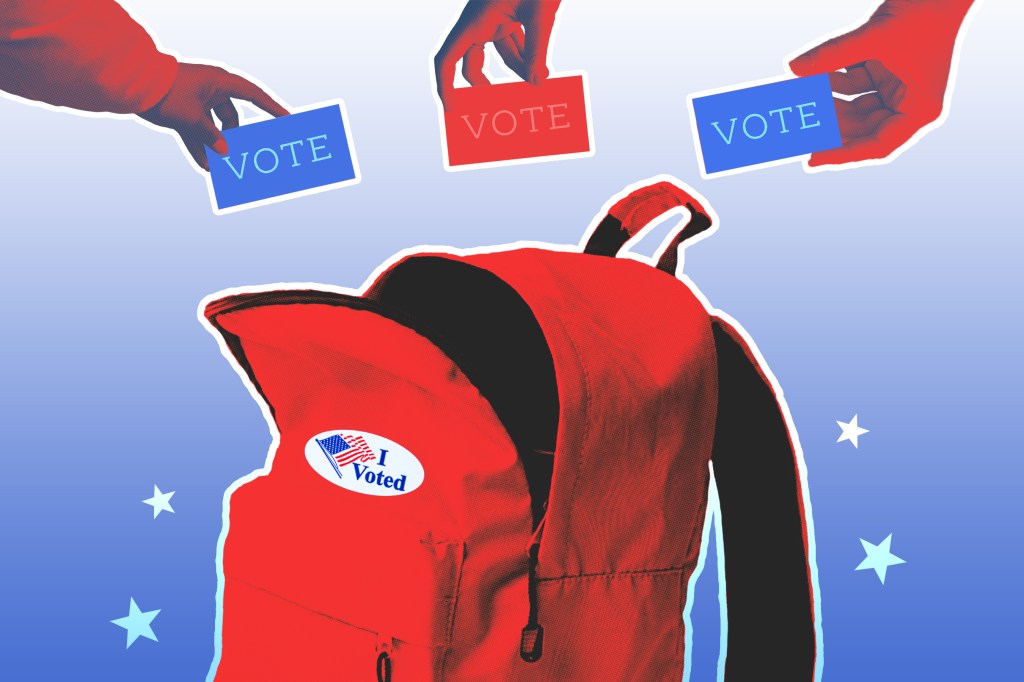
With the upcoming election in November drawing near, the stakes are high for both Democratic and Republican parties in an effort to mobilize the American youth to the polls.
As of Sept. 22, Vice President Kamala Harris had taken a 5-point lead against former President Donald Trump among registered voters in a race pollsters are calling “a very close election.”
But a key factor could hold the power to reshape the outcome of the election.
That key? Young voters.
According to a podcast recorded by the University of Chicago, “A new poll shows young voters could be the ones to ultimately decide this race.”
However, students at Moraine Valley have mixed opinions on whether and how they will vote in this election, despite the anticipation of the outcome.
“That person is the leader of our country. It should matter,” biology major Omar Ahmad, 18, said. “We’re going to have someone in power that will make decisions that affect our lives.”
Marketing major Davion Michaels, 20, said he will vote Democrat, “essentially based on the lesser of two evils.”
One student believes age is a big factor. “We’re voting for old people. In the past seven years we haven’t had a young president,” said Adnan Latif, 22, a computer science major.
Latif also argues that neither candidate is doing enough. “As long as they meet the requirements like caring about the government, caring about the people, taking care of our taxes, taking care of inflation, I’d definitely vote for them. But right now, the case is neither of the two candidates are caring about anything.”
In the hallmarks of history, young adults are seen to be in the forefront of enacting change. From the Civil Rights Movement to the Anti-War Movements to fighting for the minimum voting age to be 18 years old, there is no mistake youth activists spurred social change.
The momentum of generations before has never ceased as key issues such as inflation, reproductive rights, international policy, and climate change have gained the attention of the youth activists of today. The BLM protests in 2020 after the murder of George Floyd and the student protests on campuses against the Gaza war are recent examples of political engagement among young adults.
Cathy Cohen, political science professor at the University of Chicago says, “The votes and the actions and the beliefs and agendas of young people matter. And they’re going to matter in this election, possibly even more, because there are going to be razor-thin margins by which candidates win states and win the electoral college.”
To help students register to vote with the help of the League of Women Voters, Moraine Valley’s Democracy Commitment program and Student Life teams hosted a National Voter Registration Day event in the U building on Sept. 17. Political science professor Kevin Navratil led the event with key voter information and provided a platform for students to speak about why they believe voting is important.
Yet with the election split between Harris and Tim Walz vs Trump and JD Vance, many students hesitate to express full support for one or the other.
Raneem Abdeljaber, who is primarily concerned with the Israel-Palestine war, thinks neither Harris or Trump is as concerned as they should be. “They kind of leave other people out with everything going on with Palestine and Israel. It’s pushing Palestine away. They don’t believe the same thing we do.”
“Neither supports Palestine, so I don’t care,” said science transfer Dalia Natour, 18. “I will not vote. There are no good options.”
Cohen mentions that on a deeper scale, the willingness to vote doesn’t just come down to the candidates, but the system as a whole.
“The votes and the actions and the beliefs and agendas of young people matter. And they’re going to matter in this election, possibly even more, because there are going to be razor-thin margins by which candidates win states and win the electoral college.”
Cathy Cohen, University of Chicago
According to a genforward survey, only about 26 percent of young adults believe democracy is working well, and three in five adults say that there is a concern over the future of the country’s democracy.
“Young Black people are still being killed,” says Cohen. “They’re thinking about foreign policy and they may not like Biden’s policies around Gaza. They may not like how the Republicans think about and talk about immigration. I think for many young people, they believe the government is not functioning to their advantage or to focus on them. So it’s not surprising that they would say, ‘I disapprove of both the Republicans and the Democrats at this point.’”
Some students say that their lack of participation mostly comes from not being interested in politics at all.
“I don’t have an interest,” said Jade Devine, 18. “It makes a lot of people upset. It’s controversial.”
Vinnajia Lee, 20, has never voted. “I just was never into politics.”
This point of view is not uncommon, as Navratil has seen in his own classes. “Anecdotally, I think in my classes there’s been less interest,” he says. “I think people might find politics polarizing, or they’re apathetic about what impact they can really have. A lot of cynicism, maybe a little confusion, just kind of a lack of interest in what’s going on.”
However, there is a risk when young adults decide not to vote, history and political science professor Merri Fefles-Dunkle warns. Everyone has issues that are important to them, she says: “Whether it’s about Palestine or whether it’s about the environment, whether it’s about birth control and abortion rights, whatever those issues are, there’s something that affects all of us.
“And when you don’t engage, you’re kind of abdicating your own right to be able to have some control over this.”
Fefles-Dunkle said Democrats in particular will be trying to increase their young voter turnout. “I know that Democrats are really counting on young people to show up. Historically, they won in recent elections about two thirds of young people’s votes, and current data shows that they are nowhere near that.”
Nancy Pelosi being introduced as “Mother of Dragons” during the Democratic National Convention, a reference to the popular TV series Game of Thrones, is just one of many examples of how Harris’ campaign is trying to attract young voters by following pop culture trends.
Just recently, Taylor Swift posted on her Instagram story her endorsement for Kamala Harris. In reaction to this, more than 400,000 people clicked on the voter registration link she had posted on her story, CBS reported.
To reach out to young voters, Harris said her campaign would be visiting 150 college campuses across 11 states, NPR reported. The goal is to help more students be aware of the stakes in this election, Harris says.
Meanwhile, the Trump campaign is collaborating with Turning Point Action, a youth-focused conservative group, while also making multiple appearances with popular social media influencers.
The competition to bring out the most young voters will continue until election day, but some students say that despite their reluctance to vote, they will not pass up on the opportunity.
Alexa Pilkington, 18, feels strongly on the importance of young people voting: “Each vote counts even though there are so many people.”
The choice is now onto the shoulders of young voters to decide if they will have a hand in the outcome of the 2024 presidential election.
Nursing major Lauren Gignac, 18, points out, “People complain, but they can’t do anything if they don’t vote. So if you don’t vote, you can’t talk. Even if one vote might not make a difference in the world, you can try to vote for what you believe in.”
 Velocity
Leave a comment