
A night cruise down Tinley Park’s Harlem Avenue on Sept. 1 came with a common environment for locals: echoes of stage lights and live music coming from the Credit Union 1 Amphitheatre.
What might have been unfamiliar were the crowd’s faint chants heard in the distance.
‘Fuer – Za, Regida!’
Spanish for “governed strength,” it’s the name of the Mexican American band that showed exactly that, belting out melodies in Spanish on top-layered guitar stringed-rhythms and pumped-up brass notes. A name signaling a night of anthems and ballads for 30,000 fans of Mexican and non-Mexican heritage.
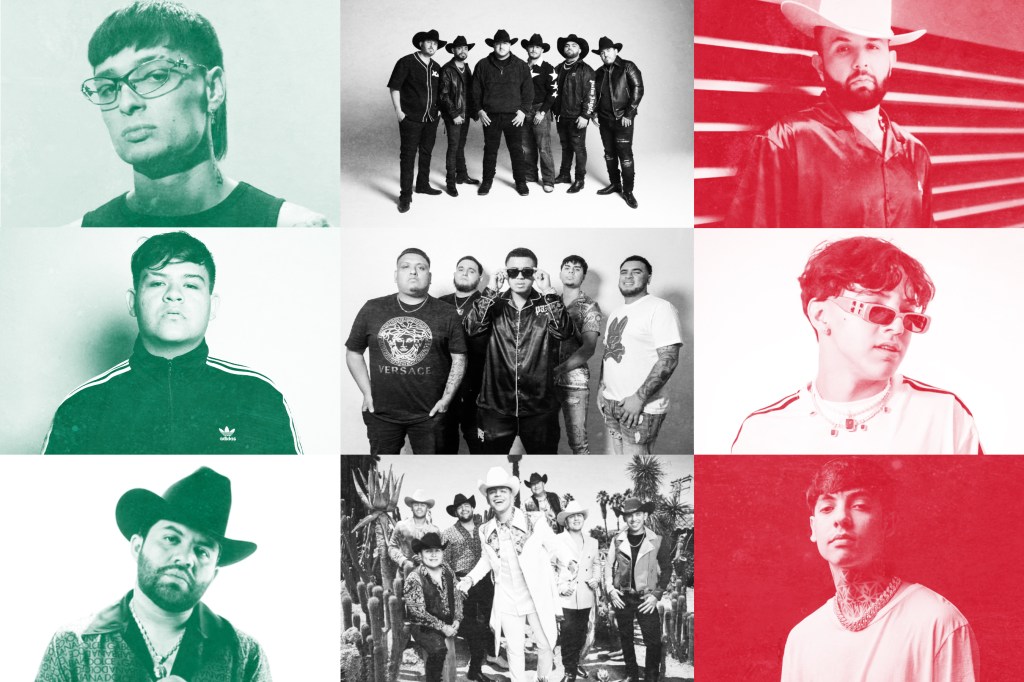
It’s not just Fuerza Regida filling up nearby venues with Mexican music: It’s singer Junior H at his Tinley concert, the band Grupo Frontera at Rosemont’s Allstate Arena, and singer Peso Pluma in the United Center.
If these names sound unfamiliar, they won’t stay that way.
These artists represent a movement within a musical scene known as Regional Mexican Music, which has recently seen its biggest success and reached the United States unlike ever before.
With the recent celebration of Mexican Independence Day and as Hispanic Heritage month continues, it’s worth viewing the scene’s new form and its breakthrough. A new wave of artists’ sounds and aesthetics are speaking to a younger generation while bridging the cultures of the U.S. and Mexico.
Regional Mexicano or Musica Mexicana started as an American music industry label for a variety of Mexico’s traditional music genres. Each genre – such as Mariachi, Corridos, Banda, Norteños, and Rancheras – comes with its own history and musical features. Outside success isn’t unheard of, but popularity and recognition has mostly stayed within Mexico or among those closest to their Mexican heritage.
However, huge milestones are being met, showing the shift: May last year was the first time that two Mexican artists charted Billboard Hot 100’s top five and took the top three spots on the global 200 singles.
Even small moments stick out; in a recent LA Times interview, Fuerza Regida frontman, Jesus Ortiz Paz, a.k.a J.O.P., proudly noted the band only doing English speaking media that day: “We’ve never really done anything with that market before.”
There’s pride in getting exposure like his peers, such as singer Carin Leon performing on both Jimmy Fallon and Jimmy Kimmel, and Grupo Frontera interviewed by Apple Music and ABC News.
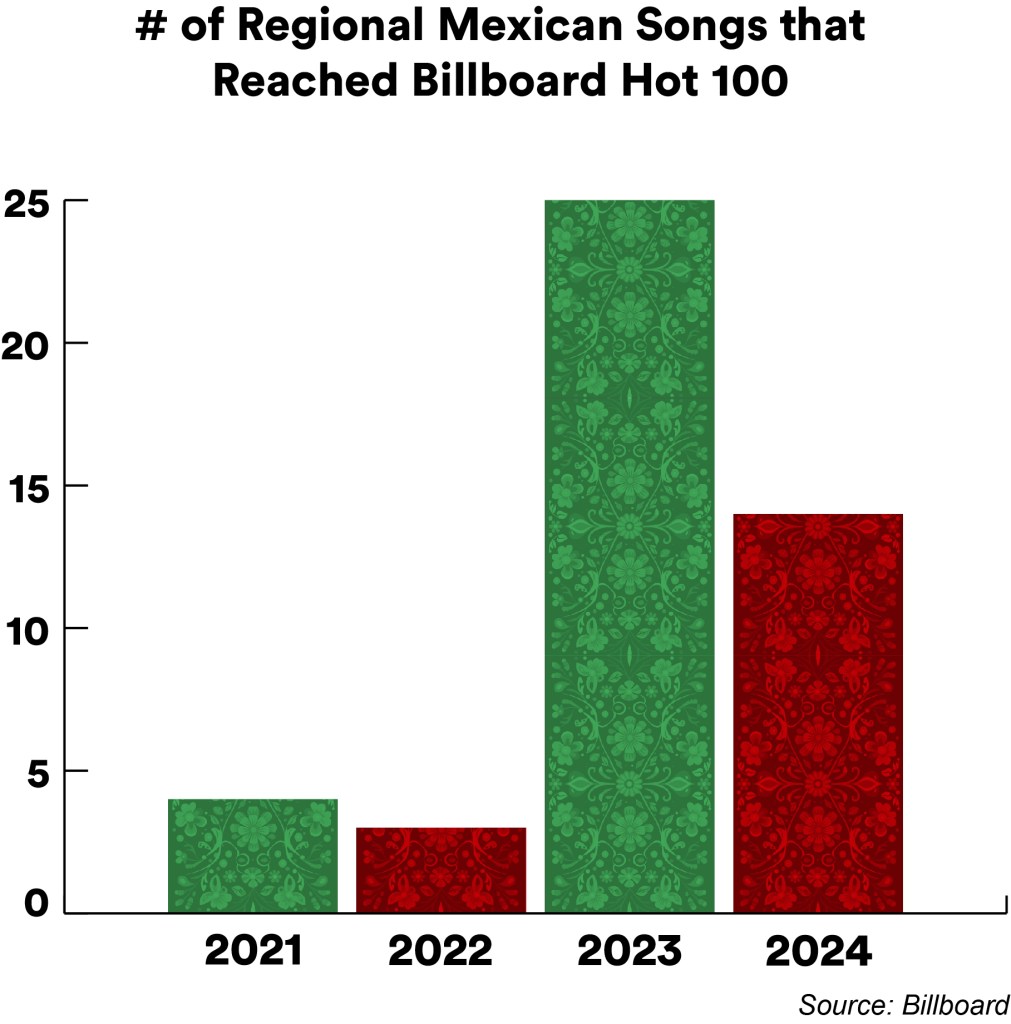
American media coverage is only catching up to how much Regional Mexican Music dominates online spaces. Spotify reported last year that Regional Mexican generated a giant 21.9 billion streams in the U.S.. On YouTube, the most popular music videos rack hundreds of millions of views, with streams growing 400 percent in the past five years while the number of Regional Mexican songs that reached the Billboard hot 100 chart has grown greatly in the same timeframe.
Singer Peso Pluma, a recent Coachella headliner and the first Regional Mexican artist to perform at The MTV VMA’s and get nominated best new artist, has become YouTube’s most viewed music artist of 2023. Gaining a massive 8.5 billion views, he beat out the likes of Taylor Swift, Bad Bunny, Drake and BTS.
It was thanks in part to the success of hit single, “Ella Baila Sola,” with the band Eslabón Armado. Currently, the corridos track has almost 700 million views, and last year it became the first of regional Mexican music to chart Billboard’s Hot 100 top 10.
Corridos is a genre mostly defined by its storytelling tradition, although instruments like 12 string and requinto guitars, brass horns (such as tubas and trombones), accordions, and tololoche (Mexican double bass) are common. Older songs would often build a steadier rhythm for singers such as the late Chalino Sanchez to lay narration over.
Tempo wise, ‘Ella Baila Sola’ takes a different route.
“The first thing I notice is so much rhythm, his high tenor voice hitting short notes, there’s pace in his melody and the harmony,” said Paul Murphy, a local record producer and adjunct music instructor at Moraine Valley. Murphy noted how the singing mixes “with the brass and the layers of guitar harmonies. There’s a lot of immersion.
“All together it’s exciting, it feels celebratory and grand.”
It exemplifies the genre’s recent evolution with more guitar strums taking lead, with traditional instruments and narrations still involved, often brought with modern rap and pop musical influences.
Developed by singers such as Natanael Cano and Luis R. Conriquez who both gained success on YouTube, the corridos’ newer forms take it to modern sounds and culture.
An assessment by Pitchfork editor Isabelia Herrera describes Cano’s impact by making the tubas, trumpets and guitars meet with “trap snare (drum) rolls” and “ …a flurry of 808s.” She further explains: “Cano enamored a younger generation of listeners by preserving the gritty spirit of corridos while dabbling in trap beats and donning chains covered in VVS diamonds.”
Rap music also influences the subject matter, highlighting the controversial issues of modern Mexico. Many newer corridos lyrics revolve around the country’s corruption and cartel violence. Peso Pluma, whose real name is Hassan Emilio Kabande Laija, has said these aren’t for glorification but just describing reality.
Newer vocal styles and guitar playing get criticized as well, often for ability in holding and hitting notes. However there’s something there, when listening to the old and new. Murphy said that while Chalino Sanchez has “a voice that can fill a room up,” he sees the appeal.
“The newer generation has more rawness in vocal performances and how it’s played,” he said. “They play more with melody and notes instead of sticking to one range.”
The slight rasp in Peso Pluma’s voice, he said, is “more within the music, in terms of mixing too…but I think that adds personality.”
Vocal personality helped 20-year-old singer Xavi go viral on TikTok and YouTube, with his single “La Diabla” topping Spotify’s top 50 global chart earlier this year.
Opening with flying guitar strings mixed up front, it’s “full of energy,” Murphy notes, adding that Xavis singing with slight reverb “sounds almost like a night at the opera. The way he sustains these notes, I mean he’s really expressing it, it feels theatrical and bouncy.”
Moraine Valley’s Allegiance of Latin American Students vice president, Estefanie Diaz, sees personality in the patterned guitar work and close-up mixes and believes that’s what may be the factor in its appeal.
“I think a lot of what is popular now is those rhythms and guitar sounds,” she said. Describing Xavi and Peso Pluma, she says, “They keep moving with the music, but I think both of their voices are really unique.”
Raised in a Mexican household in the Hispanic and heavily Mexican American community of West Lawn in Chicago, Diaz saw the effects in Regional’s popularity as high school progressed.
“More kids would bring their guitars, playing songs, especially corridos, before or after school or during lunch.”
Arizona-born Xavi’s lyrics in Spanish represent and reflect the growing trend of Regional Mexican artists coming from Mexican American communities. With Fuerza Regida and Eslabon Armado both from California, and the band Grupo Frontera coming from Texas, much popularity comes from reflecting and representing Mexican American communities, as they live culturally mixed by the two countries.
When weekends hit, house parties played Latin music, especially Mexican. Many people also go to bailes (Spanish for dance) parties at venues with Hispanic music, often live.
“It got popular to have parties and bailes that played corridos, with people handing out flyers or posting on social media,” Diaz said.
Already there were high school kids in Regional Mexican bands, but more started as new songs to be inspired by blew up.
This is all similar to how Fuerza Regida started. The band did social media posts, set up flyers and got hired at parties— just like Grupo Frontera, who used to do weddings with covers of hit songs.
A few years passed and the two bands’ collaboration, the cumbia norteña ballad, “Bebe Dame,” hit big, peaking at 25 on the Hot 100.
Cumbia is a genre full of instruments: notably its various drums and percussions to make rhythms and grooves lit up by accordions. Although originally from Colombia its Mexican styles are associated with Regional Mexicano, especially when combined with another accordion heavy genre, Norteño. Older Norteños, such as from the likes of Los Tigres del Norte, have accordions more up front with snare drums. In this mash-up of the genres, “Bebe Dame” dials accordions down and uses lower drums.
“The mixed accordions, low kick drums and percussion give space for their voices to fill in,” Murphy said. “It’s slow, but you feel the groove, and their vocals give passion.”
A similar formula came with Grupo Frontera’s cover hit, “No Se Va.” Those lower heavy kick drums may make sense to cross over to English listeners. As Murphy explains, “Those are very common in hard rock and in hip hop.”
It should be no surprise the California-based band told Billboard that drummer Carlos Guerrero is a fan of both.
It’s Mexican music, with American characteristics, made by Americans of Mexican heritage. Grupo Frontera shows what it’s like to be brought up with cultural influences from both sides of a border, and they’re not done.
While promoting their second album in an interview with Variety, lead singer Adelaido “Payo” Solís stated they are more than a cumbia group. Fom R&B, Rap, and Country, ready to experiment, Solís detailed what it means to express their wide musical tastes.
“This is the music we love, the music we grew up listening to, and in a way, it’s almost like a reminder for our audience that, as Mexicans — even if you don’t speak any Spanish but you grew up listening to music in Spanish, English, whatever — we can exist in all of these [facets] of music and expressions.”
The phrase “ni de aquí ni de allá” comes to mind, used by Hispanics in the U.S. who lack a sense of belonging with both American culture and that of their family’s background.
When discussing New Regional Mexican Music popularity in Mexican American communities, Diaz noticed more kids, especially those who are younger and not as in touch with their Mexican roots, pick up on the music.
“The mix can connect to them, even if the lyrics don’t touch on ‘ni de aquí ni de allá’, you can pick up on it sounding more American. Even if you don’t know why.”
Influence and impacts in and outside the music can come from collaborations too, as when Grupo Frontera collaborated with Puerto Rican rapper Bad Bunny for the hit, “x100to.”
The Puerto Rican-born Reggaeton and Latin Hip Hop that Bad Bunny makes takes more obvious influences on typical stateside American Hip Hop. Its rise in popularity has made streaming services more likely to introduce listeners to other Latin Music.
All this is only a piece of the trend of people listening to Spanish speaking music more than ever, in America and globally.
Last year a record number of 98 Spanish-language songs landed on the Billboard Hot 100–a huge leap from 2015, when only two made it. The Latin American population has always been strong, but with 64 million Latinos in the U.S. being almost 20 percent of the population, there are opportunities for people to bridge these cultural gaps.
“Music from Latin America always has that soul; there’s so many different kinds, but it’s always there, it’s lively,” Murphy said. “I think people get curious too, on sounds they don’t know well. Some instrument sounds work with certain emotions: for example, brass, horns, trumpets, that’s the sound of victory, it can be uplifting. I think people need a celebratory feeling.”
As Regional Mexican music artists expose American listeners to new styles, they do the same to Mexican audiences, as they expand and experiment with genres. Peso Pluma’s newest album has more elements of EDM, Carin Leon is starting to record country music, and some songs from Fuerza Regida’s newest album, “Pero No Te Enamores,” are referred by Jesus Ortiz Paz as “Jersey Corridos” — a mix of Jersey house’s bass-speeding EDM with their anthemic corridos.
“I think versatility is important; when two different worlds collide, it brings more interest,” Diaz said on the importance of collaboration and playing with new sounds. “Then they can bring some of that sound to their usual genre.”
While some may fear a loss of its musical traditions as Regional Mexican grows, Griselda Flores, Billboard senior staff writer, stated in a discussion that there shouldn’t be worry. At first afraid of the music watering down just to gain this success, she now observes that, “Mexican music has gone global without having to sacrifice anything.”
In fact, Regional Mexican music grew 400 percent worldwide over the past five years on Spotify.
Even then, traditions aren’t leaving, between new artists coming up every year, communities spreading the music, and younger audiences reconnecting to the old. Diaz mentioned her experience and that of people she knows going back to the classics, because they listened to what’s new.
“Now I appreciate old corridos even more; I know a lot of younger people get into older corridors afterwards, or at least start to tolerate and understand it better, you get the essence.”
An essence transformed, and here to stay, now shared with America and the world.



 Velocity
Leave a comment