
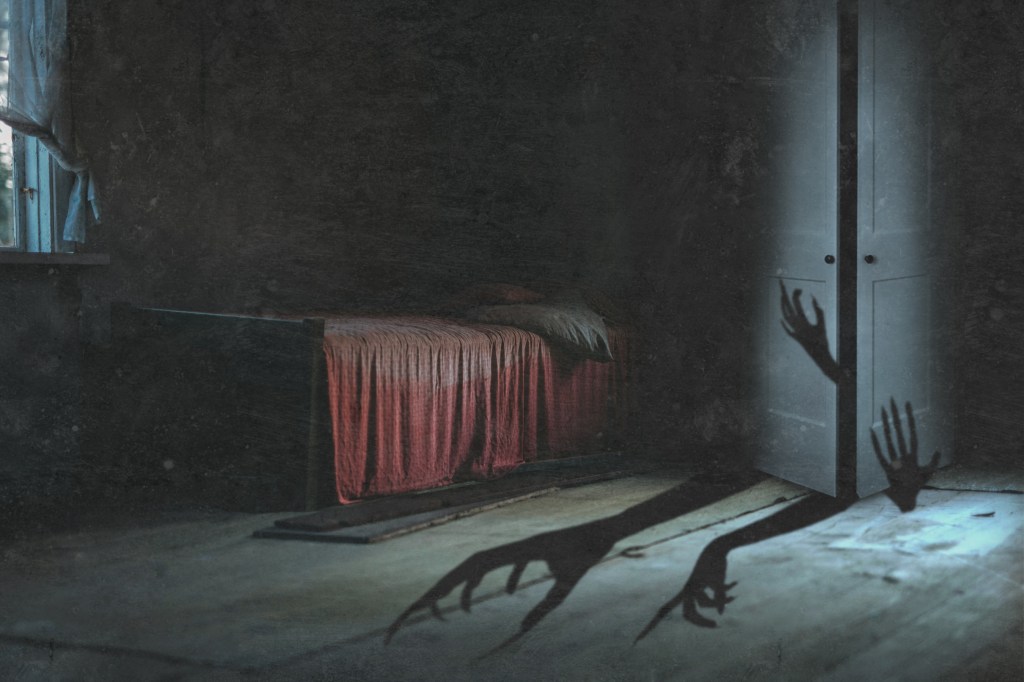
Contrary to popular belief, members of the queer community aren’t beholden to the infamous rainbow. Truth be told, they’re more likely to be decked out in orange and black. While the Halloween season excites almost everyone, it holds a special sentimentality for the queer community.
Why has the queer community flocked to horror? While it may seem like an odd choice at first, the answer is evident in the history and evolution of the genre.
The birth of horror as we know it is often credited to Gothic writers of the 18th century. Many works of literature that defined the genre as a whole were written by (presumably) queer authors, and the struggles they faced were woven into the tales they told. Perhaps the most famous amongst them was Mary Shelley. Often referred to as the mother of both horror and science fiction, the teenage Shelley penned Frankenstein and altered the course of reality.
Shelley’s sexual fluidity was well documented: From being a part of one of the most complicated throuples of the Gothic era, to her attraction to women, nothing about Mary Shelley was conventional. And that queerness bled into her work.
The Creature in her novel starts off innocent and virtuous, embarking on the most human of quests: finding love. Yet due to his abnormalities, the world rejects him. Despite having done no initial wrong, the Creature is othered, and thus unable to form proper connections with those around him. Even Victor, his creator, abandons him for not conforming to the ideals Victor had constructed. This sparks the Creature’s rage, and ultimately leads to the undoing of both Victor and the Creature.
In Shudder’s docuseries Queer for Fear, actor Briana Venskus comments on the subtext of the story: “This idea that you can recombine the elements of a human to create something is inherently terrifying. But I think that’s sort of what it means to be queer. You’re taking these elements of masculinity or femininity and redesigning them into the person that you are.”
She later expanded on how Shelley’s lived experience lent itself to the story: “She saw it as a gruesome story of what it was like to create a version of yourself from nothing. That’s her throughline, I think, through Frankenstein, is that she had to create herself from nothing.”
When looking at the history, it’s clear that horror is not a just genre queer people have flocked to–it’s one they built, brick by bloody brick.
Shelley, while the first and most famous, was far from the only gothic writer whose identity played a critical role. In fact, so much of the early gothic horrors covered quintessentially queer conundrums: the ideas of repression, societal perception, the fractured identity between public and private lives, and the dangers associated with all of the above. Robert Louis Stevenson’s The Strange Case of Dr. Jekyll and Mr. Hyde, Oscar Wilde’s The Picture of Dorian Gray, Bram Stoker’s Dracula: it’s clear that from its inception, so many elements of horror are intimately intertwined with queerness.
As horror shifts from the pages to the silver screen, the influence of queer creators goes with it. And again, we see a new era of the genre ushered in by predominantly queer creators whose life experience colors the films they create.
James Whale carved out a place for himself amidst Universal Studios. Adapting movies such as Frankenstein, The Invisible Man, The Old Dark House, and Bride of Frankenstein, Whale made a name for himself not only for exceptional directing, but for his ability to skirt restrictions. While Hollywood implemented new standards in an attempt to ward off “immorality,” Whale found new ways to slip past those standards.
The Bride of Frankenstein, in particular, was a revolutionary queer film. Whale built on Shelley’s legacy and stitched together a compelling story that encapsulates so much of the queer experience. Connection, identity, compassion, agency: they’re all compelling points in the narrative Whale weaved. While he couldn’t explicitly incorporate queerness, it lingers in every facet of the film. In an interview for Queer for Fear, writer Justin Simien says, “It’s almost like a language, I wanna say, for queer artists. In a coded way, speaking about society, in a way that society won’t necessarily catch onto.”
The queer directors of the late 1990s and early 2000s followed in Whale’s footprints and learned to speak the language. Think of Karyn Kusama’s Jennifer’s Body, Kevin Williamson’s Scream franchise, Don Mancini’s Child’s Play. The more time passed, the further horror pushed the boundaries of what was allowed. It began subverting expectations, twisting traditional gender roles and paving a way forward.
In today’s world, horror is often at the forefront of queer representation. Leigh Janiak’s Fear Street Trilogy features an explicit sapphic romance integral to the story, one that echoes through time, where the sapphic characters are the heroes. Jane Schoenbrun’s I Saw The T.V. Glow is an emotionally eviscerating commentary on the trans experience.
When looking at the history, it’s clear that horror is not just a genre queer people have flocked to–it’s one they built, brick by bloody brick. In a shadowed history of hate and oppression, queer artists found an outlet in horror. And through that, their work was able to reach their communities.
Contrary to popular belief, horror isn’t just about the guts and glory. It’s a tattered tapestry of love and loss, a legacy passed down from one generation to the next. From ink on a page to film in a reel, horror has captured the life and love of the queer community. It immortalizes those who took the risk blazing trails, and offers an endless sandbox for new creators looking to push those boundaries.
 Velocity
Leave a comment