
When Hedaya Hassanein, 20, first started at the University of Illinois, she wanted to get into politics to make a difference in people’s lives. But it took less than a year for her to be disillusioned with the field through the backlash she faced for her views.
“That’s why I don’t think I’ll ever go into politics,” she said. “It feels like you’re doing a lot for nothing.”
Despite those feelings, Hassanien still organizes protests for Palestine and does political research for her classes. And she’s not the only one doing that right now.
Over the past six months, political activism amongst college students appears to have increased, with current students adding their voices to those of generations before them. With this being an election year, the trend could increase between now and November.
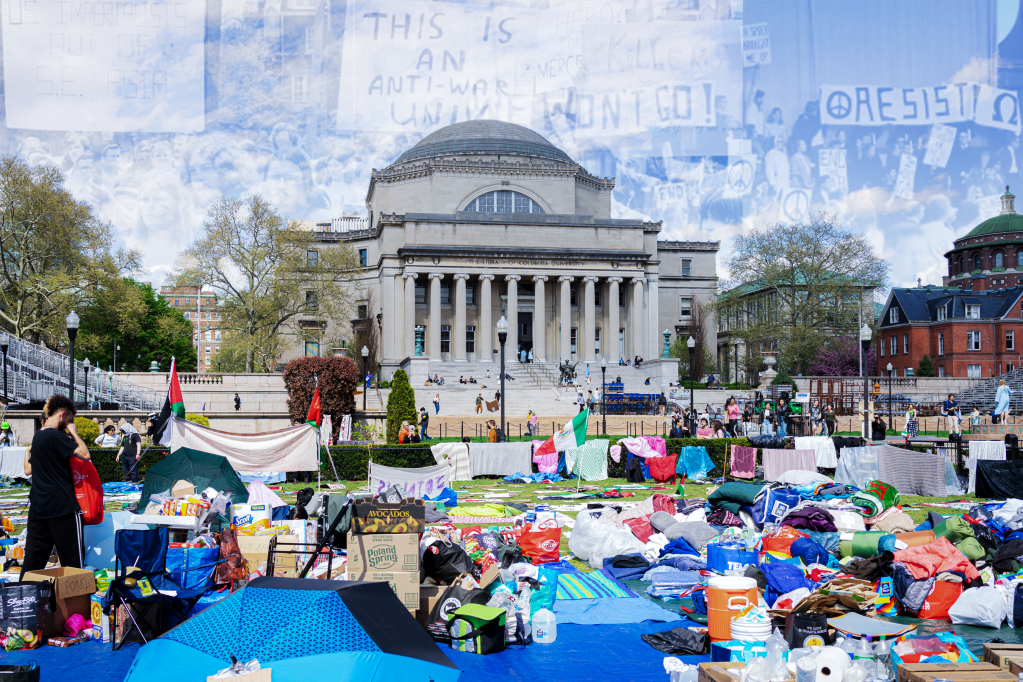
Just over the past few weeks, college campuses across the country–most recently at nearby Northwestern, DePaul and the University of Chicago–have been the scene of demonstrations and encampments.
As NPR reports, “Student activists nationwide appear determined to show their support for people in Gaza and push their universities to divest from companies with ties to Israel or who otherwise profit from its war with Hamas.”
Although much of the activism has been tied into raising awareness of Palestine, is that the only reason for the trend? Today’s college students are also part of the COVID generation, so could the pandemic and its ensuing lockdowns also play a role? Have more college students actually gotten involved in politics, or is this just a case of a few loud voices drowning out everyone else?
COVID generation’s politics influenced by pandemic
Some college students did become more politically active due to COVID, with many attributing the pandemic with raising their awareness of social issues.
“It made me more aware of my surroundings, and what’s going on around the world,” said Maria Alkoud, 19.
Ali Mahmoud, a student at Northwestern Medical School, also was influenced by what happened during the pandemic.
“There was a lot of activity in the policy we were making that influenced how we utilized the resources that we had, to prevent further harm from the pandemic,” Mahmoud said. “So that got me more active in social issues.”
Mahmoud is an example of a trend of more medical students getting involved in politics due to the pandemic. COVID-19 exposed just how politicized science and medicine have become in American society, making medical students more involved in combating misinformation about the disease and its vaccines.
Rawiah El-Leboudi, 24, an exercise science student at North Central College, said, “I was working on an ambulance at the time, so it gave me a different perspective on it. And that point was when I realized that you have to do your own research and be more self-accountable. Whatever anyone tells you, you fact-check it and make sure to cite your sources correctly.”
Medical students at Harvard University in 2021 formed a group called Future Doctors in Politics, a nonpartisan nonprofit with the mission of “empowering future doctors with the mindset and skillset to be agents of political and structural change that centers the patients and communities we serve.”
Another COVID-related factor is the increased time spent on social media, as that is the primary means of connection and news consumption amongst Gen Z, which includes many current-day college students. According to MSSMedia, the average Gen Z college student is on social media for 4.5 hours a day.
Moraine Valley political science professor Kevin Navratil points out that the combination of social media use and the news relating to the pandemic may have caused people to become more engaged.
“With COVID, and having lockdowns, and parts of the economy that were shut down, and either requiring the use of masks, or getting vaccinations, those types of things were controversial to some people,” he said. “And the pandemic resulted in higher inflation. I think that is upsetting to people.”
However, the pandemic caused some people to actually tune out of politics during that time.
“I didn’t have any mental capacity to pay attention to what was going on in politics,” said Salma Khatab, 25, a student at the University of Illinois-Chicago.
Students see ‘change in the political atmosphere’
Some Moraine Valley students are entering the political field, even if it isn’t always on campus.
“There’s a lot going on around the world which isn’t right,” said Alexis Cuitter, 19. Her motivation to become politically active led her to attend a protest for teachers to be paid more for their work.
With Gaza in the news yet again, that appears to be the main force driving current campus political activity.
“There’s no doubt that the single biggest factor is Israel and Gaza,” Navratil said. “That has been very polarizing on campuses. And I think that has been a much more significant event than COVID, in terms of having an impact on political engagement. At least among 18- to 29-year-olds.”
That factor holds especially true for Moraine Valley, as it is adjacent to Orland Park, which hosts the country’s fifth-largest Palestinian-American population.
“Nowadays, with everything going on overseas, I feel more of a reason to speak out and have a voice, politically.”
Rawiah El-Leboudi, North Central College student
Predictably, this means a lot of events and discussion revolving around Palestine, whether it’s discussing students’ feelings on the conflict, or vigils for the Palestinian people on campus.
“The October 7th attack in Israel and subsequent bombing of and catastrophe in Gaza is greatly impacting college campuses,” said Merri Fefles-Dunkle, another Moraine Valley political science professor.
“It’s influencing students and faculty in a way I have never seen. It is too soon to say if it will affect the presidential election, but the primary has taught us that democratic voters are very concerned about U.S. policy of unequivocal support of Israel and the perception of indifference towards the plight of Palestinians.”
Linah Hamed, 19, was in Palestine during the height of COVID-19, so she wasn’t as affected by it as other Moraine Valley students were. But the current violence in Gaza has made her more active in political events and activism. So far, Hamed has already done two protests for Palestine, and her message to the general public is “Free Palestine.”
This effect is also present on other college campuses. Students at universities all across the country have protested for Palestine in massive numbers, with some even making encampments to stay on school grounds until their demands are met. Police have arrested many protestors at Yale, New York and Columbia universities, with the latter switching to an all-remote class schedule. But that doesn’t mean it’s happening closer to home, in a more downplayed manner.
“Nowadays, with everything going on overseas, I feel more of a reason to speak out and have a voice, politically,” El-Leboudi said.
College students have been motivated by the injustices happening both nationally and worldwide.
“The change in political atmosphere that’s been happening over the past six months has made me more politically active,” Mahmoud said. “I go to rallies and protests in support of a ceasefire in the Gaza strip.”
Polarization both motivates and discourages involvement
In addition to Gaza and COVID, there are other, more familiar factors at play, such as the upcoming election–though polarization can motivate some people to become more involved and while discouraging others.
“We’ve had a major presidential election where half the country was happy, and half the country was unhappy,” Navratil said. “And of course, the election had some doubts surrounding it, and there was also some political violence, an attempt to overturn the election, that’s another way of saying it.
“And so I think that for all of those reasons, there’s certainly the potential for us to have more polarizing views on politics and issues.”
According to Navratil, enrollment in Moraine’s political science classes has actually gone down over the past several years, which he blamed on a couple of factors.
“One (reason) I think is that there’s fewer high school graduates in our community,” Navratil said. “So there’s a demographic decline, fewer college-age students in our area.”
But polarization and discord also may play a role. Many college students, alongside the general American population, have lost faith in U.S. politics and political institutions. Neither candidate for 2024 has the majority support of younger adults, and just thinking about politics makes 65 percent of Americans upset and exhausted, according to Pew Research Center.
“I suspect that students might find psychology or sociology either more interesting, or that politics, government are too negative, and they don’t want to have arguments, or they find it confusing,” Navratil said. “I think the way that it is covered in the media, there’s been so many fights and debates, that sometimes I think people just avoid it.”
Many people see the country’s political sphere as too polarized, stagnant, and corrupted by money to effectively represent them. This has led to widespread support for reforms such as age and term limits for Congress, along with abolishing the Electoral College.
“There’s no doubt that the single biggest factor is Israel and Gaza. That has been very polarizing on campuses.”
Kevin Navratil, political science professor at Moraine Valley
Or some people might see all of these problems and just give up on politics altogether. They often see politics as too omnipresent, too negative and too corrupt to want to engage in it Pew Research Center finds. They might still vote, but that’s the full extent they want in the field.
“I feel like my voice won’t change anything,” Salma Khatab said. “Whatever happens in politics, it’s going to happen either way.”
However, that doesn’t mean people are just tuning out of what’s going on en masse. COVID-19 exposed many societal inequalities in American society through disproportionately affecting minority and lower-income communities. This has led to more discussion of these issues and increased efforts at the individual, community and federal levels to alleviate systemic injustices.
Some examples of these include new minority outreach programs, financial and educational grants to members of marginalized groups, and more focus on the role of systemic racism in American institutions.
Gen Z’s activism actually dates back to 2018, before the pandemic. The main things driving youth politics at the time were opposition to the Trump administration and gun control in the wake of the Marjory Stoneman Douglas school shooting. In fact, according to The Harvard Gazette, between 15 and 20 percent of 18 to 29-year-olds voted in that year’s midterm election.
In addition, Circle reports about 28 percent of Gen Z’ers voted in 2022’s midterms, which is the highest turnout for an American generation’s first election since 1972.
However, ethnic minorities and those without higher education are underrepresented in these voting statistics. And 18 to 24-year-old voter registration, at 49 percent, significantly trails that of 65- to 74-year-olds, which is at about 78 percent, according to Statista.
The polarization of Donald Trump’s presidency might have played a role in increasing voter turnout among younger people, according to Navratil.
“There’s people who were either engaged for or against Donald Trump,” he said.
Maybe the question we should be asking isn’t whether students are or should be more political, but rather how they can best help their communities. Politics is most likely just one way they can make their voices heard, and bring attention to social issues.


 Velocity
Leave a comment