

Imagine going days with little to no sleep, barely eating or not bathing. It would be easy to miss class, get lower grades, doze off while driving and engage in negative self-talk.
Without self-care, it’s easy to lose sight of what’s important, especially for college students as they experience more independence and pressure to perform.
In a recent Humans of the Valley feature, students opened up on navigating depression along with emotional struggles in relationships.
“My support system is my mom, dad, brother and my best friend. They’re in my life because if I feel depressed they will help me and stand by me,” says Maheer Islam.
Mental health struggles of students go far beyond Moraine Valley’s campus.
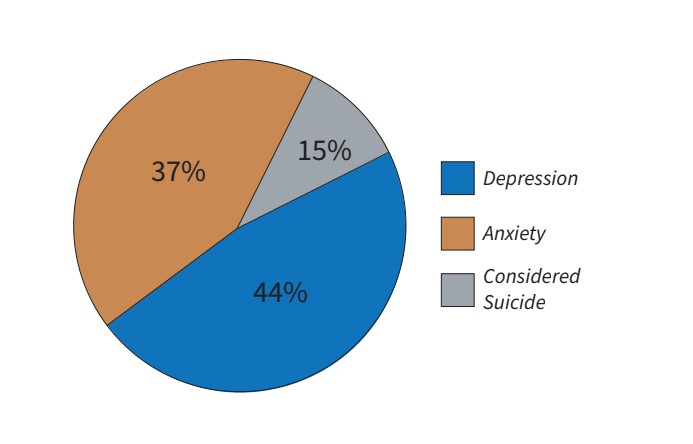
Students reported all-time high rates of depression, anxiety and suicidal ideation in a 2023 Healthy Minds survey, according to results recently posted by The National Center on Safe Supportive Learning Environments.
Source: National Center on Safe Supportive Learning Environments
GRAPHIC BY EMILY MERAZ
Among the 96,000 student participants across 133 campuses nationwide, 44 percent reported feelings of depression, 37 percent reported feeling anxiety, and 15 percent said they have considered suicide—the highest rates in the 15 years since the survey premiered.
So, how do you avoid cracking under pressure?
“I recommend developing a daily self-care practice. It is important to take care of ourselves so that we can show up more powerfully in our own lives and for the people we love,” says Kristin Lothman, a mind-body counselor with Mayo Clinic’s Department of Integrative Medicine and Health.
Lothman believes self-care should be simple and easy to fit into your routine. “Basic practices could include journaling, meditation, prayer and mindful movement, such as yoga or tai chi ― really any intentional action or behavior that gives us energy and enhances our sense of well-being.”
Despite mental health issues being personal by nature, finding coping strategies doesn’t need to be done individually.
Moraine Valley’s Counseling and Career Development Center offers a variety of support to students on campus, ranging from career and educational counseling to personal counseling.
“We don’t tell students what to do,” says Jessica Conteras, a licensed clinical counselor for Moraine Valley. “We work with students to understand what their needs are and then we can find out what the next steps are.”
“Counseling is a good first step for anything students might be dealing with. From food insecurity to challenges they’re facing in their personal life.”
Moraine Valley Counselor Jessica Conteras
“Counseling is a good first step for anything students might be dealing with. From food insecurity to challenges facing in their personal life.”
Next steps might include being seen by an on-campus counselor. If the student’s crisis persists, they would likely be referred to a private psychiatrist or therapist.
“One of our main goals is to connect students with resources,” says Alexander Resendez, also a licensed clinical counselor for Moraine Valley. “If a student or their parents lost their job and are having a hard time paying bills, they can apply for what is called an emergency assistance grant. If approved, it would grant up to $1,000 for a school year.”
Anxiety and depression can be difficult to manage if the symptoms and signs are unknown.
Resendez relies on the Diagnostic Statistical Manual to define anxiety and depression. The DSM defines generalized anxiety disorder by criteria such as excessive anxiety and worry for at least six months, difficulty controlling the worrying, significant distress or impairment in social and occupational areas, and the anxiety not being attributable to any physical cause.
Depressed mood, loss of interest or pleasure, appetite or weight changes, sleep difficulties, fatigue or loss of energy, diminished ability to think or concentrate, feelings of worthlessness or excessive guilt, or suicidality are possible symptoms of a major depression episode, according to Front Psychiatry on the National Institutes of Health website.
Contreras believes it is important that students seek counseling if they are experiencing any kind of mental health crisis, not just anxiety or depression– “suicidal ideation, self-harm, hurting someone, wanting to get revenge, anything causing danger, a panic attack, and someone going through a significant change in function— when someone is unable to do their regular day-to-day tasks.”
Speaking on where disorders such as depression and anxiety can stem from, Resendez states, “Some examples of life events that may cause students to deal with these disorders include loss of a family member, loss of a pet, a breakup, ongoing relationship problems, or experiencing financial hardships.”
Students in crisis should call or text 988, a national hotline that connects them to a crisis counselor.
“This is for anyone who is experiencing a mental health crisis or feeling like they need someone to talk to,” Contreras says. “You can also text 988–for students they may not feel comfortable talking on the phone.”
Students in crisis should call or text 988, a national hotline that will connect them to a crisis counselor.
The counseling Resendez provides allows him to sees 30 to 40 students per semester including classroom visits to talk to groups of students and table or booth setups at campus events. He is currently working on a passion project–a workshop set for 2025.
“There is more and more research and evidence coming out that shows how a poor diet can negatively impact us and lead to poor mental health issues,” he said. “I will be talking about some of this newer research and how a diet that puts us in the metabolic state of Ketosis can have significant positive impacts.”
Resendez believes this approach can be used for major conditions ranging from anxiety and depression to bipolar and OCD conditions. The workshop will be offered to students and faculty sometime in the fall or next spring.
Contreras is an expert in alcohol and drug use. She believes some of the challenges for students lie in peer pressure and normalization of substances.
“Alcohol is legal and meant to be used recreationally,” she said. “Marijuana is legal and meant to be used recreationally. Vapes have increased in access and availability. Sometimes students aren’t aware of how a try can lead down a path of regular use and ultimately addiction. New use leads to happy chemicals in our brain. Our brain doesn’t know the danger that comes with use.”
Students seeking help with addiction can start with a Moraine Valley counselor, Contreras said.
“We get some background about possible addiction in the family, how long they’ve been using, what other substances they use,” she said. “From there, we find what kind of support we can provide them. If it is to the point of addiction that is difficult to manage, we’d find support for them off campus.”
As college students ride the ups and downs of academic and personal growth, looking after mental wellness is key. By using research-backed strategies and taking advantage of available resources, students can take part in turning campuses into places where everyone can thrive.
If you think you are struggling with anxiety, depression, or any other mental health crisis, counselors want you to reach out for help. Counselors are available Monday and Tuesday from 8:30 a.m. to 6 p.m., Wednesday and Thursday from 8:30 a.m. to 5 p.m., and Friday from 8:30 a.m. to noon. To reach a counselor, send a student email to counseling@morainevalley.edu, call the office at (708) 974-5722, or pay a visit to the office in Building S, room S202.
If you are thinking about harming yourself or others, please call 911. If you are on campus, you can call campus police by dialing 5555 from a campus phone or 708-974-5555 from a cell phone.




 Velocity
Leave a comment