
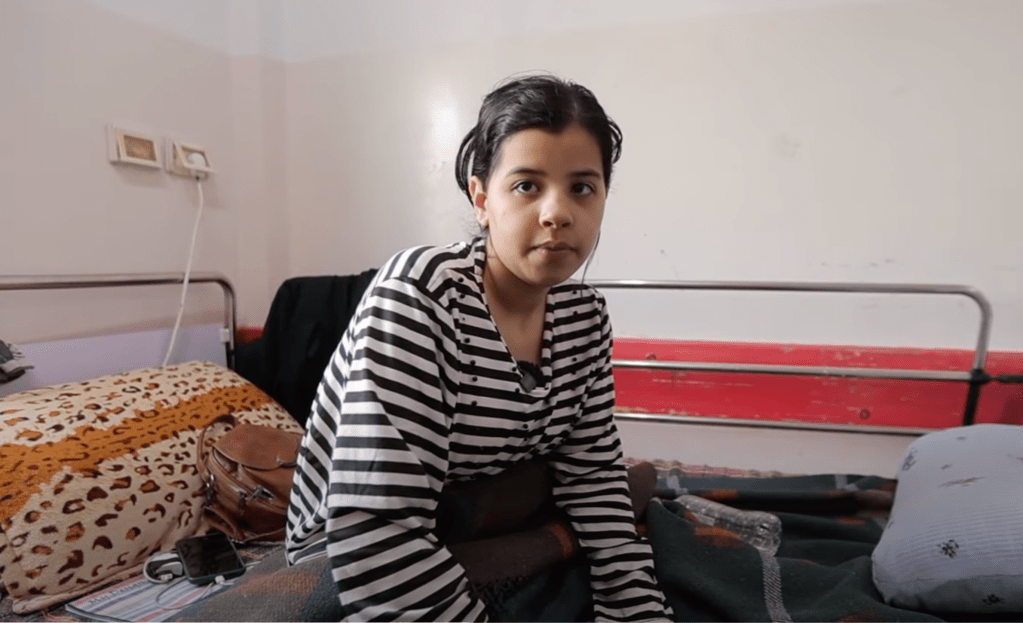
When an Israeli bombardment hit her home, 12-year-old Dunia Abu Mohsen lost her parents, lost her siblings, and lost her leg.
“I want to become a doctor, like those who treat us, so that I can treat other children,” she said in a YouTube video for Defense for Children International – Palestine, recovering in a room in Al-Nasser hospital in Khan Younis.
Two weeks later, she lost her life.
Dr. Thaer Ahmad choked up as he told Dunia’s story during an event hosted by Moraine Valley’s Muslim Student Association on Feb. 15. In addition to Ahmad, the event featured Dr. Zaher Sahloul, the president of MedGlobal, a humanitarian charity organization. They shared testimony of their on-the-ground experience in Al-Nasser hospital.
Surrounded by demolished neighborhoods and looming Israeli military, Palestinians in Gaza face a horrifying situation, the Chicago doctors said. All aspects of life in Gaza have been under attack, with barely any food and water and a lack of shelters, safety and medical care.
Ahmad remembered seeing Dunia’s hospital room after the Israeli tank shot a shell through her window, killing her on impact: “This is what childhood experience in Gaza has become. This is what childhood is. An entire generation of kids has been left like this when they should be playing.”
Her hospital bed was left empty, and the doctors and nurses of Al-Nasser hospital dedicated the empty bed to her memory.
“Hundreds of Dunias will never get the chance to fulfill their dreams,” Ahmad said. “This is one of the biggest failures that all of humanity is accountable for, as we lose people like Dunia.”
“This is one of the biggest failures that all of humanity is accountable for, as we lose people like Dunia.”
Dr. Thaer Ahmad
In the M building, rows of chairs were filled and placed in front of the podium where the doctors stood, as a large screen above their heads showed videos and pictures of tents, injured children, bloody floors of the hospital and people waiting to receive help.
“The first thing that you see when you walk into the emergency department, you see many people sheltering in and around the hospital,” Ahmad explained. “They think that the hospital and area around the hospital should be safe, is off limits. And time and time again, the people of Gaza were wrong in assuming that there would be any place that they can seek refuge.”
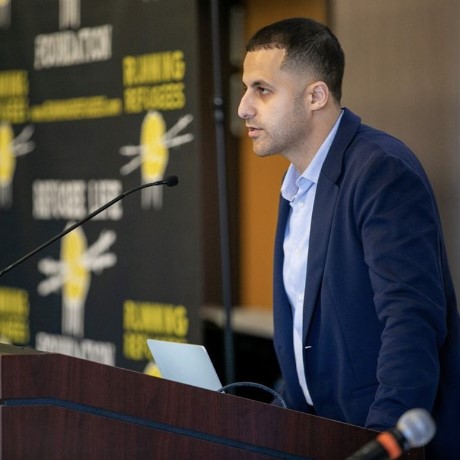
Dr. Thaer Ahmad speaks in the M building on Feb.15.
As the bombing campaign on Gaza continues, the human suffering has become overwhelming. The humanitarian crisis has become even more dire as multiple countries, including the United States, suspend funding to UNRWA, the primary humanitarian UN agency in Gaza, in the wake of an accusation that 12 UNRWA employees were involved in the Oct. 7 attack on Israel.
The agency, upon which 2 million Palestinians rely to survive, is at risk of suspending the whole humanitarian effort in Gaza.
Ahmad and Sahloul described the effects of the limited aid on the hospital.
“Gaza had 36 hospitals before the war, and now we are down to three or four fully functioning hospitals for 2.3 million people,” Ahmad said.
Showing pictures of a bloody floor in Al-Nasser hospital, he explained that because of the overwhelming amount of patients each day, there aren’t enough beds, and doctors have resorted to treating patients on the floors. They only have access to older ventilators and extremely limited supplies, he said.
“Every subsequent day the bombing was getting closer,” he said. “The gunshots were getting louder. You can hear bombing, you can hear gunfire, you can hear the drones.”
But the victims of Israeli bombardment are not the only ones who are suffering, the doctors say.
“We have hunger, we have signs of malnutrition. Our clinic started to receive children with severe malnutrition because of the shortage of food and the shortage of clean water,”
Dr. Zaher Sahloul
“We have hunger, we have signs of malnutrition. Our clinic started to receive children with severe malnutrition because of the shortage of food and the shortage of clean water,” Sahloul explained.
He reported of outbreaks of intestinal infections caused by digested unclean water. Sahloul warns that if there were an outbreak of cholera, it would kill 50 percent of the children in Gaza.
“We are seeing patients who are dying, and they are not counted as victims of wars,” he said. “Patients who have heart attacks in the middle of the night and cannot go to the hospital. Patients who have asthma attacks and do not have access to their inhalers.”
Not only are the patients in Al-Nasser suffering, but the healthcare workers are overloaded. “They’re showing up and working 24-hour shifts,” Ahmad said. “The surgeons, the doctors, the nurses–24 hours around the clock they’re working. Many of them have been in hospitals that were forced to be shut down after being raided or bombed or attacked. Many of them are being retraumatized with every single bomb that’s being hit, thinking, ‘Here we go again, it’s going to happen again.’”
Despite the desperate situation surrounding them, children who have been seeking refuge with their families play games in the halls of the hospital.
“I saw six kids playing Ring Around the Rosie in the hospital, trying to kind of make sense of all the trauma around them, all of the displacement,” Ahmad recalls, “and I thought, this is what’s happened to the kids here. This is how we failed them–not being able to give them an opportunity to play Ring Around the Rosie in the park.”
Sahloul likes to ask the children what they’d like to be in the future. He asked audience members at Moraine Valley what they thought the Palestinian children usually say, and a response of “doctor” echoed in the room. He confirmed that 9 out of 10 children will say they want to be doctors.
He mentioned one Palestinian child named Abdullah, who had a different response: “I asked what he would like to be in the future, and he said, ‘What future?’”
UNICEF estimates that 17,000 children in Gaza are either unaccompanied or are separated from their families, according to Al-Jazeera.
Ahmad noted that, “The United Nations said that there is no place that is safe in Gaza, no child is safe in Gaza, and the most dangerous place in the world to be a child right now is in the Gaza Strip.”
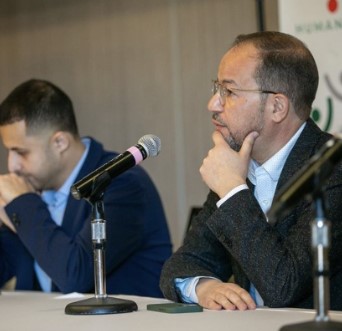
Dr. Thaer Ahmad and Dr. Zaher Sahloul share their experience at a hospital on the ground in Gaza.
As 1.5 million people are cornered into Rafah, the threat of a ground invasion could result in one of the worst catastrophes the world has ever seen, the doctors say.
MSA faculty advisor Sundus Madi-McCarthy pointed out that for Palestinians in Gaza, there are no moments of escape: “In Gaza you can’t mask what is going on. You can’t turn it off. You can’t run away from it. You can’t not look at your phone. You’re it. You’re in it. So for their experience, they’re in the nightmare.”
In times of war and conflict, it’s easy to dehumanize people, but the doctors point out that the human desires in Gaza are the same as for humans anywhere: “Wanting to be happy, wanting to be safe, wanting your family to be around you, wanting to enjoy the simplest things in life like looking at the beach,” said Ahmad.
Sahoul said that’s part of the reason they are sharing their experience on the ground in Gaza.
“You discover actually more humanity when you go into disaster areas,” he said. “It’s important to talk about these stories that we mention because that’s what makes us human. The ability to be compassionate and care about people who are suffering.”




 Velocity
Leave a comment