

Psychology professor Laura Lauzen-Collins understands why Apple wanted to replicate human eye contact with the new Apple Vision Pro.
“Our eyes are really important for communicating and forming bonds, knowing the other person’s intention, trying to figure out if that person likes us, or are they threatening,” Lauzen-Collins said.
In February, Apple unveiled the Vision Pro headset, a mixed-reality headset that marks its first venture into the virtual reality and spatial computing space. One of the device’s most notable features is its “EyeSight” mode.
“EyeSight reveals your eyes on the front of your Apple Vision Pro, and lets those nearby know when you’re using apps or fully immersed in an experience,” Apple explains on its webpage.
Velocity attended a demo of the Vision Pro to experience this technology first-hand. An Apple Store worker walked us through a setup process that used an iPhone to photograph the user’s face to provide measurements for the Vision Pro lenses and strap.
Once the demo began, we were able to experience several uses of the Vision Pro, including viewing Apple’s spatial photos and videos.
“Spatial photos and videos take you back to a moment in time, like a celebration with friends or a special family gathering, so it feels like you’re there again,” explains the Apple webpage.
Spatial photos use depth sensing technology to capture the depth of a scene which then can be viewed within the Vision Pro. During our demo we were able to view several of these images and videos.
The demo also showcased how one might use the device in a work environment to browse the web, and have multiple windows open at once in a virtual spatial computing environment.
The vision pro does not use a controller, rather, the user looks at what they want to select with their eyes and then pinches their fingers together to click or scroll.
“Our eyes are really important for communicating and forming bonds, knowing the other person’s intention, trying to figure out if that person likes us, or are they threatening.”
Laura Lauzen-Collins, Moraine Valley psychology professor
Lauzen-Collins emphasizes the importance of the sclera, the white part of our eyes, when it comes to human eye contact as opposed to that of other animals.
“If you look at other mammals you can see almost no sclera. Most of it is just iris and pupil, so the result of that is it’s harder to tell which direction they’re looking,” she said.
But because humans worry less about how the eyes would benefit us in a hunting or animalistic nature, our eyes have evolved into something rooted in subconscious communication.
“Thinking evolutionarily, what makes us special as a species is our ability to communicate with one another and to form groups because we don’t work well as single individuals,” Lauzen-Collins said. “We need to work as a collective to be successful. In order to work as a collective you have to understand to some degree what other people are thinking.”
But the attempted digitalization of human connection in the Vision Pro isn’t quite where it needs to be, Lauzen-Collins argues. She explains how when something is a little off about the face it can enter the uncanny valley.
“I remember when I first got to Moraine the [One Book One College] was on World War Z. We were talking about zombies. So I did some digging as to why we find zombies creepy,” she said.
“Some of it is movement, they don’t move in a very human-like way, but a lot of it seems to come back to eyes. When the eyes are off, it makes us feel very uncomfortable.”
Apple is attempting to lean into the familiarity and connection of eye contact with its EyeSight mode and FaceTime features.
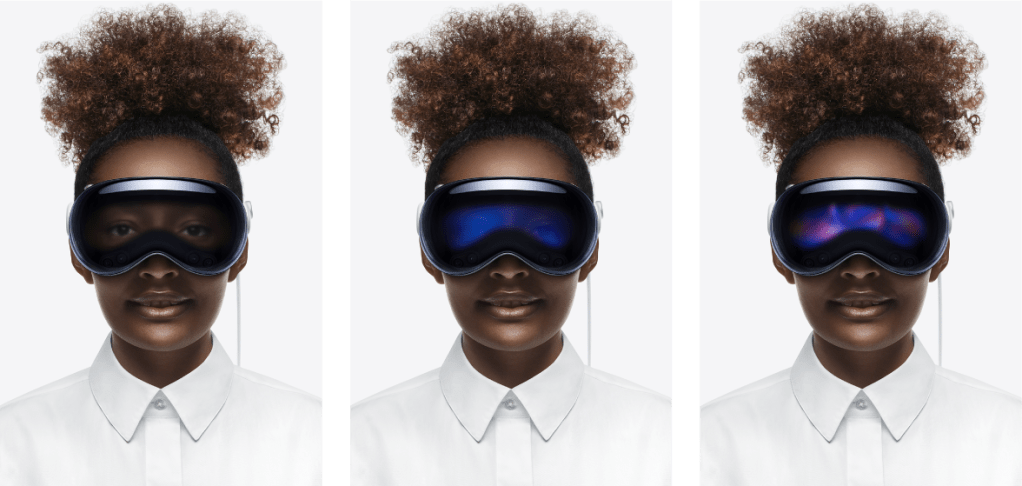
A demonstration of the EyeSight mode being used.
“Apple Vision Pro makes it easy to collaborate and connect wherever you are. FaceTime video tiles are life-size, and as new people join, the call simply expands in your room,” Apple explains.
As more companies make life-like robots and AI, “the face is profoundly important to making that thing be life-like and not falling into the uncanny valley,” Lauzen-Collins said.
“I’ve read really mixed reviews, some people have found the eyes creepy and others have found it really useful,” she said.
“I’ve read really mixed reviews, some people have found the eyes creepy and others have found it really useful.”
Laura Lauzen-Collins, Moraine Valley psychology professor
“I think the fact that it’s Apple is going to be a big deal,” Lauzen-Collins said.
She explains how Apple will most likely continue to revise this technology to make it more accessible and continue to lean into the digitized human connection the technology boasts.
“Usually the first iteration of any product is its got a lot of bugs and it’s not quite right,” she said.
Lauzen-Collins suggests that while VR isn’t on the same level as reality, it is better than imagination.
“The emotions that are being displayed in the face–the more realistically we can convey that in VR, the more comfortable people are going to feel and the more life-like their physiological reaction is going to be.”




 Velocity
Leave a comment