
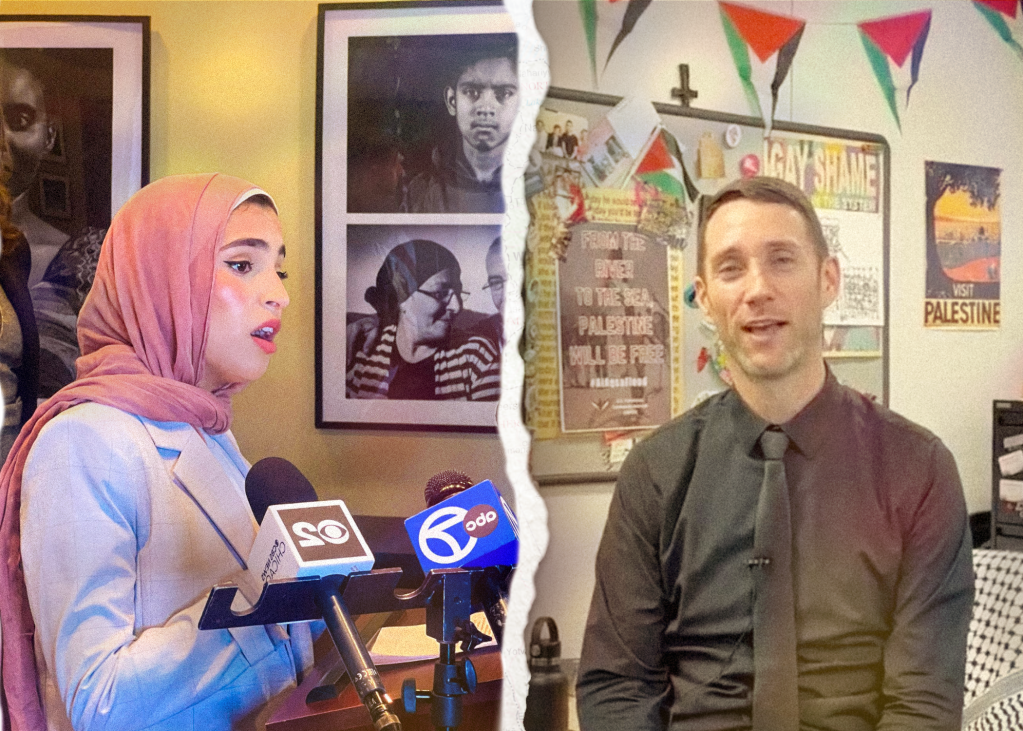
After backlash from a social media video showing an office decorated with Palestinian flags, a “Visit Palestine” poster and a Palestinian keffiyeh, a Moraine Valley professor was placed on administrative leave and the video was removed from the college’s social media accounts. Prior to its removal, the video had been reposted on X by the group “StopAntisemitism,” picking up nearly 250,000 views and numerous comments directed @MoraineValley calling for the professor to be fired.
Meanwhile outside of Moraine Valley, a recent graduate of Georgetown University Law Center lost her job offer from Chicago law firm Foley & Lardner after being questioned about her social media posts showing advocacy for Palestinian rights.
Incidents like these are leaving Moraine Valley Palestinian students fearing what’s to come in their future careers if they speak out and show solidarity with Palestine.
Lina Noful, a health science and pre-dental major, wonders what it says for her safety when a professor is put on leave because of being targeted online: “What does that mean to us actual Palestinian students? The ones that decide to wear keffiyehs, the ones that have hijabs on their heads?”
Since the beginning of the military assault on Gaza in October, protests have erupted across the globe calling for the support of Palestinian rights and for an end to the war that has killed more than 25,000 Palestinians and displaced 75 percent of Gaza’s population, more than half of whom are children, as reported by Al-Jazeera.
People who show solidarity wear keffiyehs, make social media posts about Gaza to spread awareness, and participate in protests.
But for those who have jobs, are looking for jobs, or are still in the process of pursuing their education, what does being an advocate for Palestine mean to their careers? What are the penalties for speaking out, and how can social media affect their future?
Video of professor sets off controversy
The controversy over the video featuring Moraine Valley sociology and anthropology associate professor Jeffrey McCully began shortly after it was posted to the college’s Instagram and TikTok accounts on Jan. 23. The video introduces the professor’s background and teaching style and shows McCully leaning against a desk with Palestinian memorabilia in the background.
“I really do my best to really create a welcoming environment for my students in class,” McCully says in the video. “I want my students to feel safe, feel valued and feel understood, and like that they have a place here, that they belong here, because they do.”
The comment sections were mixed, with support for McCully but also negative comments denouncing Moraine Valley for having a professor who supports Palestine.
At 11:15 a.m. on Jan. 25, an account called “StopAntisemitism” posted the video of McCully on X, saying that the video “calls for Israel’s removal” and that Jewish students don’t feel safe in the classroom. The post went viral, leading to messages directed @MoraineValley calling for McCully’s firing. The video was removed from Moraine Valley’s accounts later that day.
The next day, McCully was placed on administrative leave. The reason given was to protect McCully’s mental health, the professor says.
McCully’s initial reaction was “shock for sure but in terms of fear for my job, absolutely not. My vice president and my dean and (president Pamela) Haney, all of them reassured me that I wasn’t being put on leave as a punishment, that I didn’t have to worry about being written up, that I had done nothing wrong. So I didn’t have fear of losing my job. But that fear is real for people who don’t have the protections that I have.”
Ashkenazi Jewish student and physics major Rain Yamich saw the video posted of McCully as well as the post by “StopAntisemitism.”
“I’m kind of appalled that people call Jeffrey antisemitic,” Yamich says. “Even if you hung up some other flag on there, let’s say probably another country’s flag that’s in the Middle East, I don’t take any offense to it. It’s just very weird.”
Despite the allegation that Jewish students feel unsafe at Moraine Valley, Yamich says the opposite: “I actually feel a lot safer here than I do in most other places because it’s so diverse and I don’t have to deal with the problem of other people potentially coming after me.”
On Jan. 30, a call to action with regard to McCully was posted on the Instagram account of the Chicago chapter of SJP (Students for Justice in Palestine). The post asked the community to “Call & Email the college administration” and demand that the college supports academic freedom and denounces censorship, and for the video to be reuploaded.
In response, people flooded Moraine Valley’s TikTok and Instagram pages with messages saying “Bring back Jeffrey video” and “Reinstate Jeffrey McCully.” One commenter said, “You literally would not have a student population if it were not for the Arab and Palestinians attending your school.”
The following day, McCully’s administrative leave was lifted. McCully was surprised by the response online.
“The overwhelming majority of comments, at least on TikTok, were incredibly positive, and that made me feel good, you know,” McCully says. “It was unfortunate that people somehow interpreted from the video that I hate Jewish people, which is of course clearly not the case.”
McCully was met with similar support on campus.
“I couldn’t even get into the building without receiving support from the students,” McCully said. “Between walking to my car and the door there was already a car stopped in the parking lot. I don’t even know who this person was but they were waving to me. I can’t tell you how many times people who I do not know will stop me in the hallway and say, ‘Thank you, it’s so nice to see you, I’m glad you’re back.’”
Law grad loses job offer over support of Palestine
McCully’s temporary administrative leave based on the video is only one of many situations in which people who support Palestinian rights face potential career backlash.
Muslim Arab American Jinan Chehade of Bridgeview, a recent graduate of Georgetown Law, lost her job offer from Chicago law firm Foley & Lardner. Right before she was to start the job, the firm called her in for questioning regarding her advocacy for Palestinian rights in her social media posts and her co-founding of SJP chapters at DePaul University and Georgetown.
“Foley & Lardner is a law firm that prides itself on diversity and inclusion, but I was targeted as one of the only Muslim Arab female associates in the law firm nationwide,” Chehade says in an interview with Middle East Eye. She points out that other attorneys at the law firm who had expressed support for Israel were not targeted or fired over their comments.
“Obviously the standard was not applied holistically among attorneys,” she says. “When I walked into the meeting, they literally pulled out a packet about 15 to 20 pages that had screenshots of my social media posts, screenshots of my involvements, my quotes, my background, literally everything that involves me and my background and my advocacy for Palestine.”
Chehade had relied on the job financially, and it was a huge blow to her career, she says. Despite it all, Chehade firmly states, “I have no regrets and I will never regret being outspoken for Palestine.”
Social media can both help and hurt a career
Students in general are often cautioned to be careful what they post on social media as it can come back to haunt them in the future.
“There are opportunities where social media can assist–it can assist people in getting hired or at least getting the interview–and there are opportunities where it can hinder,” says Moraine Valley’s Job Resource Center director, Pamela Payne.
Many students take to social media to like, share and repost videos released from Gaza on Instagram accounts such as eye.on.palestine or palestine.pixel. Some document the protests they attend, posting to their stories.
“It kind of shook me at its core when I started seeing the videos,” says Yamich. “I was hearing other people’s perspectives, especially the nurses that came back from Palestine, especially from Gaza. It was really hard to hear what they were saying, and I was just like, ‘This was no different from any other genocide. We should probably stop. It’s a no-brainer.’”
Payne isn’t advising students not to speak out, but does say they should consider the potential consequences either way.
“If there’s something where one feels very passionate and they’re speaking out, when it comes to justice and things like that, I wouldn’t say, ‘Oh, you should shy away from those kinds of things,’” she said. “You just need to understand what could possibly happen as a result. It’s a risk if you don’t, it’s a risk if you do.”
Palestinian students at Moraine Valley worry not only about the career consequences, but about their physical safety. Anti-Palestinian and Anti-Muslim hate crimes have increased by 180 percent recently, according to Muslim civil rights and advocacy group CAIR.
Noful points to the three Palestinian college students who were walking on a street in Vermont speaking Arabic while wearing keffiyehs. All three were shot, and one of them was left paralyzed from the waist down, as reported by Middle East Eye.
Biology and pre-med student Haneen Heshmeh shares a similar concern: “If people saw one video of a teacher out with a Palestinian flag, nothing about it, just the flag, what would they think about a student walking around with a keffiyeh?”
“If there’s something where one feels very passionate and they’re speaking out…I wouldn’t say, ‘Oh, you should shy away from those kinds of things.’ You just need to understand what could possibly happen as a result. It’s a risk if you don’t, it’s a risk if you do.”
MV Job Resource Director Pamela Payne
Noful and Heshmeh are just two of many students making the decision to be vocal about what they believe in while also risking their future careers. But they aren’t willing to sacrifice their morals, they say.
“There are a lot of consequences that come with speaking up, but I am simply pushing to help the humanitarian aspect of the Palestinians,” Noful said. “At the end of the day, the truth will prevail.”
Yemeni student and dentistry major Nabiha Saleh says her way of showing her solidarity with the Palestinians is by wearing a keffiyeh.
“I believe it’s important for me to stand up for what I believe in. I aim to educate and raise awareness about Palestine rather than confront,” Saleh says.
As the pitfalls of activism fall onto the shoulders of supporters of Palestine, the question is left as to whether it is truly worth it.
“Speaking out is a risk, but it’s a risk I’m willing to take for the people of Gaza,” says Chehade.
Social media has become a platform for people to express themselves and be vocal about what they believe in, but with that freedom always comes the risk of judgment.
“Controversy and justice, as long as human beings exist on the planet, is going to be exactly what it is,” Payne notes. “This just happened to be one of many.”
Niki Kowal contributed to this report.


 Velocity
Leave a comment