
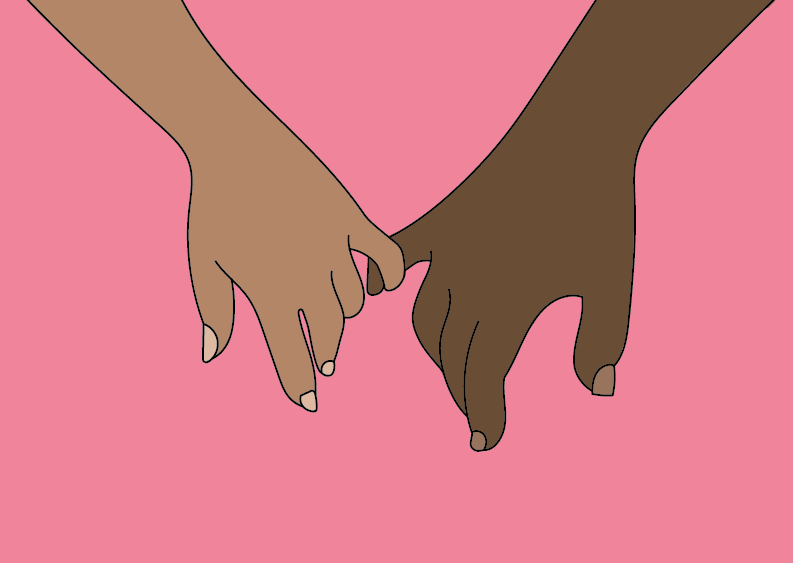
The melanin spoke to him, and it said-
“Ugh, why do I have to read this garbage?” Aysha muttered to herself. She threw the book down on the table, cursing the author for being so racist, and her Language Arts teacher for assigning this book to her, and everyone who had ever seen her as less-than because of her race.
“I had to do that book last year,” a voice responded, and Aysha turned around, catching a Nubian boy leaning on the table next to hers. He towered over her, and his hair curled out in all directions from the top of his head.
Without thinking, she said, “Can you please come here? I think a study partner would make this more tolerable.”
She didn’t expect a reply, so it surprised her when he said, “Of course,” and came over, taking the seat to her right. She felt a jolt in her heart–fear, she was inclined to call it. But maybe it was something else?
She found herself looking at his face–those lips really were filled out–when he stated, “My name’s Okonkwo. I’m an Igbo.”
“Mine’s Aysha,” she bounced back. “Can we please start focusing on the book here?”
Okonkwo’s face scrunched up. “I wish we didn’t have to.”
“You didn’t like it?”
“How could I? The main guy just hates on Asians throughout the story, and then kills their leader!”
“WHAT?!” Aysha shouted.
“I’m not joking; it was for being ‘too yellow!’” Okonkwo snorted.
“And they say we’ve moved past that stuff?” Aysha looked down at the cover, a wave of revulsion coming over her. “Guess I’m not going any further with this thing.”
“Don’t say I didn’t warn you,” Okonkwo replied, shrugging.
“Actually, thanks for the spoiler. I don’t know how I would’ve handled something like that.”
“After reading that scene, I couldn’t stop crying for days afterwards.”
Aysha was intrigued. “You really hated it that badly?”
“Yes! And worst of all, my teacher wouldn’t let me switch to something else! She said it couldn’t be affecting me that badly!”
“If that’s the case, then she needs to be fired.”
“Or maybe the higher-ups should stop forcing them to teach these hate tracts,” Okonkwo responded.
“What would you like to read instead?” Aysha asked.
“I’d say Igbo-Wakandan stories. Stuff that, you know, doesn’t use my culture to attack others.”
“Me too. I wish there was stuff that portrayed being an Arab-Wakandan accurately. Everything in the media’s portraying us as terrorists, or foreigners, or the butt of jokes. I’m sick and tired of all of it.”
Before Okonkwo could respond, the bell rang at the end of the study period. As they got up to leave, Aysha blurted out, “Where do you live, Okonkwo?”
He responded, “Al-Maghrib neighborhood. Why did you ask?”
“Because I want to visit you this weekend. Just to study,” she said.
“Okay,” he said as they exited the library.
On Friday, Aysha took the train to Okonkwo’s neighborhood. She couldn’t stop thinking about what she wanted to say to him–how she’d greet him, the topics they would bring up, what they would study…
She shook her head, reminding herself not to go too far with this. They were just studying books, not going on a date! And even so, her parents probably wouldn’t approve of him.
Before she knew it, she was standing in front of his house, ringing the doorbell and wondering who would answer. After five or six rings, the door opened, and Okonkwo was standing there, holding a pile of books in his arms.
Surprised, Aysha blurted out, “You like to read? I thought you hated that novel!”
“I still do,” he replied, shifting his weight against the shifting books. “But it’s not something I would have picked in my spare time.”
“Can I come in?” she remembered to say.
“Sure,” Okonkwo replied.
As she walked through the front hall, she marveled at the opulence of Okonkwo’s home. The glazed rare woods and marble, the vases imported straight from Somalia, the Egyptian-style furniture.
“You must be jealous of me by now,” she suddenly heard Okonkwo say, and that made her turn around to face him.
“Why would I be jealous?” Nonetheless, she felt her face heating up.
“Because you’ve seen all of the cool stuff that my family has, and you wish you could own all of it, but you can’t, because people will think you’re ‘uppity.’”
“It’s not what I’m angry about.”
“Then what is it?”
The words came rushing out of her mouth. “Being stared at in department stores. People asking me where I’m from, and then not believing me when I tell them I was born here. The terrorist accusations and ‘jokes’ and lies about my culture being conveyed by the media.”
They stood there, Aysha wondering why she had said these things to a complete stranger. Or maybe he wasn’t that to her anymore?
“Let’s start studying,” Okonkwo said, breaking her train of thought.
Aysha followed him to the living room, where books and papers and other supplies were already scattered across the main table. She smiled upon seeing that, and they sat down.
Okonkwo turned to the first chapter, and Aysha recognized the face in the book immediately. “You’re reading about Akela Kilauea?”
Okonkwo looked up, a confused look on his face. “Duh.”
“I never thought you were interested in him!” Aysha exclaimed.
“Who isn’t, with all of the great stuff he’s done for us?”
She felt herself blush upon hearing that. “What if he were still alive, and we could meet him right now?”
“Well, then I would want his autograph.” He flashed a smile at her, and she felt her own grin widening.
“Well, I would ask him what we should do about the current president. I can’t stand that racist.”
“Me neither,” Okonkwo responded, snorting. “Akela would probably be organizing a bunch of protests against Oromu. And I’d attend every single one.”
“Me too.” But then something else popped into her head, and she blurted out, “But what if it’s not enough? What if no matter what we do, nothing ever changes for the better?”
“Aysha–” Okonkwo started.
But she continued, “And what if despite our best efforts, things only end up getting worse?”
“You shouldn’t be speaking this way,” Okonkwo murmured, his smile now gone.
“Kilauea put so much effort into the movement, and what do we have to show? An openly racist president, hate crimes spiraling out of control, discrimination in housing and education and the workforce and–”
What Okonkwo said next stopped her in her tracks.
“I love you. You speak the truth about society when everyone else tip-toes around it, and it just impresses me so much.”
“I love you too, Okonkwo,” Aysha replied.
“You’re the first person to make me believe that we can do something about this problem.”
“What should we do?” Aysha asked.
“Love. Just show our love to everyone. And sure, some people might not approve because we’re different races, but we shouldn’t worry about them. They may be kind to their friends and family, but strangers? People of different colors? They’re too much for them, and then the former keep going on about love and respect and all of that. But we’re not that. We’ll stand by each other, no matter what life throws at us. And we’ll do that every day, not just on some holiday or when it’s convenient.”
Aysha smiled at Okonkwo. “You’re right,” she answered. “Forever.”

 Velocity
Leave a comment