
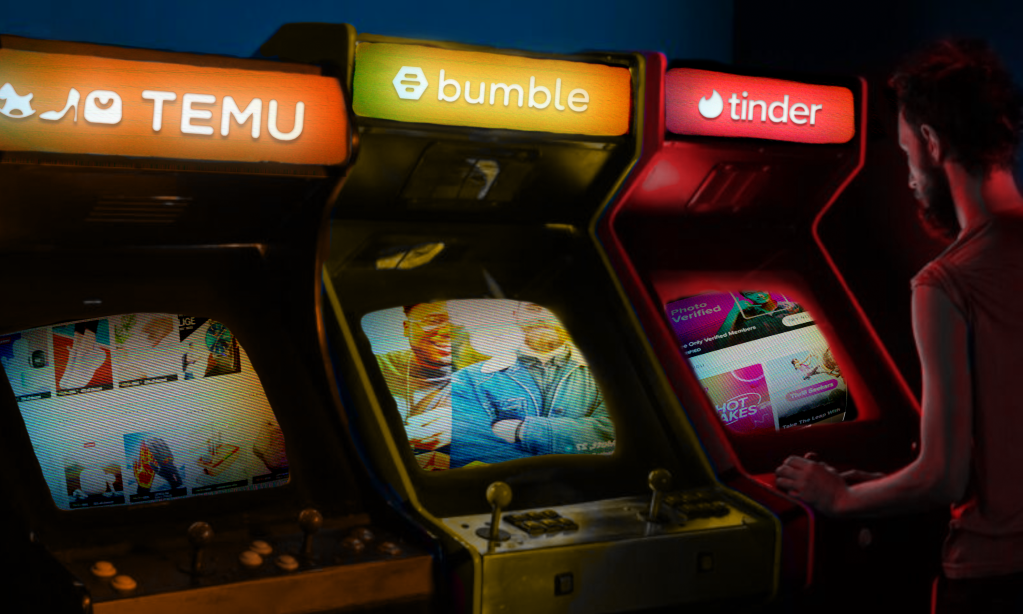
Something is changing in the digital landscape. Gone are the days when we visited Amazon for the sole purpose of ordering exactly what we needed. Now, shopping online might involve being bombarded with bright colors filling our screen, countdown timers, flash sales, wheels to spin for prizes, and invite codes to send to friends, which in turn give the user a reward for inviting more people to the app. That’s the approach used by Amazon’s new competitor, Temu, which has quickly become another giant in the field.
But it’s not just online shopping that is changing. In an attempt to draw users in and keep them engaged longer, marketing teams and app developers for everything from dating to fitness to education are tapping into core psychological principles to influence consumers. They are gamifying our digital world.
“Gamification kind of hacks into the dopamine reward system that we all have,” said Moraine Valley Psychology Professor Laura Laura Lauzen-Collins. “In the past, that dopamine reward system worked really well. It motivated us to engage in goal-seeking behavior, things that would bring us food or give us opportunities for reproduction.
“All these things would make us feel good and they were intermittent, they were not frequent, and that is the way the dopamine system is supposed to work.”
“Gamification kind of hacks into the dopamine reward system that we all have.”
Moraine Valley Psychology Professor Laura Lauzen-Collins.
Lauzen-Collins explained how, when the dopamine system is activated too frequently, it can ultimately hurt our day-to-day lives.
“What happens is, normal everyday stuff doesn’t feel good, it feels uncomfortable, so things that brought you pleasure in the past won’t be able to do that anymore,” she said.
Lauzen-Collins related the process to a drug addiction: The more you take, the more you need in order to feel an effect.
Temu was founded in July 2022 and by September, it had launched its website in the U.S. What made Temu so captivating was its low prices and the high levels of dopamine it offered its users.
Temu was a brand new company, yet according to CNBC, it amassed 30 million downloads in its first quarter, while the downloads of its direct competitor and long-time online shopping giant, Amazon, fell by 40 percent in the same quarter. Temu’s unique approach to gamifying its site is a major contributor to its success.
By turning what once was a mundane task of ordering a t-shirt online into an engaging and dopamine-fulfilling experience of minigames, countdowns, and competition, Temu could tap into the human mind.
“These apps want you to engage with them,” Lauzen-Collins said. “That’s the goal–for people to be on them more–so they know what kind of rewards work.”
But this phenomenon of gamifying our lives in order to fulfill our urge for dopamine is not limited to Temu. It’s all around us.
“In Canvas on the student side, when you submit something, you get confetti,” said Moraine Valley sociology professor Allison Lacny.
Each time a student submits an assignment on time, a burst of digital confetti fills the Canvas screen on their computer.
“As a professor, when we submit something, we don’t get confetti. So I wonder if that’s supposed to trigger that sense of reward for students,” Lacny said.
“As a professor, when we submit something, we don’t get confetti. So I wonder if that’s supposed to trigger that sense of reward for students,”
Moraine Valley Sociology Professor Allison Lacny
Some companies have attempted to leverage this reward system for the human benefit too, especially in the fitness tracker world.
“I normally wear a Fitbit,” Lacny said. “I know if I had an Apple watch, it would be a second spouse. I am totally hooked on it.”
Lacny enjoys the progress bar and reward system built into the FitBit step tracker.
“I find when I’m wearing it, I am very in tune with what I’m doing and the rewards,” she said. “It’s like that intrinsic motivation. I’ll get up and walk around the house because if I get 10 more steps then the circle is filled.”
But Lacny wonders if this reward system has gotten out of control: “Are 10 steps on a Tuesday really going to matter if I take 20 steps the next day?”
Lauzen-Collins says gamification is throwing off our brains: “The system is out of whack. It’s not getting stimulated in which the way it originally evolved to be stimulated.”
Another common theme of gamified apps is the countdown timer. Whether it’s a flash sale on Temu, or the 24-hour reply countdown on dating apps like Bumble, apps push a sense of urgency upon us in order to create more engagement amongst their users.
“That’s called scarcity, and that definitely pushes us to want to make sure we get it before someone else gets it,” Lauzen-Collins said. “That has been a long-used tactic to drive behavior.”
Lacny personally relates to the idea of caving under a time restraint.
“As a self-described procrastinator, I kinda like that pressure,” she said. “Maybe it uncovers that competitive athletic part of me. I like being under the clock. Isn’t that when a game or a match is the most exciting? When there’s like, ‘tick tick tick tick’?”
But underneath the flashy gimmicks of these apps is a far more sinister story.
The fast fashion site Temu has been facing numerous lawsuits over recent months including one filed by a customer in September over a breach in data protection of their payment information.
“I go to my home and I share what I know with my own kids because I believe in what I do. I don’t say, ‘Oh, we’re not going to talk about this because it might damage you.’”
Moraine Valley Sociology Professor Allison Lacny
Lacny stated her fear over the fact that many of the developers behind these apps don’t allow their own children to access them.
“I go to my home and I share what I know with my own kids because I believe in what I do. I don’t say, ‘Oh, we’re not going to talk about this because it might damage you,’” she said.
Lauzen-Collins urges us to step back from the constant dopamine stream of the digital world and allow ourselves to find natural stimuli outside of these apps.
“The more pleasure we seek, the less we are able to receive from the things around us,” she said. “It leads to an inability to experience these pleasures.
“The way to feel more pleasure in day-to-day things is to cut yourself off from whatever you’re getting those constant dopamine hits from.”




 Velocity
Leave a comment