
Where is Gaza?
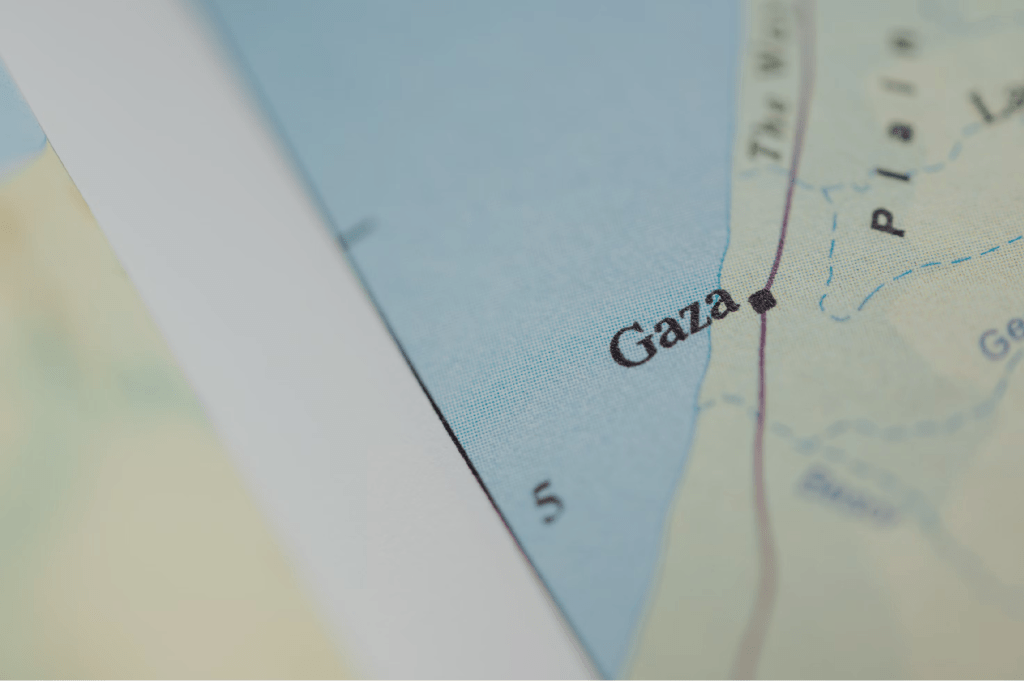
Gaza, known as the Gaza Strip, is a narrow strip of Palestinian land controlled by Israel. It is one of three Palestinian territories that are under Israeli occupation and is one of the most densely populated areas in the world. It is roughly 25 miles long, nearly equivalent to the size of Detroit.
The Gaza Strip is made up of five main governorates. From north to south is North Gaza, Gaza City, Deir-El Balah, Khan Younis, and lastly Rafah, which borders Egypt.
What are the demographics of Gaza?
About 2.1 million people are densely living in Gaza, with about 15,000 people per square mile, NBC reports. About 1.4 million Palestinians are displaced, living as refugees, according to the United Nations.
The Palestinian Central Bureau of Statistics reports about 60 percent of Gaza’s population is below the age of 25, and 50 percent is under 18. This means half the population has been born in the same narrow space.
What is the history of the blockade?
Gaza, the West Bank, and Jerusalem, along with the rest of Israel, used to be part of historic Palestine, which was seized in 1948. The Nakba, which Palestinians refer to as “the catastrophe,” started the near-total destruction of Palestine and began the violent process of Palestinian dispossession and loss of homeland for the past 75 years.
The state of Israel had come into existence, using its military forces to expel Palestinians from their villages.
“If you go back to the founding of the state of Israel in 1948, and the Nakba, the catastrophe for the Palestinians, you have 750,000 Palestinians that are displaced,” said Moraine Valley history professor Merri Fefles.
In an effort to escape the ongoing massacres committed in their villages by the Israeli military, hundreds of thousands of Palestinians were made refugees, leaving in search of safety. About 200,000 fled to Gaza in only two years after the beginning of the Nakba.
After 1948, Gaza was taken under control by Egypt but later lost to Israel with the eruption of the 1967 War, as reported by Al Jazeera.
“After the 1967 War, the six-day war where Israel launches a preemptive strike against Egypt and Syria, it ends up taking the Sinai Peninsula from Egypt, takes the Golan Heights from Syria, and it captures all of the West Bank from Jordan,” Fefles said. “It captures the Gaza Strip as well as all of Jerusalem.”
Related Coverage
Moraine Valley student Malak Eldeirawi describes the horror of what it’s like to be stuck in a war zone.
During this time Israel seized most of the remaining Palestinian territories, leaving another 300,000 Palestinians expelled from their homes.
“In each one of these, Israel expands at the expense of the Palestinians living in the region,” said James McIntyre, a history professor at Moraine Valley.
Around 1995, Israel constructed an electric fence and concrete wall along the Gaza Strip, aiming to reduce interactions between Gaza and other Palestinian territories.
Israel established illegal settlements into the strip, allowing Jewish settlers to move in. However, after the second Palestinian uprising in 2000, known as the Second Intifada, Israel began a “disengagement plan” in 2005 and ordered settlers to leave the strip.
Israel says its occupation in the Gaza territory has ceased since illegal settlements and soldiers were removed, but international law recognizes Gaza as an occupied territory because of Israel’s surrounding control of the strip.
In 2007, the elections in Gaza marked a significant turning point as Hamas, defining itself as a Palestinian Islamic national liberation and resistance movement, took control of Gaza, using armed resistance as its method of liberation. Hamas was founded in 1987, only 39 years after the Nakba, after the first Palestinian uprising against the Israeli occupation. Gaza had become a small, self-governing territory under Israeli control.
During that year of 2007, Israel significantly intensified its restrictions on land, air and sea.
“Israel over time then ends up encircling Gaza, blockading it essentially, and then you have this kind of iron curtain around the Gaza Strip,” explains Fefles.
McIntyre says, “Blockade is an act of war to begin with because you are consciously denying access of various materials into a region that you are basically at war with.”
These measures further limited the movement of goods, people, and resources in and out of the Gaza Strip, with many people referring to Gaza as an “open air prison.”
The Palestinian people have undergone four deadly Israeli military operations said to target the Hamas leaders over the years: in 2008, 2012, 2014, 2021, and most recently 2023. Air strikes have destroyed residential homes, schools, mosques and other structures, and killed thousands of Palestinians civilians, including women and children, says Al Jazeera.
“The situation is catastrophic. It’s dire. It’s awful. Can’t even be put into words, it’s overwhelming even to read, I can’t imagine what it’s like to be there.”
Merri Fefles, Moraine Valley History Professor
According to the United Nations Office for the Coordination of Humanitarian Affairs, the 2.1 million people in Gaza are “locked in” from the outside world, with limited access to medical treatment, higher education, family, employment and economic opportunities.
The heavy restrictions on Gaza have left it with no economy, with high unemployment rates, food insecurity and aid dependency.
About 1.3 million people in Gaza are in need of food assistance, and 78 percent of piped water is unfit for human consumption, as reported by the UN.
What is happening now?
“This starts on Oct. 7 in response to attacks on Israel by Hamas,” McIntyre said.
An armed group of Hamas fighters launched a surprise operation called “Al-Aqsa Flood” into southern Israel in response to the desecration of Al-Aqsa Mosque and increased Israeli settler violence against Palestinians. The operation killed 1,400 Israelis and took more than 200 hostages into Gaza.
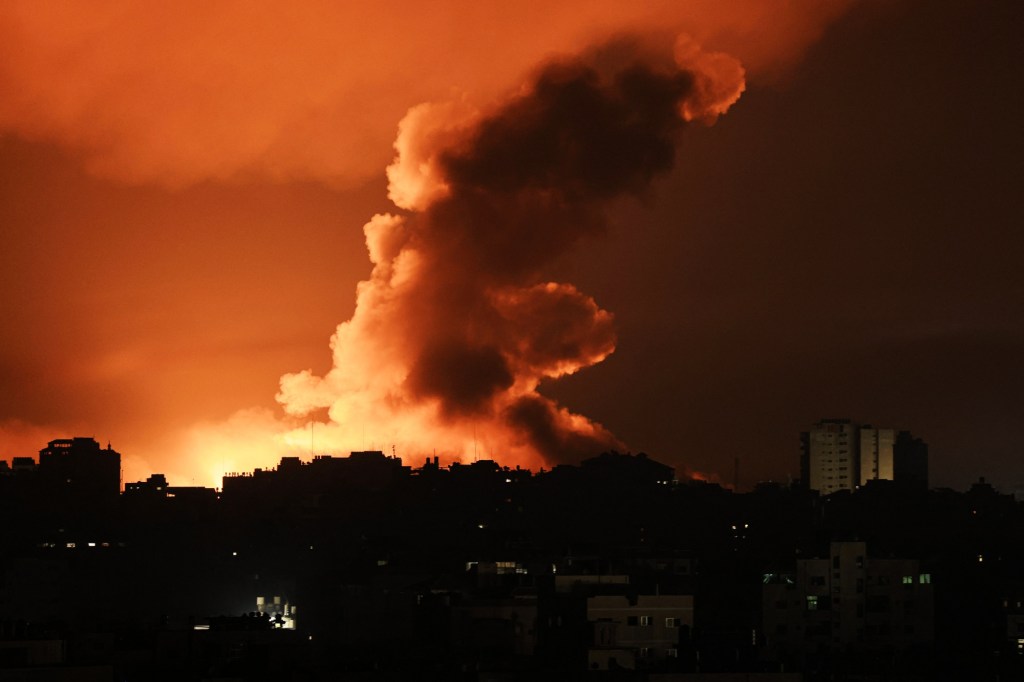
In response, Israel “declared war” with Hamas, cutting off fuel, food, water, and electricity on all Gaza civilians while bombarding Gaza with non-stop airstrikes. As of Nov. 30, more than 6,000 children are included in the overall death toll, Al Jazeera reports.
“You have now at this point what was 11,000 before, we’re at 12,000 civilians now if not more. I mean it’s a disgusting number,” says Fefles.
“In the last couple weeks, the Israeli defense forces have been pushing in, bombing night and day. Israel claims they are bombing targeted places. Israel also claims that Hamas has tunnels underneath areas where there are civilians and therefore those then become legitimate military targets.”
Israel issued an evacuation order on Oct. 13 for residents in North Gaza, ordering 1.1 million people to flee towards the south within 24 hours. Al Jazeera reported residents hastily packing their belongings and evacuating in various vehicles, including cars and vans. People who are left with no transportation are forced to walk with only what they’re able to carry off from their homes.

Related Coverage
“The bombardment that’s been going on, now the forces are on the ground,” Fefles says. “Civilians have been told to flee, so you’re told to go south, you go south, but then you’re getting bombarded there. You go to the border of Egypt, and they’re not letting people in there except for very minimal amounts of humanitarian assistance that’s now been getting in, but very small amounts.”
Despite the overwhelming situation at the Rafah border, some people are able to find their way out of the enclave.
“Some nationals from other countries were allowed to leave last week and they are still allowing people to leave here and there but these are small numbers. What are people supposed to do?” adds Fefles.
“The fact is they respond with overwhelming force but in this case it’s such overwhelming force and it’s so indiscriminate that it leads many people to question, what’s the goal?” adds McIntyre.
What is the current crisis?
Trapped in Gaza with her family, Moraine Valley student Malak Eldeirawi described the horror of what it’s like to be stuck in a war zone.
“Being on the ground in Gaza is execrable. It’s not ground. We’re walking on destroyed homes, people’s flesh, blood, and dead animals, so being on the ground here is walking on a graveyard,” she wrote in response to an email with interview questions.
Gazans are cut off from food, water, electricity and fuel. Hospitals have been on the brink of collapse, with patients scattered all over the floors, needing medical attention or seeking refuge from the bombings.
The constant bombings of Israeli airstrikes have demolished schools, hospitals, and whole neighborhoods. The UNRWA, the main relief and human aid agency for Palestinian refugees in Gaza, has reported that nearly a half a million people haven’t been able to access food rations from distribution centers due to its closing since the attacks of Oct. 7.
Churches have also been destroyed due to Israeli airstrikes: The 1,600-year-old Greek Orthodox Church of Saint Porphyrius, the oldest church in Gaza, was targeted, with the Israeli military claiming it was “striking a military command center,” says Middle East Eye. The strike killed at least 18 people, according to the Palestinian health ministry, as Palestinian Christians had been using the church for refuge.
What humanitarian aid is getting through?
Beginning last Friday, Hamas and Israel have agreed to a four-day pause in fighting in order to exchange hostages and prisoners as well as allow more humanitarian aid to be entered into Gaza.
On the fifth day of the pause, historian Heather Cox Richardson reports in her “Letters from an American,” about 10 Israeli and dual-national hostages including two Thai nationals were released by Hamas, while Israel released 30 Palestinians from Israeli jails, many of them being women and children.
As the pause has passed its fifth day, negotiations have continued to extend the pause to allow more hostages and prisoners to be released.
Since last Friday, about 750 trucks of humanitarian aid have been allowed through the Rafah border, which is about 150 trucks per day, reports Al Jazeera. The UNRWA, however, has expressed its concerns as 200 trucks are needed daily for the next two months in order to cover basic needs for the people in Gaza.
According to the New York Times, as supplies make their way inside, the W.H.O. warns disease could kill more Gazans than Israeli strikes if there aren’t enough medical supplies.
A humanitarian crisis that’s ‘catastrophic’
The ongoing humanitarian crisis in Gaza has sparked global protests demanding an immediate ceasefire. The United Nations has issued appeals for a ceasefire. Secretary-General Antonio Guterres has expressed grave concerns, stating that in Gaza, “a humanitarian catastrophe is unfolding before our eyes.”
“When there’s been calls for ceasefires, Israel keeps saying we can’t call for a ceasefire because it will allow Hamas to regroup,” says Fefles. “There’s more pressure being put on Israel by external forces. I think the U.S. is finally now starting to step up and getting a little stronger by saying to them, ‘You know, you need to call for a ceasefire.’
“The situation is catastrophic. It’s dire. It’s awful. Can’t even be put into words, it’s overwhelming even to read, I can’t imagine what it’s like to be there.”




 Velocity
Leave a comment