
An email that was meant to show support and compassion touched an open wound for some members of the Moraine Valley community in light of recent events in Palestine and Israel.
The email, sent from the office of President Pamela Haney on Thursday, Oct. 19, was intended to convey a “reaffirmation of Moraine Valley as a place where all students, faculty, and staff members are made to feel safe, supported, and valued” in light of the “distress, fear and sadness” that is “palpable” on campus.
However, it ended up revealing the significant difficulties in navigating the intricate emotions surrounding the ongoing and long-standing events in the Middle East and compelling the Moraine Valley community to grapple with the complexities of the situation.
At 5:07 p.m. Friday, Oct. 20, another email arrived in inboxes inviting students, faculty, and staff to two separate listening sessions to hear the concerns of members of the Moraine Valley community.
As many at Moraine Valley observe with a sense of powerlessness, classmates and colleagues are experiencing profound distress, particularly those with connections to Palestine and Israel.
The impact of this issue is felt heavily in Palos Hills, with its proximity to Orland Park, the city with the 4th largest Palestinian population in America, ranking behind only New York, Houston and Los Angeles.
The wound for many Moraine Valley students is raw, as they worry for their families overseas, see news of a 6-year-old Palestinian-American boy being killed in nearby Plainfield, see rumors of Islamophobic threats being posted on social media, and hear of a Moraine Valley student being called an “f-ing Arab” inside a classroom.
The inherent challenge in addressing this sensitive topic results in a sense of isolation, intensifying the feelings of sorrow and stress experienced by everyone involved. This isolation not only amplifies the emotional burden but also makes it more challenging for people to find common ground and promote productive conversation.
The impact of this issue is felt heavily in Palos Hills, with its proximity to Orland Park, the city with the 4th largest Palestinian population in America, ranking behind only New York, Houston and Los Angeles.
In an article in the New York Times, Jewish American students shared their own feelings of isolation.
“It felt like I was very alone today,” said Ahuva Mahalel, a 16-year-old who said she has many Jewish friends and neighbors but doesn’t know any other Jews at her New York City public high school. “I think Jews feel it’s very personal. No one understands it and no one can experience the nuance of it.”
In the email sent Oct. 19, Haney acknowledged the pain felt by members of the Moraine Valley community, ending with the statement, “Join me today, and every day, in ensuring that kindness and care is at the heart of all we do.”
However, some students had concerns with word choice within the email referring to “the Israel-Hamas conflict.”
In light of the concerns, administrators decided to conduct the listening sessions for the purpose of “information gathering,” saying the sessions would be “only the beginning of what we expect will be a continuing dialogue on our campus.”
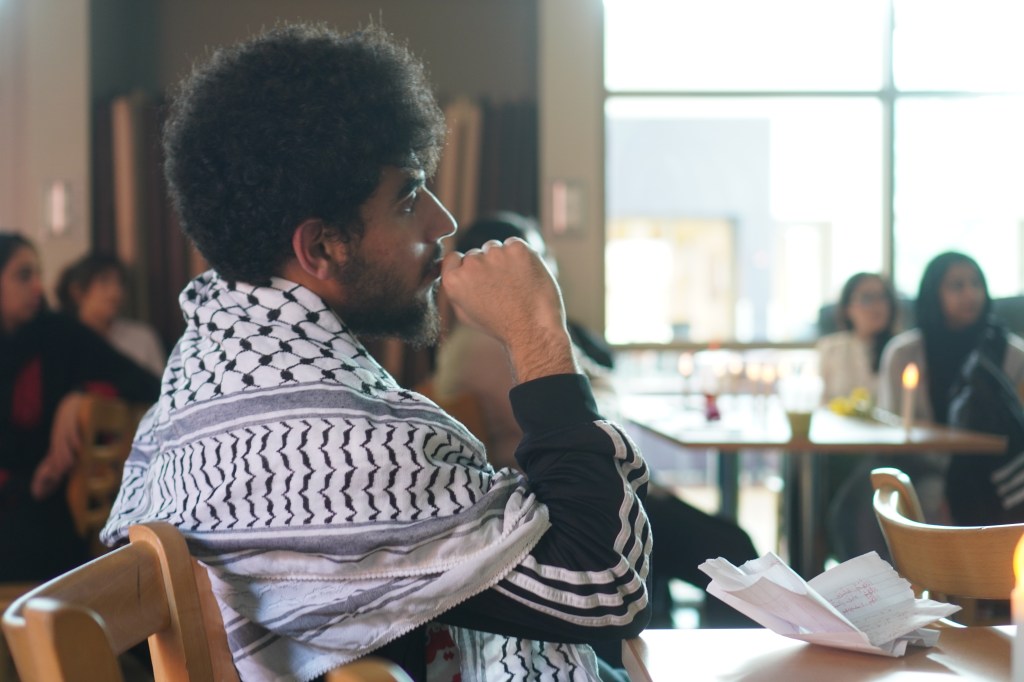
On Oct. 23, the M building was the venue for these listening sessions. The building carried an air of uncertainty. The mood in Moraine Room 3 mirrored this uncertainty as, prior to the panel’s commencement, attendees appeared emotionally and physically distant.
Six members of the administration were seated at the front of the room: Haney, Vice President of Student Development Normah Salleh-Barone, Vice President of Academic Affairs Ryen Nagle, Executive Director of Diversity, Equity and Inclusion Rory Smith, Vice President of Institutional Advancement Margaret Lehner, and Police Chief Pat Treacy.
Also in attendance were Vice President of Administrative Services Rick Hendricks, Dean of Liberal Arts Kiana Battle and Vice President of Information Technology Kamlesh Sangvhi.
Many attendees hesitated to approach the front of the room, while the back tables and walls were filled with individuals. Later, as more people came in, all the tables were filled.
Student Lina Nofal stepped up to the microphone to express her concern with the wording of the email.
“The word ‘conflict’ undermines the occupation and oppression of the Palestinian people,” she said. “It is not a conflict but rather an ethnic cleansing and a genocide of the Palestinian people, not Hamas. Palestinian people pay the price.”
Student Layth Awadallah expanded on those feelings, describing the wording of the original email as “disheartening.”
“Right now, millions of people are being displaced, half of the population is less than 18 years old, and we are referring to this as a ‘conflict between Israel and Hamas,’” he said. “This is people resisting colonization, and we need to address it as such. This has been happening to our people for 75 years. This is the only time that we’re hearing about it, now, because the oppressor was attacked. But when we are attacked, everybody is silent.
“The solution to this conflict is decolonization, so that’s what I want to hear from Moraine Valley.”
The room burst into applause in response to Awadallah’s speech.
“The word ‘conflict’ undermines the occupation and oppression of the Palestinian people. It is not a conflict but rather an ethnic cleansing and a genocide of the Palestinian people, not Hamas. Palestinian people pay the price.”
Lina Nofal, Student
A student who identified herself as Aya thanked administrators for the listening session and for allowing Palestinian students to have a voice.
“I’m here to tell you that me and my peers feel dehumanized,” she said. “We feel ‘less than,’ and this does not come out of thin air. This comes from very detailed wordplay in the media that is specifically pitted against us.”
Haney responded to the concerns at one point, saying, “The intent of the email was not to harm or diminish your feelings in any way. We were trying to stay neutral to make sure we were not offending one side or the other, but I will say this. We are here to support everyone.
“We don’t get it right all the time, thus we are here today to hear from you.” She referred to the session as a “learning opportunity for all of us,” saying “we are all open and we want to work together.”
After the listening sessions, Smith, Moraine Valley’s director of diversity, equity and inclusion, described plans to follow up on what the administration had heard.
“The meetings were to signal to our students that we care, that we support our students, and that we are hearing students in a way that is authentic and genuine. In a way that are willing to learn,” he said.
“The president has tasked us with putting together a series of training programs and so that has already begun.”
To help move ahead in a positive light, on Tuesday, the Arab Student Union will be holding a meeting for students to have an opportunity to learn more about the meaning of Palestinian symbolic figures while also having the chance to choose a symbol and paint it on a canvas. The event will take place at 3:30 in B284.
Meanwhile, 27 Moraine Valley faculty members signed a letter expressing their solidarity with the Palestinian-American students on campus.
“We, the undersigned faculty at Moraine Valley Community College, express our solidarity with the people of Gaza and all of Palestine who are struggling for self-determination and their freedom from the apartheid state of Israel,” the letter states. “Our institution, being situated in a congressional district with one of the largest concentrations of Palestinians and Arab Americans in the US, enrolls a sizable number of Palestinian students, and we witness their pain.”
The situation weighed heavily on President Haney during a week that was planned to be a celebration of her investiture as the sixth president of Moraine Valley Community College. When she stepped up to the microphone to deliver her investiture speech, she began with a two-minute statement and moment of silence.
“While we gather to celebrate this moment, I want to say that this is also a heartbreaking and painful time for me,” she said. “I want to acknowledge the recent events happening in Gaza and throughout Palestine and Israel.
“During this difficult time, many of our students and colleagues are experiencing grief, isolation and anxiety. Let us remain compassionate, kind, and understanding. Moraine Valley is a vibrant tapestry of diversity, fostering ethnic and religious inclusivity, and representing many nations across the globe.
“Let me be clear: We are committed to the continued safety of our students and encourage discourse of peaceful expression and debate on our campus. Because we respect the sanctity of life, Moraine Valley will never value one life over another. Therefore, we stand with our students and families who may be grieving the loss of innocent lives of both Palestinians and Israelis. I want to emphasize that we support all of our Moraine Valley community. We will not tolerate any form of hate against students, faculty and staff, and will continue to foster an environment that is respectful and safe.”
Following the moment of silence, the audience gave Haney a standing ovation.




 Velocity
Leave a comment