
By Aidan McGuire
& Juan Carbajal
with additional reporting by Yasmeen Nogura
What does a typical day look like for you as a community college student in 2023?
Wake up and immediately begin to peer over the phone. Start playing music or podcasts. Maybe briefly say good morning to family. Make your personal breakfast, look through your emails, take a quiz on Canvas for an online course.
Drive alone to school. Walk into a classroom, sit down and immediately start staring at your phone. Don’t engage in conversation with other students.
Go to the gym for that personal workout routine with your headphones plugged in to keep your focus from slipping to glance at another person. Maybe work behind a counter or register later, while scrolling through faces on screen via TikTok. Clock in, clock out. Drive home and just look at the road ahead. Sleep. Repeat.
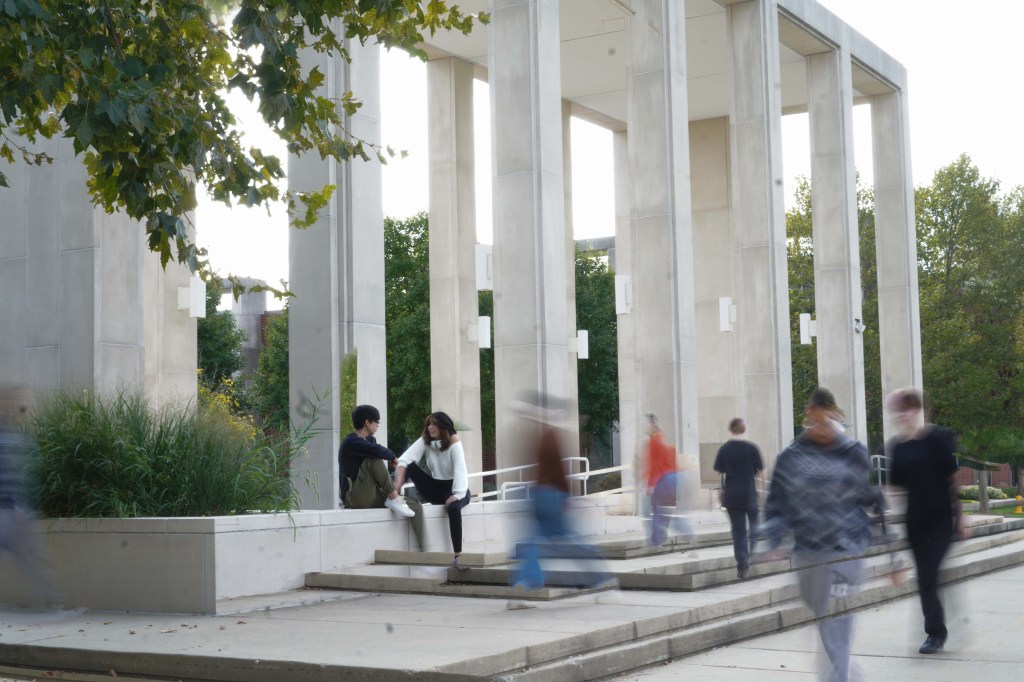
Although enrollment numbers are steadily climbing and more students are filling the halls of Moraine Valley, something more powerful is radiating through the college. An unmistakable feeling of isolation.
“It’s like there’s a sheet of glass in between students and me.”
Communications Professor Eric DeVillez
‘It’s like there’s a sheet of glass in between students and me,” said communications professor Eric DeVillez.
Around the world, people are in the midst of a loneliness epidemic, with a lack of a sense of connection and community. In addition to the effects on physical and mental health in general, recent studies have shown that students are less successful academically when they don’t have a sense of belonging.
The problem is so significant that earlier this year, the U.S. surgeon general, Dr. Vivek H. Murthy, issued an 81-page advisory on “Our Epidemic of Loneliness and Isolation.” In the past, similar warnings were issued about such major health issues as the dangers of smoking.
In fact, Murthy compares the physical effects of loneliness with the effects of smoking: “The mortality impact of being socially disconnected is similar to that caused by smoking up to 15 cigarettes a day.”
He writes, “People began to tell me they felt isolated, invisible, and insignificant. Even when they couldn’t put their finger on the word ‘lonely,’ time and time again, people of all ages and socioeconomic backgrounds, from every corner of the country, would tell me, ‘I have to shoulder all of life’s burdens by myself,’ or ‘if I disappear tomorrow, no one will even notice.’”
The problem is especially acute for college students. As Nicholas Kristof reports in The New York Times, “We often think that older people are most lonely, but polls find that young adults are twice as likely as seniors to report loneliness.”
Technology advances us to a new kind of epidemic
For a generation of students that has been raised in front of addictive online distractions from comforting screens, face-to-face interactions have become less common. Combine that with the increase in mental health problems, more online courses, rising costs of college and fewer in-person places to socialize in a post-COVID world, and the result is not only isolation but also a disconnect from the college experience.
Many students still opt for the online courses they became used to during the pandemic, which DeVillez sees as exacerbating the problem.
“I understand the benefits to online learning, but I think it contributes greatly to isolation and lack of motivation,” he said. “What better way to isolate yourself and make yourself lonely with a depleted mental health than to take only online classes?”
But Moraine Valley political science professor Kevin Navratil says this pattern of isolation began much before COVID-19.
“2008-10 was a peak era with my best classes,” he said. “It felt like there was more participation in my in-person classes as opposed to now.”
Navratil emphasized how technology, especially smartphones, has decreased student engagement: “It’s like a muscle memory. If you spend more time communicating by texting and looking at a phone and less time via face-to-face interactions—well then, it gets harder to do.”
Psychology professor Amy Wiliamson says she has noticed recently “a disconnection that’s newer, in terms of students not appearing as engaged in course material, even if their grades say otherwise.”
Mentally, we are wired for connection, she says: “Our brains evolved to need contact and interaction with others.”

Related coverage
Tips for finding a sense of belonging and community
Sociology professor Alison Lacny wonders how this lack of socialization and self-isolation of everyday modern life affects the college experience.
“As a professor, it’s like we have to become salespeople. When students aren’t doing the reading, that sense of discovery is lost,” she said.
DeVillez also says students are not engaging as much in a sense of discovery:: “I see more of a quest for the right answer than (their) own answer.” The college experience is not simply a means to an end, he says, and if you view it that way, you miss out on a lot. “College isn’t just about knowing certain things– it’s about understanding what those things are and from there having that help you understand more.”
Loneliness can even affect critical thinking skills, according to Navratil–especially with today’s political culture. People who are lonely tend to be more likely to be caught in extremist views or fall for conspiracies and spread misinformation.
Making connections enhances chances for success
If you want to succeed academically, finding ways to make connections with others makes sense on several levels.
“When a student lacks a sense of belonging, it’s a sign that they might struggle to make progress in their college program, according to a study published in the May issue of Science,” the website EdSurge reports.
Moraine Valley’s newly named vice president of academic affairs, Ryen Nagle, is fully aware of the need to form connections. “The research is very clear,” he says. “Students who get involved on campus, they form relationships with faculty, they form relationships with each other, they’re more successful.
“Once they get interested in something outside of the classroom, then the stuff they’re doing inside the classroom comes alive in this whole new way.”.
So what can be done to help foster these kinds of connections?
The world is taking steps forward. According to the New York Times, Britain is at the forefront of this issue and created a minister of loneliness in 2018 that “oversees public-private partnerships that collectively knit millions of people together with programs like nature walks, songwriting workshops, and community litter pickups.” The country has spent $100 million to help combat loneliness.
As the world navigates a new chapter of finding ways to address the loneliness epidemic, Moraine Valley is entering its own new chapter with a large turnover in leadership. Earlier this year, President Sylvia Jenkins retired. Former vice president of academic affairs Pamela Haney has stepped into the role, and former dean of business and science Ryen Nagle is moving up to replace Haney as VP.
Both Haney and Nagle say they are set on fostering meaningful connections throughout campus.
Haney prioritizes interacting with students around campus.
“My goal is to really get out on campus and to meet with students, get to know their names,” she said. “I have lunch in the cafeteria. I stop, I speak to students.”
College can serve as ‘third space’ for relationships
Nagle describes a concept known as the third space.
“The first space in your life is your home, the second space in your life is your work, and the third space is, well what sociology is saying is that Americans don’t have that anymore,” he said. “There’s not the coffee shop, or the church social group, or the corner tavern.”
Navratil traced the historical trend this way: “ We’re having less adults partake in clubs outside of work and school, less usage of public transit, more people in their own cars. Before, we shopped the at same market. Now, we can just order groceries online.”
Nagle explains that this third space is any area where someone goes to form connections and relationships.
“A third space for me was disc golf growing up,” he said. Nagle, who has an MV Cyclones disc hanging on his office wall, explained how this sport has allowed him to form many connections throughout his life.
“In my doctoral program, I wrote a paper about how disc golf on college campuses can create a sort of third space for students and they get to meet people they wouldn’t ordinarily meet.”
He said Moraine Valley actually has more third space opportunities than most community colleges, partly due to its demographic, which he says is “about the youngest it gets” in terms of community colleges in the area.
“What that tells me is that we have students who are more the traditional-age college students looking for a traditional college experience,” he said.
What is Moraine Valley doing to tackle loneliness?
Nagle discussed several things that Moraine has already implemented to provide third spaces for students, including the FitRec. “It’s great to see,” he said, “There’s probably 100 students over there right now, and that’s creating a good connection for them.”
In his previous position as dean, Nagle spent time helping grow the STEM club and the cybersecurity team. As he moves into his vice president role, Nagle plans to continue meeting students where they are to offer them the best involvement opportunities possible.
He encourages faculty to get involved in sponsoring student clubs “so they’re just not the teacher in the classroom but have a more rounded personality to these students.”
“One thing right before the pandemic, the big thing was Esports. I know that’s huge at a lot of universities. And we were looking at an Esports team,” he said.
The surgeon general’s report listed ways educators can help fight the loneliness epidemic, including building social connection into health curricula, implementing socially based educational techniques and creating a supportive school environment.
Nagle explained steps Moraine is taking to address these ideas.
“I think as we do our strategic planning for the next five years, I do believe that one of the key trends that will emerge is supporting students’ mental health.”
New Academic Affairs VP Ryen Nagle
“I think as we do our strategic planning for the next five years, I do believe that one of the key trends that will emerge is supporting students’ mental health,” he said.
Nagle noted how the college will be having student focus groups along with conducting a student engagement survey to gain a further understanding of the specific needs of students.
He gave an example of the kind of thing the college is doing on the academic side to align with the surgeon general’s recommendations: a new scholarship program called the Greer Scholars, consisting of a cohort of 18 STEM students.
“To keep their scholarship there’s a little bit of a carrot they have to do, so many different STEM engagement things,” Nagle explained. “They’re building social connections, they’re doing group work, and we’re creating a supportive environment,”
Math Professor and Moraine STEM Center Coordinator Paula DeAnda-Shah is leading Greer Scholar project. She explained how building community in her own college career helped her.
“I loved math but then there came a point where things got really hard,” she said.
“The only way I was able to survive those really hard classes was because I went out of my way to find a community of students, I could work with.”
DeAnda-Shah is coordinating various activities for the Greer Scholars and the STEM club, like visiting the cadaver lab on campus or touring other schools.
“If we could take some of that financial burden off students [it would] create space for the students to be able to engage in these opportunities that we feel could really make a difference in their life,” she said.
But it’s not just up to the college to fight this loneliness epidemic, professors and administrators say. Students have to make an effort to fully plug in and take the initiative to forge connections.
Navratil explains some of the steps he takes in the classroom, including “think pair share” where students learn material, pair up to discuss it, and then share it in a discussion with the class afterward. Navratil explained how group work helps students connect with each other and the material, as they “will feel more like they are part of what’s happening.”
To increase connection, Lacny urges students to participate in activities outside of the classroom and offers her students extra credit for attending things like a trustee speech. She also encourages students to become involved in their communities.
“Students say my one vote doesn’t count— but you’re going and your voice will say something in a position where you can directly influence your community. Figure out what matters to you in your community and when presented an opportunity like this, plug in,” she said.
Nagle sees addressing connections as a partnership. “It’s a two-way street. The college has to have engaging clubs, engaging content, a portable disc golf course,” he joked.



 Velocity
Leave a comment